When Should I Speak to a Mortgage Adviser?
Speak to a mortgage adviser before you commit to a property, submit a mortgage application or change an existing mortgage.
Early advice can help you understand affordability, lender requirements, likely costs and the documents you may need. It can also reduce the risk of applying to a lender whose criteria do not suit your circumstances.
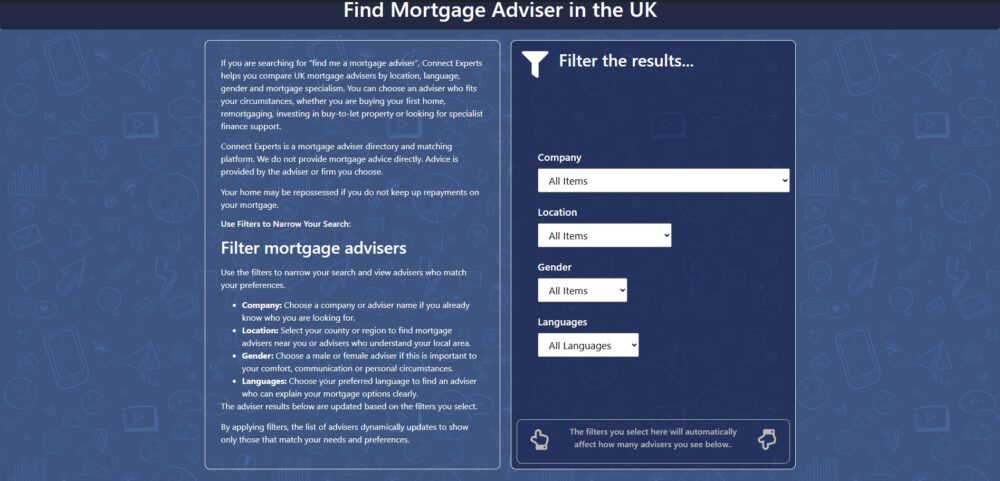
Connect Experts helps you find a mortgage adviser by mortgage type, location, language, gender and adviser preference.
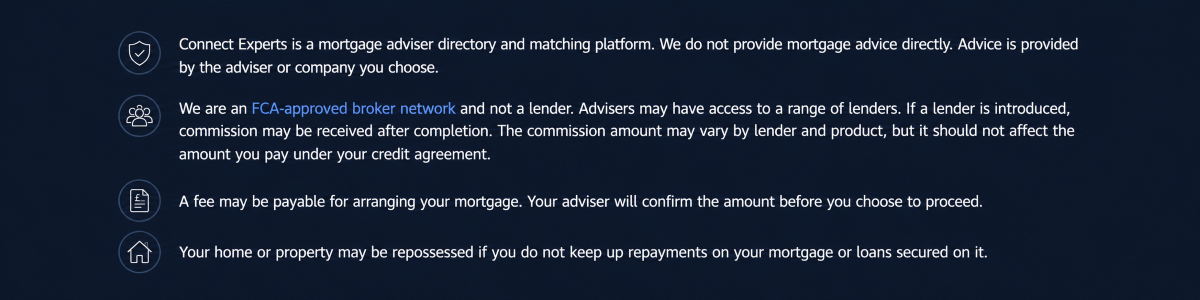
Connect Experts is a mortgage adviser directory and matching platform. It does not provide mortgage advice directly. Advice is provided by the adviser or firm you choose.
At a Glance
You may benefit from speaking to a mortgage adviser:
- Before viewing properties
- Before requesting an Agreement in Principle
- Before making an offer
- Before submitting a full mortgage application
- Several months before your current mortgage deal ends
- Before changing jobs or becoming self-employed
- When your income is irregular or complex
- Before buying a buy-to-let or unusual property
- After credit problems or a declined application
- Before borrowing more against your property
The earlier conversation does not commit you to taking a mortgage. Its purpose is to identify what information, preparation and advice may be needed.
Should I Speak to a Mortgage Adviser Before Looking at Properties?
It can be useful to speak to an adviser before arranging serious property viewings.
A lender’s affordability assessment may differ from an online calculator. It can consider income, regular expenditure, debts, dependants, credit commitments and the proposed mortgage term.
An early conversation may help you establish:
- A realistic purchase price
- The deposit you may need
- Likely monthly repayments
- Which documents to prepare
- Whether your income may require specialist assessment
- Possible property or lender restrictions
- The additional costs of buying a home
This information can keep your property search within a more realistic range.
However, an initial assessment is not a mortgage guarantee. The lender will still need to assess the full application, the property, and the supporting evidence.
When Should a First-Time Buyer Speak to an Adviser?
A first-time buyer can speak to an adviser while saving a deposit and before making an offer.
You do not need to wait until you have found a property. An adviser may explain how lenders could assess your income, deposit and existing commitments.
They may also identify issues that need attention before an application. These could include missing documents, an incorrect credit record or unexplained bank transactions.
A suitable sequence may be:
- Review your income and regular commitments.
- Check your credit reports.
- Estimate your available deposit.
- Speak to an adviser.
- Prepare the required evidence.
- Consider an Agreement in Principle.
- Begin serious property viewings.
- Make an offer within your assessed range.
First-time buyers can search for first-time-buyer brokers in the Connect Experts directory.
Should I Speak to an Adviser Before Getting an Agreement in Principle?
You may choose to speak to an adviser before requesting an Agreement in Principle.
An Agreement in Principle may indicate how much a lender could be willing to lend. It is based on limited information and remains subject to further checks.
It is not a final mortgage offer.
Before approaching a lender, an adviser may review:
- Your income structure
- Your deposit
- Existing borrowing
- Credit history
- Employment status
- The likely property type
- Your preferred mortgage term
This can help determine whether the proposed lender’s criteria appear suitable before a credit search or assessment is completed.
Should I Get Mortgage Advice Before Making an Offer?
It is sensible to understand your likely borrowing position before making an offer.
An estate agent may ask whether you have an Agreement in Principle and evidence of your deposit. However, neither confirms that a lender will approve the final application.
The property must also meet the lender’s requirements.
A lender may consider:
- The property’s condition
- Construction type
- Lease length
- Location
- Valuation
- Intended use
- Saleability
- Any legal restrictions
An adviser can explain why the property and the borrower must both meet the lender’s criteria.
When Should I Speak to an Adviser About Remortgaging?
Start reviewing your mortgage several months before your current deal ends.
The exact timing will depend on your lender, your current mortgage, any early repayment charges, and your personal circumstances.
Starting early provides time to:
- Check when the existing rate ends
- Review early repayment charges
- Compare a product transfer with remortgaging
- Prepare income and property documents
- Check the remaining mortgage balance
- Consider fees and total costs
- Complete any required valuation or legal work
Waiting until the final weeks may reduce the time available to compare options.
A remortgage broker may help you review your options before your current deal expires.
Should I Speak to an Adviser Before Changing Jobs?
A planned employment change can affect the timing of a mortgage application.
Lenders may treat probation periods, temporary contracts, recent promotions and career changes differently. Some may accept a signed employment contract before the new role begins. Others may require payslips or evidence of completed probation.
Speak to an adviser before:
- Resigning from your current position
- Starting a new job
- Reducing your working hours
- Moving from employment to self-employment
- Taking an extended career break
- Changing from a permanent to a temporary contract
The purpose is not to stop a reasonable career decision. It is to understand how the timing could affect lender assessment.
When Should a Self-Employed Person Seek Mortgage Advice?
Self-employed applicants may benefit from speaking to an adviser before the end of an accounting period or before submitting an application.
Lenders can assess sole traders, company directors, contractors and business partners differently.
They may review:
- Tax calculations
- Tax year overviews
- Business accounts
- Salary and dividends
- Share of business profits
- Retained profits
- Contract history
- Recent business performance
A self-employed mortgage broker may help explain how different lenders could interpret the available evidence.
Your accountant can advise on accounts and tax. A mortgage adviser can explain how lenders may assess the resulting income figures. These are separate professional roles.
When Should I Speak to an Adviser About Credit Problems?
Speak to an adviser before submitting several mortgage applications if you have experienced credit problems.
Relevant issues may include:
- Missed payments
- Defaults
- County Court judgments
- An Individual Voluntary Arrangement
- A Debt Management Plan
- Previous arrears
- Bankruptcy
- Repossession
- Payday loan use
- A low credit score
Lenders can assess the type, value, age and status of credit events differently.
An unsuccessful application may also leave a record of a credit search. Therefore, applying repeatedly without understanding the likely criteria may not improve your position.
You can use Connect Experts to search for an adverse credit mortgage broker with relevant experience.
Should I Contact an Adviser After a Mortgage Application Is Declined?
A declined application does not always mean every lender will reach the same decision.
However, you should try to understand why the application was declined before applying elsewhere.
Possible reasons include:
- Affordability
- Credit history
- Income evidence
- Employment type
- Property condition
- Valuation
- Loan size
- Deposit source
- Undisclosed commitments
- A difference between the application and supporting documents
An adviser may review the circumstances and explain whether another application appears appropriate.
They cannot guarantee approval. The decision remains with the lender.
When Should Landlords and Property Investors Seek Advice?
Landlords may benefit from taking advice before making an offer, creating a company structure or committing to major building work.
Buy-to-let lenders may assess:
- Expected rental income
- Interest coverage
- Deposit size
- Property type
- Landlord experience
- Personal income
- Portfolio size
- Ownership structure
- Existing borrowing
- Intended tenants
An accountant or tax adviser should explain tax consequences. A mortgage adviser can explain the lending implications.
Keeping these functions separate helps ensure that each professional advises within their area of responsibility.
When Should I Seek Advice for an Unusual Property?
Speak to an adviser before committing to a property that may fall outside standard lender criteria.
Examples can include:
- Non-standard construction
- Short leases
- Flats above commercial premises
- Properties with several acres
- Homes requiring major renovation
- Mixed residential and commercial use
- Houses in multiple occupation
- Holiday lets
- Listed buildings
- Properties with restrictive legal conditions
A low purchase price does not necessarily make a property easy to mortgage. The lender must consider the property as security for the loan.
What Should I Prepare Before Speaking to an Adviser?
You do not always need every document for an initial conversation. However, accurate information will make the discussion more useful.
Prepare details of:
- Your income
- Employment or business structure
- Monthly credit commitments
- Regular household expenditure
- Available deposit
- Deposit source
- Existing properties and mortgages
- Credit history
- Preferred purchase price
- Expected mortgage term
- Current mortgage deal, if remortgaging
You may later need identification, bank statements, payslips, accounts, tax records and evidence of deposit.
Document requirements vary by lender and application type.
What Should I Ask During the First Conversation?
Ask practical questions before deciding whether to proceed.
These may include:
- Which parts of the mortgage market do you consider?
- Do you regularly handle cases like mine?
- How will you assess my likely affordability?
- What documents will I need?
- Are there any fees?
- When would those fees become payable?
- How may you receive commission?
- Who will manage my application?
- How will we communicate?
- What could delay the process?
- Is the adviser or firm listed on the FCA register?
You can check a firm’s regulatory details through the Financial Services Register.
Any charges and commission arrangements should be explained before you agree to proceed.
Is It Ever Too Early to Speak to a Mortgage Adviser?
It may not be too early if you are planning to purchase a property or change your mortgage in the foreseeable future.
An initial discussion can identify what must happen before you are ready to apply.
For example, you may need time to:
- Build a larger deposit
- Complete an accounting period
- Reduce selected borrowing
- Correct inaccurate credit information
- Gather evidence of income
- Allow a fixed-term contract to develop
- Resolve a property or legal issue
Good timing is not about rushing an application. It is about creating enough time to make a considered decision.
A mortgage is arranged at one moment, but its consequences can continue for decades. Therefore, the value of early advice often lies in the decisions made before an application begins.
How to Find a Mortgage Adviser Through Connect Experts
Connect Experts allows you to search for advisers using criteria relevant to your circumstances.
You can search by:
- Mortgage type
- Location
- Language
- Gender
- Adviser or company name
- Specialist area
- Communication preference
Review the available profiles and choose who you would like to contact.
Connect Experts does not select a mortgage product or provide mortgage advice. The adviser or authorised firm you choose is responsible for any advice given.
Search the A–Z mortgage broker directory to compare available adviser profiles.
Frequently Asked Questions
When is the best time to speak to a mortgage adviser?
Speak to an adviser before making a financial or property commitment. This may be before viewing properties, requesting an Agreement in Principle, making an offer or changing an existing mortgage.
Should I speak to a mortgage adviser before viewing houses?
You can view properties first, but early advice may help establish a more realistic budget. It can also identify documents or financial issues that require attention.
How long before buying a house should I contact an adviser?
There is no single period that suits every buyer. Contacting an adviser before serious property searching provides more time to assess affordability and prepare evidence.
Do I need a property before speaking to an adviser?
No. An initial conversation can take place before you have chosen a property. The final mortgage application will require details of the property being purchased.
Is an Agreement in Principle a mortgage offer?
No. It is an initial indication based on limited information. A full mortgage offer depends on detailed underwriting, supporting evidence and an acceptable property assessment.
When should I speak to a remortgage adviser?
Start reviewing your position several months before your current deal ends. Check your mortgage terms because early repayment charges and application times can vary.
Can an adviser guarantee that my mortgage will be approved?
No. An adviser can assess your position and recommend a suitable course of action. The lender makes the final decision.
Does Connect Experts provide mortgage advice?
No. Connect Experts is a directory and matching platform. Mortgage advice is provided by the adviser or firm selected by the user.
Find an Adviser Before Your Next Mortgage Decision
You do not need to wait until you are ready to submit an application.
Speaking to an adviser earlier may help you understand your position, prepare the right evidence and avoid preventable delays.
Use the Connect Experts mortgage adviser directory to search by mortgage need and personal preference.