
Moving within the UK can be exciting, but it also comes with important financial decisions. Whether you are relocating for work, moving closer to family, upsizing, downsizing or searching for a better quality of life, it helps to understand your mortgage options before making plans.
At Connect Experts, we help you find mortgage advisers who can support your move with clear, practical guidance. Many of our advisers can also assist in different languages, helping you discuss your mortgage needs with greater confidence.
Whether you are moving from one city to another, relocating to a new county or comparing different parts of the UK, this guide explains what to consider before moving and where to explore next.

Why People Move Within the UK
People move within the UK for many reasons. Some are looking for more space. Others want shorter commutes, better schools, lower living costs, a new job opportunity or a lifestyle change.
You may be moving from London to a commuter town, from a city to the countryside, from one county to another, or closer to relatives. Your reason for moving can affect your mortgage options, property search and timescale.
Common reasons for moving include:
- Buying a larger family home
- Moving closer to work
- Relocating after a job change
- Moving near schools or universities
- Downsizing after children leave home
- Moving closer to relatives
- Searching for more affordable property
- Looking for better transport links
- Moving from renting to home ownership
- Buying a second home or investment property
Before you move, it is worth reviewing your budget, existing mortgage, future income, deposit, moving costs and the type of property you want to buy.

Can You Move House if You Already Have aMmortgage?

Yes, you may be able to move house if you already have a mortgage. However, your options depend on your current mortgage deal, lender, affordability and the property you want to buy.
Some homeowners may be able to port their current mortgage to a new property. This means transferring the existing mortgage product to the new home, although you will usually still need to pass affordability checks and meet the lender’s criteria.
Other homeowners may need to remortgage, repay their current mortgage or apply for a new mortgage altogether.
Things to check include:
- Whether your mortgage is portable
- Whether early repayment charges apply
- Whether your lender will approve the new property
- Whether your income still meets the affordability criteria
- Whether you need to borrow more
- Whether you are changing employment or income type
- Whether your credit profile has changed
- Whether the new property is leasehold, freehold, new build or non-standard
Speaking to a mortgage adviser before making an offer can help you understand your position and avoid unexpected delays.
Moving to Another Part of the UK
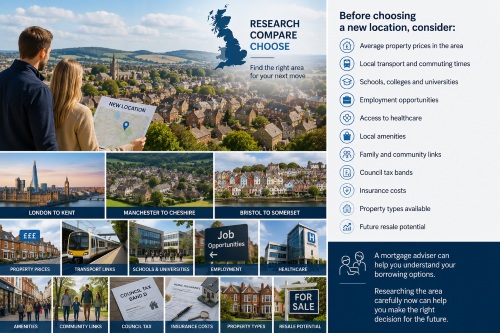
Moving to a new part of the UK can affect more than your mortgage. Local property prices, transport links, council tax, schools, rental demand and employment opportunities can all vary between areas.
For example, someone moving from London to Kent may have different priorities from someone moving from Manchester to Cheshire or from Bristol to Somerset.
Before choosing a new location, consider:
- Average property prices in the area
- Local transport and commuting times
- Schools, colleges and universities
- Employment opportunities
- Access to healthcare
- Local amenities
- Family and community links
- Council tax bands
- Insurance costs
- Property types available
- Future resale potential
A mortgage adviser can help you understand your borrowing options, but it is also worth researching the area carefully before making a final decision.
Mortgage Advice When Relocating Within the UK

Relocating can make the mortgage process more complex. This is especially true if you are changing jobs, moving to a new employment contract, becoming self-employed, buying before selling or moving to a higher-value property.
Mortgage lenders will look at your income, commitments, deposit, credit history and the property itself. If you are moving for work, they may also consider your new employment details, probation period or contract type.
A mortgage adviser may help with:
- Understanding how much you may be able to borrow
- Reviewing your current mortgage
- Explaining porting, remortgaging or new mortgage options
- Comparing lenders
- Checking affordability
- Supporting self-employed applicants
- Helping contractors and company directors
- Reviewing buy-to-let options
- Finding suitable lenders for complex circumstances
- Explaining the mortgage process in clear language
If English is not your first language, it may also help to speak with an adviser who can communicate in your preferred language.
Bilingual and Multilingual Mortgage Support
Moving home is a major financial decision, and it is important to understand the details clearly. For many people, speaking to a mortgage adviser in their preferred language can make the process easier.
Connect Experts helps people find advisers who may speak languages such as Hindi, Urdu, Punjabi, Bengali, Gujarati, Polish, Arabic, Tamil, Mandarin, Cantonese and others, depending on availability.
A multilingual mortgage adviser may help you discuss:
- Mortgage affordability
- Deposit requirements
- Property types
- Lender criteria
- Interest rates and mortgage terms
- Buy-to-let options
- Protection and insurance
- Required documents
- The home-buying process
This can be especially useful if you are supporting family members, buying jointly or moving to an area with a strong local community.
Visit our page: Multilingual Mortgage Broker

Moving within the UK mortgage checklist
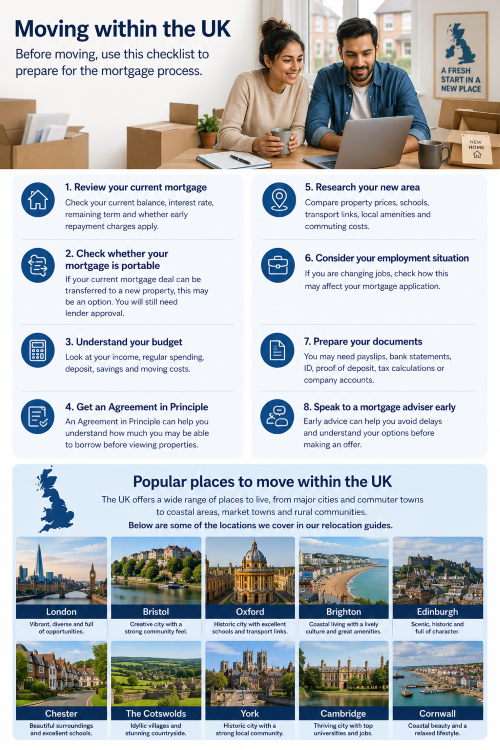
Before moving, use this checklist to prepare for the mortgage process.
Review your current mortgage
Check your current balance, interest rate, remaining term and whether early repayment charges apply.
Check whether your mortgage is portable
If your current mortgage deal can be transferred to a new property, this may be an option. You will still need lender approval.
Understand your budget
Look at your income, regular spending, deposit, savings and moving costs.
Get an Agreement in Principle
An Agreement in Principle can help you understand how much you may be able to borrow before viewing properties.
Research your new area
Compare property prices, schools, transport links, local amenities and commuting costs.
Consider your employment situation
If you are changing jobs, check how this may affect your mortgage application.
Prepare your documents
You may need payslips, bank statements, ID, proof of deposit, tax calculations or company accounts.
Speak to a mortgage adviser early
Early advice can help you avoid delays and understand your options before making an offer.
Popular places to move within the UK
The UK offers a wide range of places to live, from major cities and commuter towns to coastal areas, market towns and rural communities.
Below are some of the locations we cover in our relocation guides.
Popular Places to Move Within the UK
Why Move to London?
London remains one of the UK’s most popular places to live and work. It offers strong employment opportunities, world-class universities, cultural diversity, extensive transport links and a broad property market.
It may appeal to professionals, students, families, investors and people who want access to one of the world’s most connected cities. However, property prices and living costs can be higher than in many other parts of the UK.
London may suit you if you want:
- Strong career opportunities
- Excellent transport connections
- Access to universities and schools
- A diverse food, culture and arts scene
- A wide choice of property types
- Multilingual communities
- Access to international travel links
Read our full guide: Why Move to London
Why Move to Hampshire?
Hampshire offers a mix of cities, countryside, coastal areas and commuter towns. Winchester, Southampton, Portsmouth, Basingstoke, and Andover all offer distinct property and lifestyle options.
The county may appeal to families, professionals, students, and people seeking access to both the South Coast and London.
Hampshire may suit you if you want:
- Coast and countryside nearby
- Access to London and the South Coast
- Good schools and universities
- Employment opportunities in major towns and cities
- A wide choice of property types
- Family-friendly communities
- Strong road and rail connections
Read our full guide: Why Move to Hampshire
Why Move to Berkshire?
Berkshire is popular with professionals and families due to its strong transport links, major employers, schools and access to London.
Towns such as Reading, Slough, Maidenhead, Newbury, Bracknell and Windsor offer a range of property types and lifestyle options.
Berkshire may suit you if you want:
- Strong commuter links
- Access to major employers
- Good schools and local amenities
- A mix of town and village living
- Access to the M4 corridor
- Proximity to London and Heathrow
- A range of family homes and apartments
Read our full guide: Why Move to Berkshire
Why Move to Essex?
Essex is popular with people who want access to London while enjoying more space, coastal towns, countryside and a wider range of property options.
Areas such as Chelmsford, Colchester, Brentwood, Basildon, Southend-on-Sea and Braintree offer different lifestyles, from commuter-friendly towns to seaside living.
Essex may suit families, professionals, first-time buyers and people moving out of London for more space.
Essex may suit you if you want:
- London commuter links
- Coastal and countryside locations
- A mix of towns, villages and cities
- Family-friendly communities
- Access to schools and local amenities
- Potentially more space than central London
- A range of residential and buy-to-let opportunities
Read our full guide: Why Move to Essex
How to compare UK locations before moving
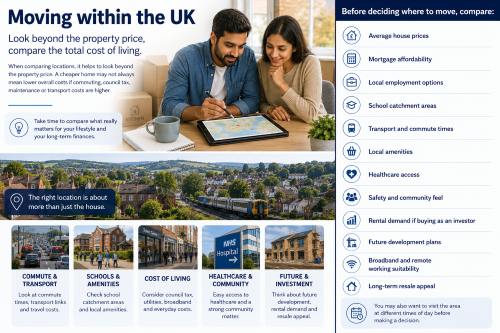
When comparing locations, it helps to look beyond the property price. A cheaper home may not always mean lower overall costs if commuting, council tax, maintenance or transport costs are higher.
Before deciding where to move, compare:
- Average house prices
- Mortgage affordability
- Local employment options
- School catchment areas
- Transport and commute times
- Local amenities
- Healthcare access
- Safety and community feel
- Rental demand if buying as an investor
- Future development plans
- Broadband and remote working suitability
- Long-term resale appeal
You may also want to visit the area at different times of day before making a decision.
.
Moving for work within the UK
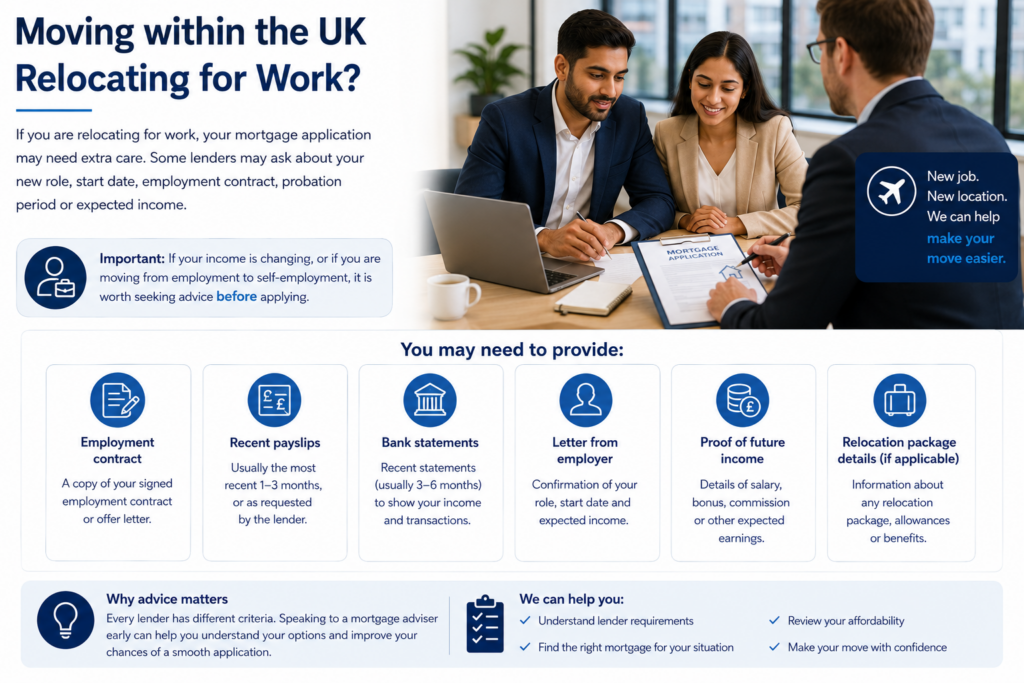
If you are relocating for work, your mortgage application may need extra care. Some lenders may ask about your new role, start date, employment contract, probation period or expected income.
You may need to provide:
- Employment contract
- Recent payslips
- Bank statements
- Letter from employer
- Proof of future income
- Details of relocation package, if applicable
If your income is changing, or if you are moving from employment to self-employment, it is worth seeking advice before applying.
Exploring Attractions in the UK

The UK has a wide range of attractions. These include castles, museums, beaches, piers, national parks, gardens, heritage cities, theatres, shopping districts, cultural landmarks, and family days out.
Historic castles are among the UK’s most popular attractions. Windsor Castle, Edinburgh Castle, Warwick Castle, Caernarfon Castle, and the Tower of London all offer visitors a chance to explore centuries of royal, military, and architectural history.
The UK is also home to world-class museums and galleries. Popular choices include the British Museum, the Natural History Museum, the Victoria and Albert Museum, the National Gallery, Tate Modern, and the National Museum of Scotland.
For countryside and outdoor experiences, the UK offers stunning national parks and protected landscapes. These include the Lake District, Snowdonia, the Peak District, the Yorkshire Dales, the Cairngorms, and the South Downs.
Coastal attractions also play a major role in UK tourism. Visitors can enjoy seaside towns, beaches, harbours, piers, and dramatic coastlines, from Cornwall and Devon to Brighton, Blackpool, Whitby, the Jurassic Coast, and the Scottish Highlands.
Other popular attractions include Stonehenge, Bath, York, Oxford, Cambridge, the Cotswolds, Giant’s Causeway, Loch Ness, the Eden Project, Chester Zoo, Alton Towers, Legoland Windsor, and the many theatres, restaurants, shops, and cultural venues found across London, Manchester, Liverpool, Edinburgh, Cardiff, Belfast, and other major UK cities.
Buying before selling your current home
Some people want to buy a new home before selling their current property. This can be possible, but it depends on affordability, deposit, equity and lender criteria.
Options may include:
- Selling and buying at the same time
- Porting your current mortgage
- Remortgaging
- Using savings or equity
- Considering short-term finance
- Keeping the current property as a buy-to-let, where suitable
Buying before selling can create extra costs and risks, so advice is important.

How Connect Experts can help
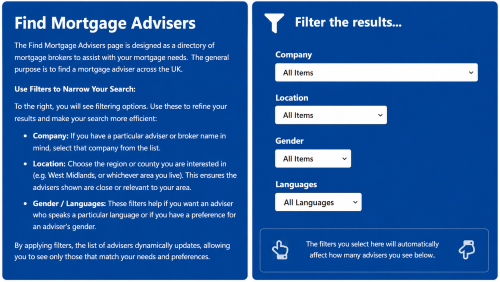
Connect Experts helps people find mortgage advisers across the UK. Whether you are moving locally or relocating to a new part of the country, you can search for advisers based on location, language and mortgage needs.
An adviser may help you understand:
- Whether you can move with your current mortgage
- Whether you should remortgage
- How much you may be able to borrow
- Which lenders may suit your circumstances
- How your employment affects your application
- What documents may you need
- How to prepare before making an offer
- What protection or insurance do you need
Moving home can feel complicated, but the right advice can make the process clearer.
People who found this page helpful also explored these related topics

Mortgage Broker in Barrowden: Seek Expert Advice Near You

Cottesmore Mortgage Advice: The Confidence You Need

Edith Weston Mortgage Adviser: Advice Based on Your Circumstances

Empingham Mortgage Advice: Decision On Your Options

Mortgage Broker in Exton: Looking Beyond the Immediate Decision

Greetham Mortgage Advice: Get Your Next Move Right in Rutland
Find a Broker By
Language
Find a Broker By
Gender
High Net Worth Mortgage
Brokers
FAQs: Moving within the UK
| Question | Answer |
|---|---|
| Can I move house if I already have a mortgage? | Yes, you may be able to move house if you already have a mortgage. You may be able to port your mortgage, remortgage or apply for a new mortgage. Your options depend on your lender, affordability, current deal and the property you want to buy. |
| What does porting a mortgage mean? | Porting means transferring your existing mortgage product to a new property. You still need to apply to your lender, meet affordability checks and satisfy their criteria. If you need to borrow more, the extra borrowing may be on a different rate. |
| Should I speak to a mortgage adviser before moving? | Yes, it is often helpful to speak to a mortgage adviser before viewing properties or making an offer. An adviser can help you understand your borrowing options, current mortgage position and potential costs. |
| Can relocating for work affect my mortgage application? | Yes, relocating for work can affect your application if your income, employer, contract type or probation status changes. Some lenders may ask for additional documents, such as a contract or employer letter. |
| Can I get a mortgage if I am moving to a different county? | Yes, moving to a different county does not prevent you from getting a mortgage. The lender will still assess your income, deposit, credit profile, commitments and the property you want to buy. |
| Can I use a mortgage adviser who speaks my language? | Yes, Connect Experts can help you find mortgage advisers who may speak different languages, depending on availability. This can make it easier to understand your mortgage options and ask questions clearly. |
| What should I check before moving to a new area? | You should check property prices, schools, transport links, commuting costs, council tax, local amenities, healthcare access and future resale potential. It is also sensible to visit the area before committing. |
| Can I buy a new home before selling my current property? | It may be possible, but it depends on affordability, equity, deposit and lender criteria. This can be more complex, so mortgage advice is important before making a decision. |
| Is moving from London to another part of the UK a good idea? | It depends on your goals. Some people move from London for more space, lower property prices, family reasons or lifestyle changes. You should compare travel costs, employment, schools and mortgage affordability before deciding. |
| Can I keep my current home and rent it out when I move? | Possibly. You may need consent to let from your lender or a buy-to-let mortgage. You should also consider tax, insurance, rental demand and landlord responsibilities. |
Important Information
Connect Experts is a mortgage adviser directory and matching platform. We do not provide mortgage advice directly. Advice is provided by the adviser or company you choose.
We are an FCA-approved broker network and not a lender. Advisers may have access to a range of lenders. If a lender is introduced, commission may be received after completion. The commission amount may vary by lender and product, but it should not affect the amount you pay under your credit agreement.
A fee may be payable for arranging your mortgage. Your adviser will confirm the amount before you choose to proceed.
Your home or property may be repossessed if you do not keep up repayments on your mortgage or loans secured on it.