
Why move to Monmouthshire? Because where we choose to live often reflects what we want more of, not simply what we want to leave behind.
For some people, that means more countryside. For others, it means a market town with shops, schools and a railway station, or a home that keeps Cardiff, Newport and Bristol within practical reach.
Monmouthshire offers all of these possibilities.
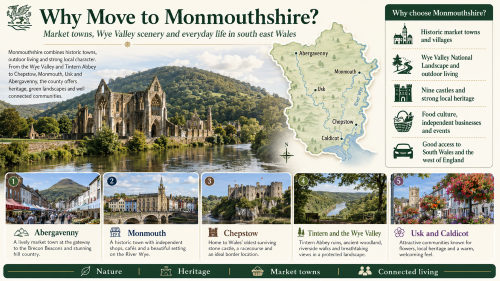
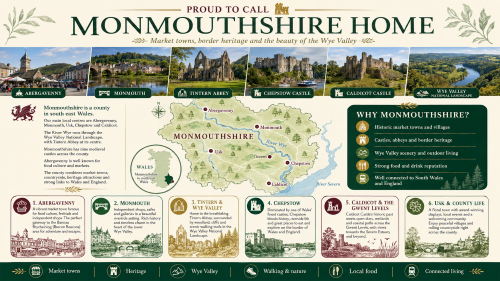
Abergavenny sits close to the Black Mountains and Bannau Brycheiniog. Monmouth combines riverside character with an established town centre. Chepstow provides access towards Bristol and the Severn crossings. Usk offers a smaller market-town setting, while Caldicot and Magor can appeal to households looking for links towards Newport and the M4 corridor.
The county also reaches across the Wye Valley, Usk Valley and Gwent Levels, giving different communities their own relationship with countryside, water, heritage and neighbouring cities.
That variety may be the real answer to why move to Monmouthshire. The county doesn’t ask everyone to live the same way.
When the lifestyle decision becomes a financial one, you can explore Mortgage Brokers in Monmouthshire and compare advisers who cover the county.
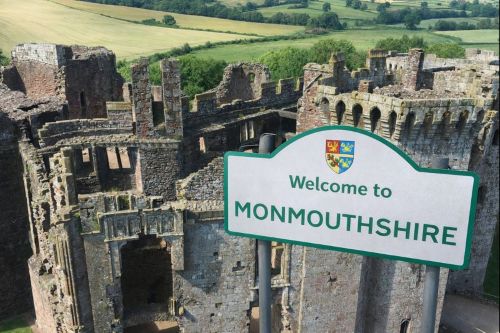
Market Town, Border Community or Countryside: Different Ways to Live in Monmouthshire
Monmouthshire isn’t defined by a single dominant town.
Abergavenny offers shops, rail connections, food culture, and access to Bannau Brycheiniog and the Black Mountains.
Monmouth has a different character, shaped by the River Wye and River Monnow, independent businesses, schools and its historic centre.
Chepstow sits close to the English border and combines medieval heritage with useful road and rail access to Bristol, Newport, and the wider South West.
Usk offers a smaller market-town environment around the River Usk.
Further south, Caldicot, Magor and Rogiet provide a different proposition, with links towards the M4, Severn Tunnel Junction and employment centres on either side of the border.
Then there are villages and rural communities where space, views and access to countryside may matter more than being close to a larger centre.
That creates genuine choice.
One household may want to walk into Abergavenny town centre.
Another may value Chepstow because work is based in Bristol.
Someone else may want a cottage outside Usk or a larger home around Monmouth.
The right part of Monmouthshire depends on the life you want the property to support.
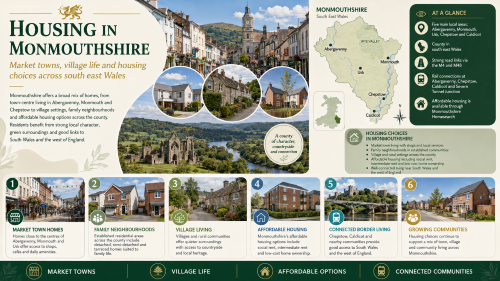
Homes in Monmouthshire: A Higher-Value Welsh Property Market
Housing is one of the clearest reasons to research Monmouthshire carefully rather than rely on a general view of the Welsh property market.
The Office for National Statistics reported an average house price in Monmouthshire of £335,000 in July 2026. That was the highest average among Welsh local-authority areas at the time.
Average prices by property type were:
- Detached: £499,000
- Semi-detached: £302,000
- Terraced: £237,000
- Flats and maisonettes: £152,000
First-time buyers paid an average of £270,000, while home movers paid £387,000. Homes bought with a mortgage averaged £340,000.
View the latest ONS housing data for Monmouthshire.
Those figures still hide substantial differences between individual properties.
A modern home around Caldicot may create straightforward valuation questions.
A period property in Monmouth or Abergavenny may involve age, alterations or conservation considerations.
A rural house outside Usk could include acreage, outbuildings, private drainage or unusual access.
Property close to the Wye or Usk may also require buyers to investigate flood information and insurance.
The purchase price is therefore only one part of the mortgage decision. The property itself must also fit lender criteria.
Education Choices Can Shape a Monmouthshire Move
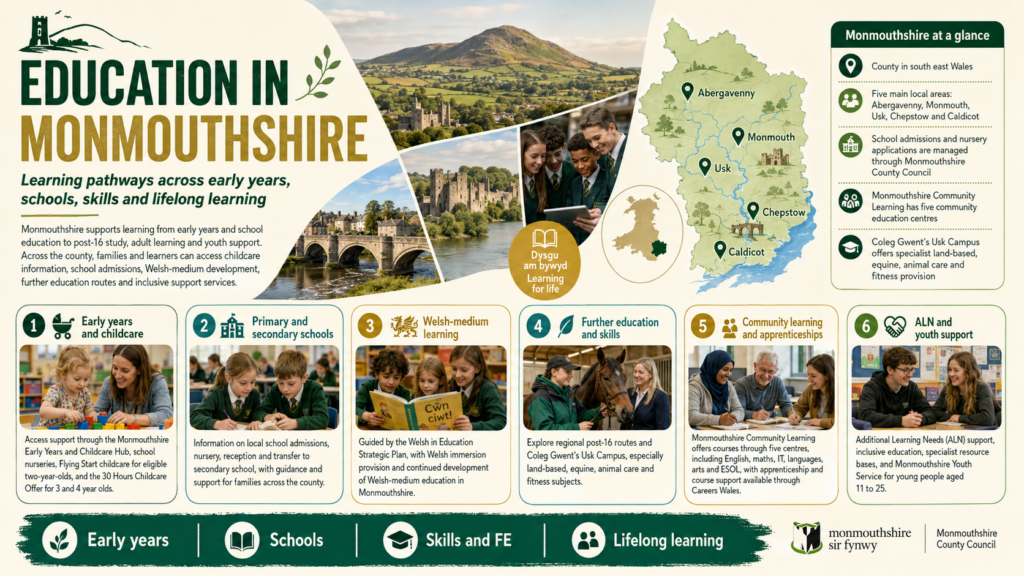
Families often choose a location through a combination of housing, school access and everyday travel.
Monmouthshire County Council currently lists 31 primary schools, including English-medium, Welsh-medium, Church in Wales and Roman Catholic provision. It also operates three Welsh-medium primary schools in Abergavenny, Monmouth and Caldicot.
That makes language of education another consideration for some families.
The county also has independent education, most notably in Monmouth, and the council provides separate guidance for families applying to independent schools or schools outside Monmouthshire.
Before choosing an area, it can therefore be useful to compare:
- school locations;
- admissions arrangements;
- Welsh-medium provision;
- school transport;
- childcare;
- commuting patterns;
- independent-school fees where relevant;
- how education costs affect household expenditure.
These costs sit outside the mortgage itself, but regular commitments can influence affordability.
Where fee-paying education forms part of the family’s longer-term plans, Education Finance may also be relevant.
A home should work for the family living in it, not simply satisfy a property search today.
Monmouthshire’s Economy Connects Local Work With Wider Regional Employment
Not everyone considering why move to Monmouthshire is leaving the county each morning.
Monmouthshire has an economy shaped by local services, tourism, hospitality, health, food, agriculture, professional work and smaller businesses.
The council’s Economy, Employment and Skills Strategy identifies health, accommodation and food, retail and professional services as significant employment sectors. Its latest progress update also reported an economic activity rate of 79.8% in June 2025 and noted that self-employment accounted for 11.6% of economically active residents.
There is also considerable movement across county and national boundaries.
The council reported that 17,100 residents commuted out of Monmouthshire for work, with almost 27% travelling to Bristol and a further 21% to other parts of England.
That can create varied mortgage circumstances.
Applicants may receive income through:
- salary;
- overtime;
- commission;
- self-employment;
- company profits;
- dividends;
- consultancy;
- seasonal work;
- several income sources.
A move prompted by a new job may therefore involve more than proving a basic annual salary.
Where income structure is less conventional, lender choice can become as important as property choice.
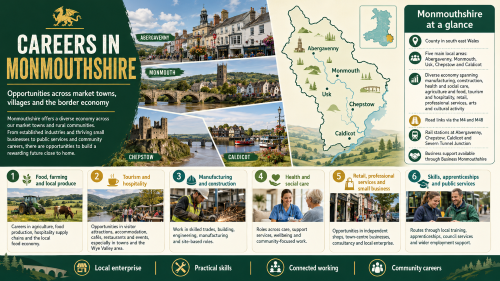
Road and Rail Connections Shape Where Monmouthshire Works Best
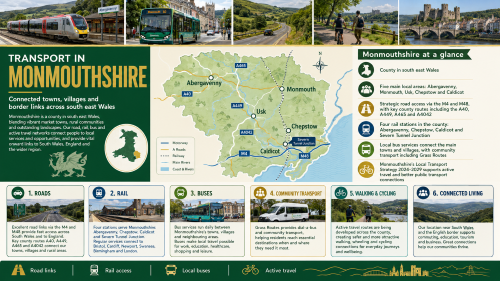
Transport in Monmouthshire is unusual because the county sits on the border between Wales and England.
That makes travel direction important.
Visit Monmouthshire lists four railway stations within the county: Abergavenny, Caldicot, Chepstow and Severn Tunnel Junction. Rail services connect the area with destinations including Bristol, London, Birmingham and Crewe.
Road connections include:
- M4;
- M48;
- A40;
- A449;
- A465.
These routes help connect different parts of the county with Newport, Cardiff, Bristol, Herefordshire and Gloucestershire.
But transport convenience varies considerably by location.
Chepstow can make sense for someone travelling towards Bristol.
Abergavenny may work better for journeys towards Newport, Cardiff or Herefordshire.
Monmouth has no railway station, so road travel and bus connections may matter more.
A rural village could provide exactly the lifestyle someone wants while adding significant time to school runs or work journeys.
Before moving, compare the entire routine rather than the headline journey time:
- station distance;
- parking;
- fuel;
- ticket costs;
- peak traffic;
- school travel;
- hybrid working;
- frequency of office attendance.
Where you live and how you travel are part of the same household budget.
Castles, Valleys and Outdoor Life Give Monmouthshire More Than Scenery
Another reason to move to Monmouthshire lies beyond the property itself.
Visit Monmouthshire lists nine castles, 19 nature reserves, Bannau Brycheiniog National Park, the Wye Valley National Landscape, the Monmouthshire and Brecon Canal, and the Severn Estuary among its attractions.
Historic places include:
- Chepstow Castle;
- Raglan Castle;
- Caldicot Castle;
- Abergavenny Castle;
- Tintern Abbey;
- Monnow Bridge and Gate.
Outdoor options are equally distinctive.
The River Wye supports canoeing and riverside activities, while the county connects to the Offa’s Dyke Path, Wye Valley Walk, and Usk Valley Walk.
The Sugar Loaf rises above Abergavenny, while the Black Mountains and Bannau Brycheiniog provide a very different landscape from the flatter communities towards the Severn.
For a prospective resident, these are not merely visitor attractions.
They represent what can be available after work, on weekends, and in everyday family life.
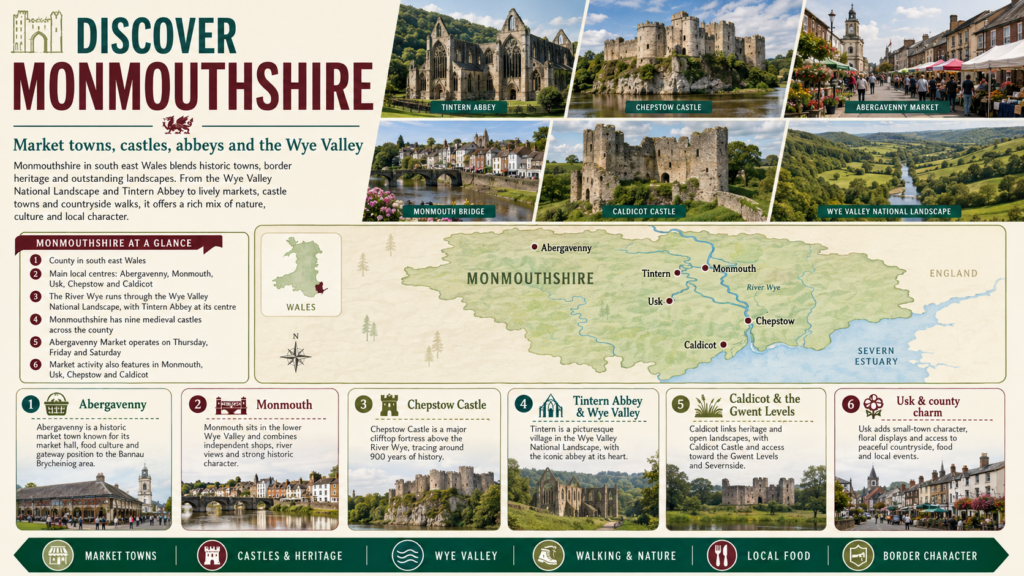
Food, Markets and Everyday Life Give Monmouthshire Its Own Identity
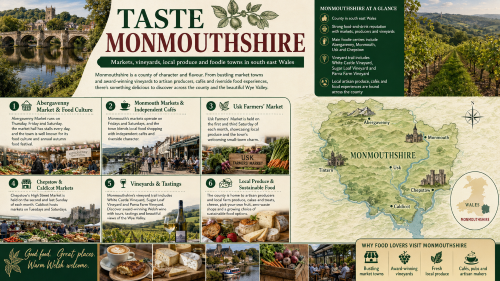
A property’s floorplan matters before moving.
The surrounding life often matters more afterwards.
Monmouthshire has a particularly strong connection to food, local producers, market towns, and hospitality.
Abergavenny is closely associated with food culture and its annual food festival. Monmouth, Usk and Chepstow support independent cafés, pubs and restaurants, while rural parts of the county include farm shops, vineyards and food producers.
Visit Monmouthshire highlights a county containing vineyards, distilleries, a brewery, a meadery and a cider maker, alongside restaurants and local produce.
That creates different ways to spend ordinary weekends.
Someone living in Abergavenny may walk into town for a market or meal.
A household near Usk may prefer a country pub and riverside walk.
Someone in Monmouth may combine the town centre with the Wye Valley.
These details can appear secondary when comparing mortgage rates and asking prices.
Once the boxes are unpacked, these details often make a location feel like home.
What the Mortgage Needs to Support After You Move
The useful mortgage question is not simply, “How much could I borrow?”
It is also, “How much borrowing still allows the rest of this move to work?”
Monmouthshire’s relatively high property values can make that particularly important.
A move may change:
- mortgage repayments;
- deposit requirements;
- commuting costs;
- childcare;
- school expenditure;
- household energy costs;
- insurance;
- property maintenance;
- council tax;
- the amount needed for renovations.
Property characteristics can also influence underwriting.
For example, a rural home may require a lender comfortable with land or outbuildings. A listed or historic property may raise different valuation questions. A home near a river could require closer assessment of flood risk and insurance.
If you are comparing several parts of the county, Find a Mortgage Adviser by Location can help you compare advisers who cover the areas you are considering.
The most suitable home isn’t always the one that stretches borrowing to the maximum.
Sometimes financial flexibility is part of what makes a move sustainable.

Higher-Value Property and Complex Borrowing in Monmouthshire

Higher-value property is not confined to one corner of Monmouthshire.
The latest ONS data provides useful context. Detached homes averaged £499,000 in July 2026, while home movers paid an average of £387,000 across the county.
Individual properties in areas around Monmouth, Usk, Abergavenny, the Wye Valley and rural villages can exceed those averages considerably.
Larger mortgages may also coincide with less straightforward income.
Applicants might receive:
- company-director income;
- dividends;
- retained profits;
- bonuses;
- investment income;
- partnership drawings;
- multiple salaries;
- income from property or other assets.
In these circumstances, the closest adviser may not necessarily have the most relevant experience.
High Net Worth Mortgage Brokers may be relevant where borrowing size, property value or income structure requires more specialist consideration.
The important point is not to classify Monmouthshire as universally high-net-worth. The point is to recognise that the county genuinely includes property and borrowing scenarios where specialist expertise can matter.
Downsizing, Retirement and Later-Life Moves in Monmouthshire
A move does not always happen because a household needs more bedrooms.
Priorities change.
Some Monmouthshire homeowners may eventually want to:
- move closer to family;
- reduce property maintenance;
- downsize;
- live nearer shops or healthcare;
- exchange a rural property for a town setting;
- move towards the countryside after retirement;
- release capital tied up in a larger home.
This is especially relevant in a county with an older age profile.
At the 2021 Census, Monmouthshire’s median age was 49, up from 45 in 2011. The number of residents aged 65 to 74 had risen by around 25% over that decade.
That does not mean every older homeowner needs later-life borrowing.
For some, selling and downsizing may provide enough capital.
Others may still have an existing mortgage or want to understand whether housing wealth should form part of retirement planning.
If you’re considering equity release, it should remain a separate specialist decision. Homeowners can explore Equity Release Advisers in Monmouthshire.
Equity release can affect inheritance, means-tested benefits and the future value of an estate, so regulated advice is important.

Why Monmouthshire Can Still Fit When Life Changes
A useful place to live should not work only for the person you are on moving day.
It should leave room for what comes next.
A first-time buyer may look to Caldicot or another location where their budget stretches further.
A professional working across the border may prioritise Chepstow or Severn Tunnel Junction.
A family may prioritise schools and space around Monmouth or Abergavenny.
Someone running a business from home may value a village property but need dependable broadband and road access.
A higher-value buyer may be looking at a larger rural home.
Someone approaching retirement may prefer Usk, Monmouth, Abergavenny or a quieter community where daily services remain accessible.
That is why why move to Monmouthshire is not really a question with one answer.
The county’s value is that different parts can suit different stages of life.
A successful move should still feel practical after employment changes, children grow older, commuting patterns shift, or financial priorities become different.
Browse Our Advisers in Monmouthshire
Once you have decided where you may want to live, the next step is to consider whether the mortgage fits both the property and your circumstances.
Connect Experts lets you find mortgage advisers and compare profiles based on factors such as location, mortgage expertise, and language.
An adviser doesn’t need to live in the same town.
Relevant experience with your income, borrowing requirements, and property type may be more important than distance.
Connect Experts is a mortgage adviser directory and matching platform. It does not provide mortgage advice directly. Advice is provided by the adviser or firm you choose.
People who found this page helpful also explored these related topics:

Mortgage Broker in Usk: Find Advice for Your Move
Mortgage Broker in Undy for Home Buyers and Movers
ortgage Broker in Trellech for Your Next Property Move

Mortgage Broker in Tintern: Wye Valley Home Finance
Mortgage Broker in Shirenewton for Home Movers

Mortgage Broker in Rogiet: Home Buying & Remortgage
Neighbouring Counties
FAQs: Why Move to Monmouthshire?
Is Monmouthshire significantly more expensive than other parts of Wales?
It can be. The average Monmouthshire house price was £335,000 in July 2026, compared with £215,000 across Wales, and Monmouthshire had the highest local-authority average in Wales at that point. Property type and individual town still make a substantial difference.
Which part of Monmouthshire may suit someone working in Bristol?
Chepstow and communities in the county’s south-east may be worth considering for their M48 road access and rail connections to Bristol. Severn Tunnel Junction can also be relevant for rail commuters. Actual door-to-door travel times, ticket costs and working patterns should be checked before choosing an area.
Can I live rurally in Monmouthshire without being completely isolated?
Yes, but the answer depends heavily on the property. Areas around Usk, Monmouth and Abergavenny offer countryside or village living while keeping town services within reach. Buyers should check broadband, mobile coverage, road access, public transport and everyday journey times for the exact property rather than relying on the postcode alone.
What should I check before buying an older or rural home in Monmouthshire?
Consider construction, access, drainage, water supply, acreage, outbuildings, rights of way and any planning or listed-building restrictions. Properties near rivers or low-lying areas may also require flood and insurance checks. These factors can affect both valuation and lender criteria.
Does living in Monmouthshire work if one person works in Wales and another in England?
Potentially. The county’s border location makes cross-border commuting common. The council’s economic data show significant commuting out of Monmouthshire, including towards Bristol and other parts of England. The practical choice will depend on work locations, travel frequency, and whether road or rail offers the better route.
What makes Monmouthshire different from neighbouring rural counties?
Monmouthshire combines a comparatively rural landscape with strong links towards both South Wales and South West England. The Wye Valley, Bannau Brycheiniog, market towns, border location, and access to Newport, Cardiff, and Bristol give it a different balance than more geographically isolated counties.