
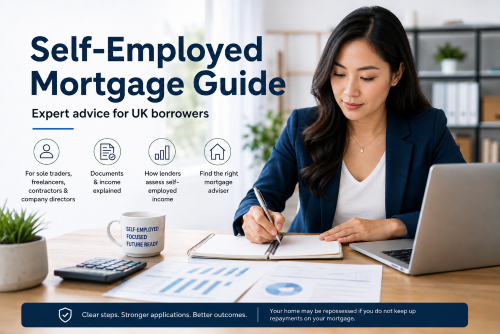
Self-Employed Mortgage Guide UK – Getting a mortgage when you are self-employed can feel more complicated than applying with payslips. It does not mean you cannot get a mortgage. It means lenders need to understand how your income works, how stable it is, and whether the repayments are affordable.
This Self-Employed Mortgage Guide explains how lenders assess sole traders, freelancers, contractors, company directors and business partners. It also explains what documents you may need, how income can be calculated, what can delay an application, and when it may help to speak with a specialist mortgage adviser.
Connect Experts helps you find FCA-authorised mortgage advisers across the UK. You can search by mortgage type, location, language, gender and adviser expertise, including advisers who support self-employed applicants.
Can You Get a Mortgage if You Are Self-Employed?
Yes, you can get a mortgage if you are self-employed. Lenders usually want evidence that your income is reliable, sustainable, and sufficient to support your mortgage repayments.
Instead of payslips, lenders may look at your SA302 tax calculations, tax year overviews, company accounts, accountant references, bank statements, contracts, dividends or retained profits, depending on how your income is structured.
The right lender can depend on:
- How long have you been trading
- Whether your income is stable, rising or falling
- Your deposit or equity
- Your credit history
- Your business structure
- Your documents
- The type of property you want to buy
- Whether you are buying, remortgaging or investing
If you are unsure how your income will be assessed, start with a broker who understands self-employed mortgage cases.
Who counts as self-employed for a mortgage?
For mortgage purposes, you may be treated as self-employed if you do not receive all your income through standard PAYE employment, or if you own a significant share of a business.
You may be classed as self-employed if you are a:
- Sole trader
- Freelancer
- Contractor
- Limited company director
- Partner in a business
- Consultant
- Locum professional
- Subcontractor
- Business owner with salary and dividends
- Landlord using business or company income as part of affordability
Some applicants have mixed incomes. For example, you may have a PAYE salary and self-employed income, or you may be a company director taking both salary and dividends. In these cases, lenders usually need a clear picture of all income sources.
Why self-employed mortgages are assessed differently
A salaried employee can usually show payslips, a P60 and bank statements. A self-employed applicant may need to show income through tax records, accounts, bank statements and business evidence.
This does not mean the application is weaker. It simply means the lender needs more detail before deciding how much income can be used for affordability.
Lenders usually want to understand:
- What you earned
- Whether that income is likely to continue
- Whether your business is trading well
- Whether your tax records match your declared income
- Whether your bank statements support the figures
- Whether your income has increased or decreased
- Whether the mortgage remains affordable after regular commitments
A mortgage adviser can help identify lenders that are more comfortable with your type of self-employed income.
Self-Employed Mortgage Income by Trading Type
Different lenders assess self-employed income in different ways. The table below gives a simple guide.
| Trading type | How lenders may assess income | Documents commonly requested |
|---|---|---|
| Sole trader | Net profit from tax calculations | SA302s, tax year overviews, bank statements |
| Freelancer | Usually net profit, sometimes contract evidence | SA302s, invoices, contracts, bank statements |
| Contractor | Day rate, contract rate or self-employed income | Current contract, previous contracts, bank statements, tax records |
| Limited company director | Salary and dividends, sometimes retained profit | Company accounts, SA302s, tax year overviews, accountant reference |
| Partnership | Share of net profit | Partnership accounts, SA302s, tax year overviews |
| Mixed income applicant | PAYE income plus self-employed income | Payslips, P60, SA302s, accounts and bank statements |
This is why two self-employed applicants with the same annual income may receive different lending outcomes. One lender may average the last two years. Another may use the latest year. Another may consider retained profit or contract day rate.
How Many Years of Accounts do You Need?
Many lenders prefer two years of evidence of self-employment income. Some may ask for three years, especially where the case is more complex.
Some lenders may consider one year of accounts if the rest of the application is strong. This may depend on your deposit, credit history, previous employment, business stability, sector experience, and evidence of future income.
You may have more options if you can show:
- A strong deposit
- Clean credit history
- Previous experience in the same industry
- Ongoing contracts or regular clients
- Stable or increasing income
- Clear bank statements
- Up-to-date tax records
- Accounts prepared by a qualified accountant
If you only have one year of account history, avoid applying at random. A declined application can slow your progress and may make the next application harder.
Documents needed for a self-employed mortgage
The documents you need depend on your trading structure and the lender. Preparing them early can reduce delays.
You may need:
- SA302 tax calculations
- Tax year overviews
- Latest company accounts
- Accountant reference
- Business bank statements
- Personal bank statements
- Proof of ID
- Proof of address
- Proof of deposit
- Gifted deposit letter, if applicable
- Current contract, if you are a contractor
- Evidence of retained profits, if relevant
- Details of loans, credit cards or commitments
- Proof of rental income, if applicable
- Evidence of future income, where relevant
Self-employed mortgage document checklist
Before speaking with an adviser, try to prepare:
- Your last two years of SA302s or tax calculations, if available
- Matching tax year overviews
- Your latest business accounts
- Three to six months of business bank statements
- Three months of personal bank statements
- Proof of deposit
- Details of current credit commitments
- Your accountant’s contact details
- Any contracts or invoices that support future income
- Your preferred purchase price or remortgage amount
You may not need every document straight away. However, having them ready helps your adviser understand which lenders may fit your case.
What is An SA302?
An SA302 is a tax calculation that shows income declared through Self Assessment. Lenders often use it to verify income for self-employed applicants.
A tax year overview is a separate document that confirms the tax position for that year. Many lenders ask for both the SA302 and the tax year overview to ensure the figures match.
If you are preparing for a mortgage, make sure your tax return is submitted, your figures are correct, and your documents are available before applying.
How Lenders Calculate Self-Employed Income
There is no single method used by every lender. This is one of the main reasons self-employed mortgage advice can be valuable.
A lender may use:
- Your latest year’s income
- An average of the last two years
- An average of the last three years
- Your salary and dividends
- Net profit
- Share of partnership profit
- Contractor day rate
- Retained profit, where acceptable
- A lower figure if income has recently fallen
Example: sole trader income
If your net profit was £42,000 last year and £48,000 this year, a lender may average the two years and use £45,000. Another lender may use the latest year. Another may ask why the income changed.
Example: limited company director’s income
If you take a salary of £12,000 and dividends of £38,000, some lenders may use £50,000. Some may also look at the company’s profit. Others may focus only on salary and dividends.
Example: contractor income
If you work on a day rate, some lenders may calculate your income based on your day rate over a set number of working weeks. Others may treat you like a company director or sole trader, depending on your setup.
The right lender depends on how your income is paid, evidenced and expected to continue.
Can You Get a Self-Employed Mortgage with 1 Year of Accounts?
Yes, it may be possible to get a mortgage with one year of accounts, but lender choice may be more limited.
A lender may look more closely at:
- Your deposit size
- Your previous employment
- Whether you worked in the same sector before becoming self-employed
- Your credit history
- Your bank statements
- Your accountant’s confirmation
- Whether your income appears sustainable
- Whether you have contracts or repeat clients
- The type of property you are buying
If you have only been self-employed for a short time, do not assume you need to wait another year. A specialist adviser can help you understand whether any lenders may consider your case now.
Can you get a self-employed mortgage if your income has changed?
Yes, but the lender will want to understand the change.
If your income has increased, a lender may ask whether the higher income is sustainable. If your income has decreased, a lender may use the lower figure for affordability.
You should be ready to explain:
- Why income changed
- Whether the change is temporary or ongoing
- Whether your business costs have changed
- Whether you have future contracts
- Whether the latest year is a fair reflection of your earnings
This is especially important for freelancers, contractors and directors whose income can move from year to year.
Common Self-employed Mortgage Problems
Self-employed applications often run into problems because the lender cannot clearly verify income or affordability.
Common issues include:
- Tax returns not submitted
- SA302s not matching tax year overviews
- Falling income
- Large unexplained bank transfers
- Business and personal spending mixed together
- Low declared income after expenses
- Accounts not finalised
- Recent change from sole trader to limited company
- High credit card balances
- Missed payments or defaults
- Applying to the wrong lender
- Not having enough deposit
- Property type not fitting lender criteria
Many of these problems can be managed if they are spotted early.
How to Improve Your Chances of Getting a Self-Employed Mortgage
You can improve your position before applying by getting your income, documents, and credit profile in order.
1. Submit your tax return early
Do not leave your Self Assessment until the last minute if you plan to apply for a mortgage. Lenders may need your latest tax calculation and tax year overview.
2. Keep business and personal finances clear
Separate business and personal spending where possible. Clear bank statements make it easier for lenders to understand your income.
3. Speak to your accountant before applying
Your accountant may help you understand how your income is shown in your accounts and tax documents.
4. Check your credit reports
Review your credit reports before applying. Correct errors and avoid unnecessary new borrowing.
5. Reduce unsecured debt where possible
Credit cards, loans, car finance and other commitments can reduce affordability.
6. Keep deposit evidence ready
Lenders need to understand where your deposit has come from. Keep savings statements, gift letters or sale proceeds evidence.
7. Avoid major business changes before applying
Changing from sole trader to limited company just before applying can make the income assessment more complex.
8. Use the right adviser
Self-employed income is not assessed the same way by every lender. A broker who works with self-employed applicants can help match your case to lenders that understand your income structure.
Self-Employed First-Time Buyers
You can be a first-time buyer and self-employed. The main difference is that you may need to prepare more income evidence than an employed applicant.
A lender may assess:
- Your deposit
- Your self-employed income
- Your credit history
- Your bank statements
- Your regular spending
- Your property choice
- Your affordability after bills and commitments
If this is your first property purchase, it can help to read the wider first-time buyer process before applying.
Self-Employed Remortgage Applicants
If you are self-employed and your current mortgage rate is ending, start reviewing your options early.
A remortgage lender may still assess your income, even if you have kept up with your current mortgage payments. If your income has changed since your last application, your options may be different.
You may want advice if:
- Your current deal is ending
- Your income has increased or decreased
- You changed the business structure
- You want to borrow more
- You want to consolidate debts
- You have become self-employed since your last mortgage
- Your credit profile has changed
Limited Company Directors and Mortgages
Limited company directors can be assessed in different ways. Some lenders focus on salary and dividends. Some may consider retained profits. Some may want an accountant reference or the latest company accounts.
This matters because a director may keep money in the business rather than taking it all as personal income. One lender may not use that retained profit. Another may consider it where the accounts support it and the business appears sustainable.
A mortgage adviser can help you understand which lenders may be more suitable for a company director’s income.
If you are buying an investment property through a company, you may also want to compare limited company buy-to-let adviser options.
Contractors and Freelancers
Contractors and freelancers often have strong earning potential, but their income may not fit a standard employed profile.
A lender may ask for:
- Current contract
- Contract history
- Day rate or hourly rate
- Invoices
- Bank statements
- Tax calculations
- Accountant reference
- Evidence of ongoing work
The key question is whether your income looks sustainable. Long gaps between contracts, a short trading history, or inconsistent income may reduce lenders’ willingness to lend.
A specialist adviser can help present the case clearly.
How much can you borrow if you are self-employed?
The amount you can borrow depends on verified income, affordability, deposit, credit profile, debts, dependants, mortgage term and lender criteria.
Lenders do not only look at income multiples. They also assess regular spending and whether the mortgage would remain affordable.
Your borrowing amount may be affected by:
- Declared income
- Business expenses
- Personal loans
- Credit card balances
- Car finance
- Childcare costs
- Dependants
- Student loans
- Property type
- Mortgage term
- Interest rate stress testing
- Deposit size
A self-employed mortgage adviser can estimate borrowing based on your documents before you make a full application.
Questions to Ask a Self-Employed Mortgage Adviser
Before choosing an adviser, ask:
- Do you regularly work with self-employed applicants?
- Which lenders may consider my trading history?
- How will my income be calculated?
- Will lenders use my latest year or an average?
- Can retained profits be considered?
- Do I need one, two or three years of accounts?
- What documents should I prepare first?
- Could my credit history affect lender choice?
- Should I apply now or wait until my next accounts are ready?
- What fees apply before I proceed?
Connect Experts helps you compare advisers by expertise, location, language and personal preferences.
People Also Browse These Guides
FAQ: Self-Employed Mortgage Guide
| Question | Answer |
|---|---|
| Can I get a mortgage if I am self-employed? | Yes, self-employed applicants can get mortgages. Lenders usually need evidence of income, affordability and trading stability. |
| Do I need three years of accounts? | Not always. Many lenders prefer two years, some may ask for three, and some may consider one year if the rest of the application is strong. |
| What documents do I need for a self-employed mortgage? | You may need SA302 tax calculations, tax year overviews, company accounts, accountant references, business bank statements, personal bank statements, proof of deposit, ID and proof of address. |
| Can I get a mortgage with one year of accounts? | It may be possible, but lender choice may be more limited. A strong deposit, good credit history and evidence of sustainable income may help. |
| How do lenders calculate self-employed income? | They may use your latest year, an average of recent years, net profit, salary and dividends, partnership profit, contract day rate or retained profit, depending on the lender and your structure. |
| Are self-employed mortgage rates higher? | Not necessarily. The rate depends on your overall application, deposit, credit profile, lender choice and product availability. Being self-employed does not automatically mean you must pay a higher rate. |
| Can limited company directors use retained profits? | Some lenders may consider retained profits, but not all. It depends on the lender, accounts, business sustainability and your wider circumstances. |
| Can I remortgage if I became self-employed recently? | You may be able to remortgage, but the lender will assess your current income and documents. If your income evidence is limited, adviser support may be useful. |
| Can I get a self-employed mortgage with bad credit? | It may be possible, depending on the type, date and severity of the credit issue. Lender choice may be more limited, so specialist advice is important. |
| Should I use a mortgage adviser if I am self-employed? | It can be helpful because lenders assess self-employed income differently. A suitable adviser can help you prepare documents, understand affordability and avoid lenders that are unlikely to fit your case. |
| Find a self-employed mortgage adviser | Find a self-employed mortgage adviser |
Important Information
Connect Experts is a mortgage adviser directory and matching platform. We do not provide mortgage advice directly. Advice is provided by the adviser or company you choose.
We are an FCA-approved broker network and not a lender. Advisers may have access to a range of lenders. If a lender is introduced, commission may be received after completion. The commission amount may vary by lender and product, but it should not affect the amount you pay under your credit agreement.
A fee may be payable for arranging your mortgage. Your adviser will confirm the amount before you choose to proceed.
Your home or property may be repossessed if you do not keep up repayments on your mortgage or loans secured on it.