
Why Move to Derbyshire? Derbyshire offers a strong mix of countryside, heritage, market towns, village living, and regional connectivity. It is well known for the Peak District, stone-built villages, historic estates, industrial heritage, walking routes, and towns such as Chesterfield, Matlock, Buxton, Bakewell, Ashbourne, Belper, Ripley, Ilkeston, Swadlincote, Glossop, and Long Eaton.
The county appeals to people who want access to open countryside without being completely disconnected from major centres. Chesterfield sits close to the M1 and has rail links on the Midland Main Line, while places such as Buxton, Matlock, Glossop, and the Hope Valley provide access to countryside, commuter routes, and local services. Chesterfield is also described as a gateway to the Peak District, with road connections including the A61, A617, A619, A632, and nearby M1 junctions.
For home movers, Derbyshire offers a broad property mix. Buyers can find stone cottages in Peak District villages, terraces in historic towns, modern family homes, rural properties, apartments, and larger detached homes in suburban and village locations. Its mix of countryside lifestyle and practical access makes it attractive to families, professionals, remote workers, downsizers, and buyers relocating from larger cities.
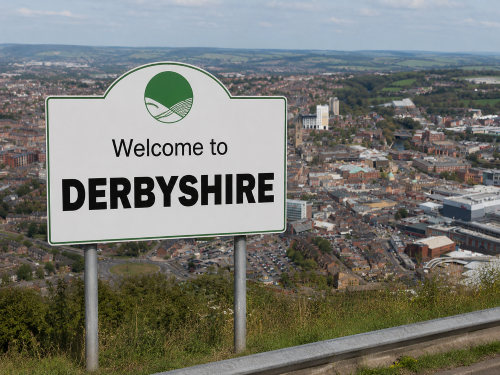
Why Move to Derbyshire - What to Expect
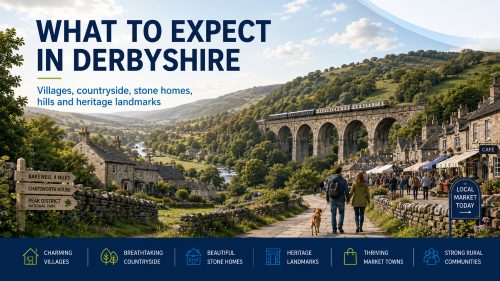
Living in Derbyshire can feel very different depending on where you choose to settle. Towns such as Chesterfield, Ilkeston, Long Eaton, and Swadlincote offer practical access to employment, schools, shops, and transport, while towns such as Matlock, Buxton, Bakewell, Ashbourne, and Glossop are strongly connected to countryside living and the Peak District lifestyle.
Derbyshire is especially appealing for outdoor living. The Peak District offers moorland, limestone dales, gritstone edges, reservoirs, market towns, cycling routes, walking trails, and heritage landscapes. A Peak District guide describes the area as a diverse landscape with the White Peak’s rolling hills and streams, the Dark Peak’s wild moors and rock formations, and activities including climbing, cycling, paragliding, and rambling.
The county also has strong historic character. Chesterfield is known for its market and the crooked spire of the Church of St Mary and All Saints, while Bakewell is a market town associated with Bakewell pudding and Peak District visitor activity.
For people moving from larger urban areas, Derbyshire can offer more space, countryside access, and a slower pace, while still providing access to nearby cities such as Derby, Nottingham, Sheffield, Manchester, and Birmingham depending on location.
Why Move to Derbyshire - Housing in Derbyshire: Exploring Your Options
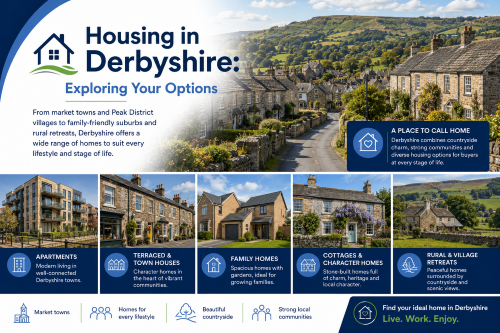
Derbyshire has a varied housing market, with options ranging from rural cottages and converted stone buildings to town terraces, suburban semis, modern new-build homes, apartments, and larger detached properties. Housing styles vary by area. Peak District villages often feature traditional stone homes, while towns such as Chesterfield, Ilkeston, Long Eaton, Swadlincote, and Ripley offer more conventional town and suburban housing.
Buyers looking for countryside character may consider areas around Bakewell, Matlock, Wirksworth, Ashbourne, Buxton, Glossop, and the Derbyshire Dales. Those who want stronger commuting links may look at Chesterfield, Belper, Duffield, Long Eaton, Dronfield, Ilkeston, or areas closer to Derby, Sheffield, Nottingham, and the M1.
Market conditions can change quickly. In May 2026, national reporting on the England and Wales housing market noted weaker buyer demand and caution around mortgage rates, which means buyers should check affordability, lender criteria, and current local pricing before making an offer.
A mortgage broker can be especially useful in Derbyshire because property type and location may influence lender appetite. Rural homes, older stone cottages, converted buildings, listed properties, buy-to-let homes, and homes with land can sometimes need more detailed lender checks.
Education in Derbyshire: A Hub of Learning

Derbyshire offers education options across early years, primary, secondary, sixth form, further education, apprenticeships, and higher education pathways. Families moving to the county should consider school catchments, admissions, transport, Ofsted reports, and the practical distance between home, school, and work.
Secondary options vary across the county. Examples of Derbyshire secondary schools include schools in areas such as Dronfield, Chapel-en-le-Frith, Heanor, Chesterfield, Glossop, Tibshelf, and Etwall. Some schools include sixth form provision, while others connect students to local colleges and post-16 providers.
Further education is available through providers such as Chesterfield College and Derby College Group. Chesterfield College is a further and higher education college in Chesterfield, while Derby College Group has campuses and provision across Derby and parts of Derbyshire.
Higher education links include the University of Derby, which has its main campus in Derby and a teaching site in Chesterfield. The University of Derby’s Chesterfield site is connected with health, psychology, and social care provision.
For families, this gives Derbyshire a practical education base, with access to local schools, college routes, vocational training, apprenticeships, and university-level study nearby.
Why Move to Derbyshire - Employment Opportunities
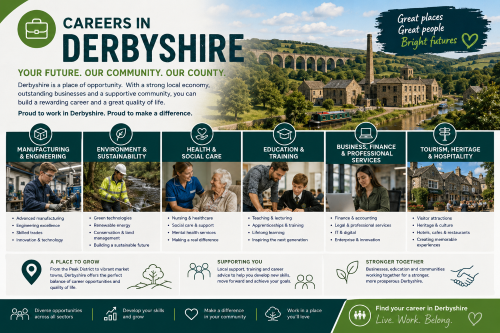
Derbyshire has a varied employment base shaped by manufacturing, engineering, logistics, health and social care, education, tourism, hospitality, agriculture, construction, retail, public services, and small businesses.
Chesterfield has long-standing industrial and market-town roots, with transport connections that support access to Sheffield, Derby, Nottingham, and the wider East Midlands. It is served by major roads, including the A61, A617, A619, and A632, as well as nearby M1 junctions.
Tourism and hospitality are also significant in areas linked to the Peak District, including Bakewell, Buxton, Matlock Bath, Castleton, Ashbourne, and villages near Chatsworth, Dovedale, and walking routes. The Peak District’s outdoor activities, accommodation, food, and heritage economy support a wide range of local jobs.
Key Employment Sectors in Derbyshire
Manufacturing and Engineering
Derbyshire and the surrounding East Midlands have strong links in manufacturing and engineering. Buyers working in engineering, rail, aerospace, construction, supply chain, or advanced manufacturing may find employment opportunities in and around Derby, Chesterfield, Ilkeston, Alfreton, Swadlincote, and nearby regional business parks.
Tourism and Hospitality
The visitor economy supports jobs in hotels, pubs, cafés, restaurants, attractions, outdoor activities, accommodation, retail, and heritage destinations. Chatsworth, Bakewell, Dovedale, Matlock Bath, Buxton, and the Peak District are important parts of Derbyshire’s visitor appeal.
Health, Care, and Public Services
Hospitals, care providers, local authorities, schools, colleges, emergency services, and community organisations provide year-round employment across the county. This can suit people seeking stable work close to home.
Education and Training
Schools, colleges, apprenticeships, and higher education providers support teaching, support roles, vocational training, and specialist education pathways across the county.
Logistics and Connectivity
Derbyshire’s position near the M1, A38, A50, A6, and regional rail links supports logistics, warehousing, distribution, transport, and commuting-related employment.
Green Economy and Rural Enterprise
Derbyshire’s rural landscape supports farming, land management, countryside services, tourism, renewable projects, environmental work, and small rural businesses.
Mortgage Brokers in Derbyshire: Securing a Home

Buying a home in Derbyshire can involve different considerations depending on location, property type, income, deposit, credit profile, and long-term plans. A mortgage broker in Derbyshire can help you compare lenders, understand affordability, and prepare your application.
This can be particularly useful if you are buying an older cottage, listed property, rural home, property with land, new-build home, buy-to-let, or home in a high-demand Peak District location. Lenders may look closely at condition, construction type, survey results, income stability, and intended use.
Mortgage brokers can support first-time buyers, home movers, remortgage clients, self-employed applicants, contractors, landlords, and buyers with complex income. They can also help explain product options, lender criteria, deposit requirements, documentation, protection, and general insurance.
With the right advice, buyers can approach the Derbyshire property market with greater confidence.
Transport Links in Derbyshire
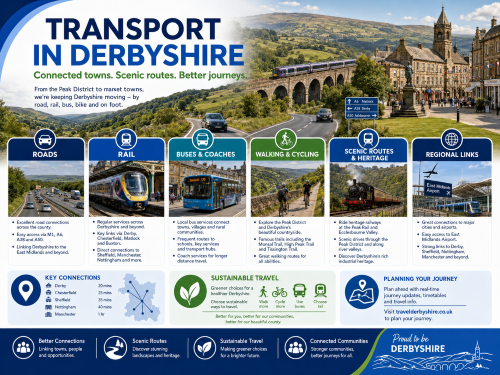
Transport in Derbyshire depends heavily on where you live. Larger towns and commuter locations tend to have stronger access to rail and major roads, while rural villages may require greater reliance on cars, buses, or local community transport.
Chesterfield has strong road access, with the M1 passing to the east of the town and road connections through the A61, A617, A619, and A632. Its railway station is on the Midland Main Line and is served by East Midlands Railway and CrossCountry, with links including Sheffield, Derby, London St Pancras, Nottingham, Newcastle, Birmingham, and the South West.
Matlock station is served by the Derwent Valley Line, with typical off-peak services to and from Derby, Nottingham, Newark Castle, and Matlock. Buxton station is managed and served by Northern and connects the town with Manchester Piccadilly.
For walkers and cyclists, Derbyshire also benefits from routes such as the Monsal Trail, which follows part of a former railway route through the Wye Valley and is used for cycling, walking, horse riding, and accessible recreation.
When choosing where to live, buyers should compare commuting time, school travel, road access, parking, public transport frequency, and the practical difference between urban, village, and rural locations.
Exploring Attractions in Derbyshire
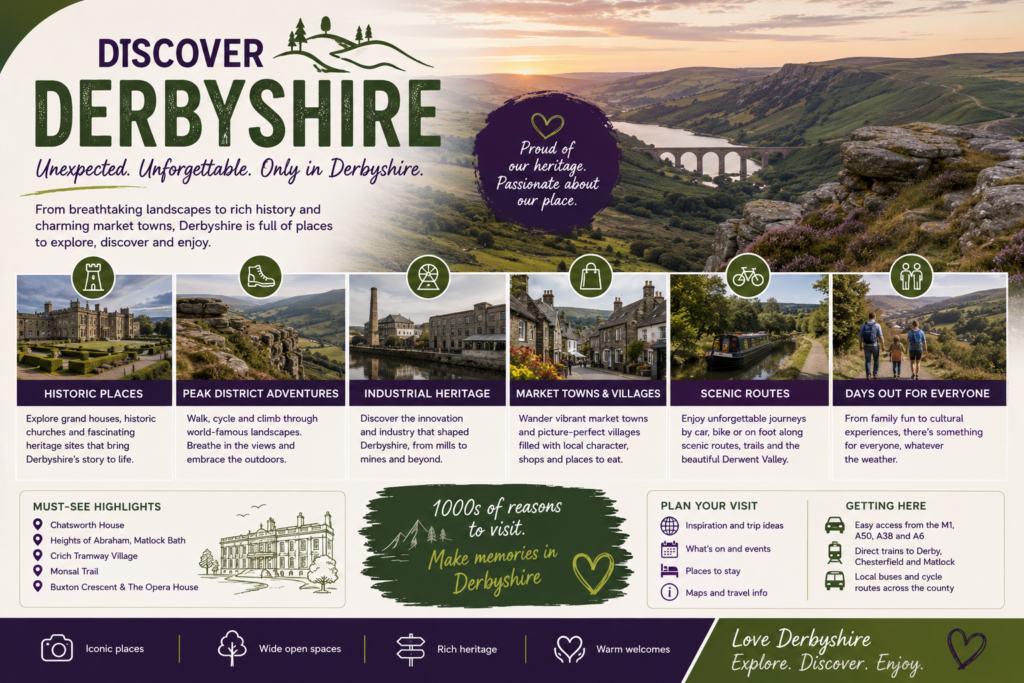
Derbyshire offers a wide range of attractions, from stately homes and historic market towns to caves, tramways, walking routes, reservoirs, and Peak District landscapes.
Chatsworth is one of the county’s best-known destinations. Recent reporting describes the Chatsworth Estate as a major Peak District estate with Chatsworth House, the Chatsworth Farm Shop, holiday accommodation, pubs, and visitor experiences.
Dovedale is another major attraction, known for the River Dove, limestone scenery, Thorpe Cloud, and stepping stones. It is one of the Peak District’s most recognisable outdoor destinations and is strongly associated with walking and countryside days out.
Bakewell offers market-town charm and food heritage, including Bakewell pudding. Chesterfield is known for its market and crooked spire, while Matlock Bath, Buxton, Castleton, Crich Tramway Village, and the Derwent Valley provide further days out.
For outdoor-focused buyers, Derbyshire offers access to the Peak District, Monsal Trail, Dovedale, Stanage Edge, Kinder Scout, reservoirs, woodland walks, cycling routes, and climbing locations. This makes the county particularly appealing to people who value nature, heritage, and active weekends.
Dining Out: The Best Places to Dine in Derbyshire
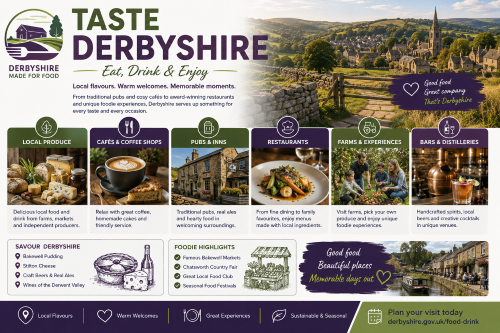
Derbyshire’s dining scene reflects its countryside, market towns, visitor economy, local produce, and traditional pubs. Residents can find country inns, tea rooms, farm shops, cafés, restaurants, bakeries, and independent food businesses across towns and villages.
Bakewell is strongly associated with Bakewell pudding, and the Peak District is known for dishes and local food traditions such as Derbyshire oatcakes, Ashbourne gingerbread, local beef, lamb, cheese, ales, and produce from farm shops and markets.
Country pubs are a key part of Derbyshire life, especially in villages and Peak District locations. Recent reviews have highlighted dining and accommodation on the Chatsworth estate and in Peak District inns, with locally sourced menus and countryside settings forming part of the county’s food appeal.
For everyday dining, areas such as Derby, Chesterfield, Matlock, Buxton, Bakewell, Ashbourne, Belper, Wirksworth, and Glossop offer a mix of restaurants, cafés, pubs, takeaways, independent coffee shops, and food-led visitor destinations.
Whether you prefer a Sunday roast after a countryside walk, a café in a market town, a farm shop lunch, or a relaxed dinner in a Peak District inn, Derbyshire offers a strong range of dining options for residents and visitors.
Why Derbyshire is the Perfect Place to Call Home

Derbyshire is a strong option for people who want a balance of countryside, community, transport links, heritage, education, and regional opportunity. It offers market towns, historic villages, active outdoor living, family-friendly communities, and access to larger cities.
The county’s lifestyle appeal is clear. The Peak District offers walking, cycling, climbing, heritage sites, food destinations, and scenic landscapes, while towns such as Chesterfield, Matlock, Buxton, Bakewell, Ashbourne, Belper, and Glossop offer local identity and practical amenities.
For families, Derbyshire can offer access to schools, colleges, green space, and community life. For professionals, it provides access to employment across Derbyshire, the East Midlands, South Yorkshire, and Greater Manchester depending on location. For downsizers and retirees, it can offer village life, countryside, and strong local character.
As with any move, buyers should consider house prices, transport, schools, work, healthcare, broadband, and day-to-day travel before choosing an area.
Browse Our Advisers in Derbyshire



People who found this page helpful also explored these related topics:
FAQ: Why Move to Derbyshire
| Question | Answer |
|---|---|
| What makes Derbyshire an attractive place to live? | Derbyshire offers the perfect balance between countryside serenity and urban convenience. With the stunning Peak District National Park on your doorstep and great transport links to major cities like Sheffield, Nottingham, and Derby, it’s ideal for both families and professionals. |
| How affordable is property in Derbyshire compared to nearby cities? | House prices in Derbyshire are typically lower than in surrounding city areas, offering excellent value for money. Buyers can often find larger homes, gardens, and scenic views for the same price as a small apartment in city centres. |
| What are the best areas to live in Derbyshire? | Popular locations include Chesterfield for its character homes, Matlock and Bakewell for countryside charm, and Derby for modern amenities and strong commuter connections. Each area offers something unique depending on your lifestyle. |
| What is the local job market like? | Derbyshire has a strong and diverse economy with opportunities in engineering, manufacturing, education, and healthcare. Major employers include Rolls-Royce, Toyota, and Bombardier, creating a stable employment base. |
| Are there good schools in Derbyshire? | Yes. Derbyshire has many high-performing primary and secondary schools, along with access to further education at the University of Derby. This makes it an excellent choice for families with children. |
| What about lifestyle and leisure? | From hiking trails and country pubs to market towns and heritage sites, Derbyshire offers an unbeatable quality of life. The region’s rich culture, including Chatsworth House and the Peak District, attracts both visitors and locals year-round. |
| Is Derbyshire suitable for commuters? | Absolutely. With excellent rail and motorway connections, Derbyshire provides easy access to nearby cities while maintaining a relaxed, rural lifestyle. The M1 and A38 make commuting quick and convenient. |
| What’s the community like in Derbyshire? | Residents enjoy a friendly, welcoming atmosphere and a strong sense of local pride. Communities are close-knit, with plenty of local events, markets, and festivals that make newcomers feel at home. |