
Why move to Dorset? Because where you live eventually becomes more than an address. It shapes how far you travel, what you spend, where children grow up, how weekends feel and what kind of future your home needs to support.
Dorset offers several very different answers.
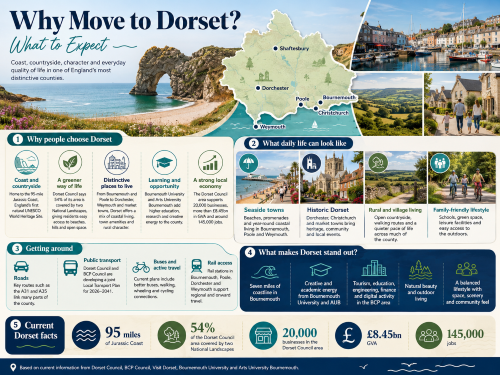
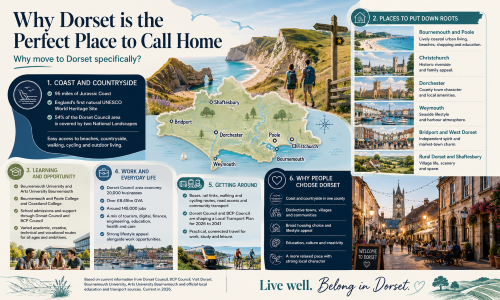
Bournemouth and Poole provide larger urban and coastal centres. Christchurch combines harbour living with access towards the New Forest. Dorchester brings county-town services and history, while Weymouth, Swanage, Bridport and Lyme Regis put the coast much closer to everyday life.
Further inland, Sherborne, Shaftesbury, Wimborne Minster and Blandford Forum offer a different pace, while smaller villages can provide more space, countryside and community life.
The useful question is therefore not simply why move to Dorset.
It is which part of Dorset still makes sense once the excitement of moving has passed and ordinary life begins.
When the move becomes a mortgage decision, users can explore Mortgage Brokers in Dorset
Coast, Market Town or Countryside: Dorset Gives You More Than One Way to Live
Dorset is unusual because its character can change significantly within a relatively short distance.
Bournemouth offers jobs, university life, shopping, beaches, and a wide range of housing.
Poole has a strong maritime identity, with Poole Harbour, established suburbs, apartments and higher-value coastal areas.
Christchurch brings together historic streets, two rivers, harbour access and links towards Hampshire.
Further west, Weymouth offers a traditional seaside setting with a working harbour and rail connection, while Bridport and Lyme Regis have a smaller-town character shaped partly by the Jurassic Coast.
Inland Dorset feels different again.
Dorchester acts as an important service and employment centre. Sherborne is known for its historic environment and schools. Shaftesbury sits on a hilltop, while Blandford Forum, Wimborne Minster, Gillingham and surrounding villages offer buyers alternatives to the larger coastal towns.
This variety matters.
One household asking why move to Dorset may want a sea view.
Another may want a practical family home close to work.
Another may want land, privacy or a quieter retirement.
Dorset can support all three, but not necessarily in the same place.
Dorset Housing: Coastal Demand, Market Towns and Rural Property
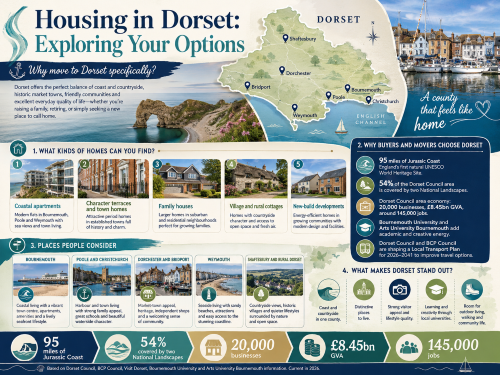
Dorset should not be treated as one single property market.
The latest ONS figures show that the average house price in the Dorset Council area was £325,000 in July 2026. First-time buyers paid an average of £254,000, while mortgage buyers paid an average of £317,000. Detached properties averaged £515,000.
Bournemouth, Christchurch and Poole form a separate local-authority area. There, the average house price was £310,000 in July 2026, with first-time buyers paying £249,000 on average. Detached homes averaged £551,000.
Those figures show why a county-wide headline can only go so far.
A buyer might be comparing:
- a Bournemouth flat;
- a family home in Christchurch;
- a Poole harbour apartment;
- a detached property around Wimborne;
- a period home in Sherborne;
- a coastal house in Weymouth;
- a rural property outside Dorchester;
- a cottage around Bridport or West Dorset.
The property itself can also affect lender appetite.
Leasehold flats, listed buildings, coastal homes, properties with land, older cottages, unusual construction and rural homes can all require different valuation or underwriting considerations.
For first-time buyers, First-Time Buyer Mortgage Advice may be useful where deposit, affordability and lender criteria are still being worked through.
Education Choices Can Shape a Dorset Move

For some households, a move to Dorset begins with housing.
For others, it begins with education.
The county has state schools, further-education provision, universities and long-established independent schools. Bournemouth University and Arts University Bournemouth also give the eastern part of the county a significant student and higher-education presence.
Independent education is relevant in locations such as Sherborne, Blandford and the wider Poole area.
That does not mean education should determine every move.
Families still need to compare:
- school journey times;
- catchment areas;
- childcare;
- public transport;
- whether both adults commute;
- school fees where relevant;
- the effect of regular education costs on disposable income.
A property may look affordable on purchase price alone, but the wider household budget can tell a different story.
Where independent-school costs form part of the longer-term plan, Education Finance may also be relevant.
The house and the life around it should be considered together.
Dorset’s Economy Is Broader Than Tourism
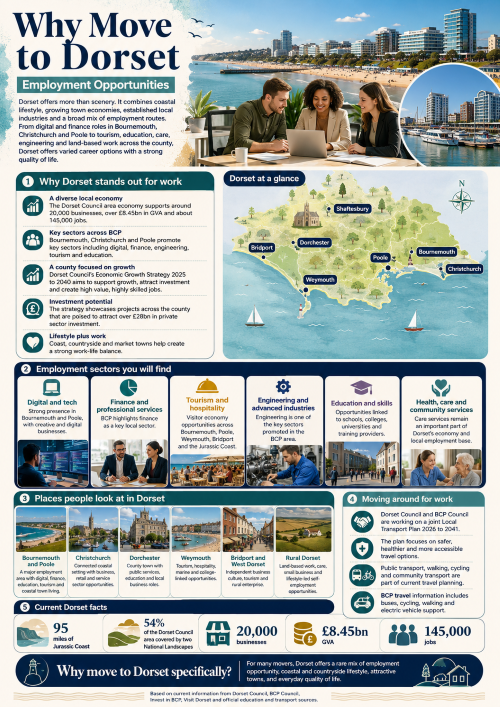
Tourism is highly visible in Dorset, but it doesn’t make up the whole economy.
Dorset Council says the area supports around 20,000 businesses, generates more than £8.45 billion in GVA, and supports around 145,000 jobs. It identifies strengths across agriculture, retail, coastal and marine activity, hospitality, care, advanced manufacturing, maritime, defence and renewable energy.
Bournemouth and Poole add further strength in digital, professional services, finance, education and the creative economy.
That creates very different types of mortgage applicants.
Some may have conventional salaries.
Others may receive:
- self-employed income;
- company-director remuneration;
- dividends;
- retained profits;
- seasonal income;
- commission;
- multiple income streams;
- contract income.
Dorset’s economy also has a strong SME base, so lender treatment of business income can be particularly relevant.
Someone moving for a new role may therefore need to consider more than where the job is based.
How that income is structured can influence mortgage affordability and lender choice.
Mortgage Planning Should Develop Alongside the Dorset Property Search
A Dorset property search is more useful when you consider borrowing early.
The location may affect the price.
The property may affect the lender.
The income may affect affordability.
Together, all three usually matter more than any single factor.
Someone buying a leasehold Bournemouth apartment may need to consider lease length and service charges.
A buyer looking at a coastal property in Weymouth or Lyme Regis may need to consider condition, exposure, insurance and valuation.
A rural property may include land, private drainage, outbuildings or access arrangements.
A period home in Sherborne or Dorchester may be listed or have non-standard features.
Mortgage planning may therefore include:
- deposit size;
- loan-to-value;
- affordability;
- lender criteria;
- property valuation;
- mortgage term;
- income assessment;
- existing borrowing.
If you are comparing several Dorset areas, Find a Mortgage Adviser by Location can help identify advisers covering the places you are considering.
The better question is not only:
How much can I borrow?
It is also:
How much borrowing still leaves enough room for the rest of my life after I move?

Higher-Value Dorset Homes Can Require a Different Mortgage Conversation

Higher-value property is a genuine part of Dorset’s housing market, but it should not be applied to the whole county.
Some coastal and harbour locations command very different values from the county average.
Parts of Poole, including Sandbanks, Canford Cliffs, Lilliput and Lower Parkstone, are well known for higher-value homes. Higher-value property can also be found in parts of Christchurch, Purbeck and selected rural or coastal locations.
The ONS figures reinforce the distinction. In July 2026, detached properties averaged £551,000 in Bournemouth, Christchurch and Poole and £515,000 in the Dorset Council area.
Larger borrowing can also coincide with less straightforward income.
Applicants may receive:
- bonuses;
- dividends;
- retained company profits;
- investment income;
- partnership drawings;
- income from property;
- income from more than one company or asset.
In those circumstances, choosing the closest adviser may be less important than choosing someone familiar with the borrowing profile.
High Net Worth Mortgage Brokers may be relevant where the property value, loan size or income structure requires a more specialist approach.
Dorset Can Also Suit a Later-Life Move
Not every move is about gaining another bedroom.
Some people move for fewer responsibilities, lower running costs, or a different pace of life.
Dorset can appeal to households who are:
- downsizing;
- moving closer to family;
- retiring;
- moving towards the coast;
- leaving a larger property;
- considering how housing wealth fits into later life.
Weymouth, Swanage, Lyme Regis, Christchurch, Bridport and smaller market towns can appeal to buyers whose priorities have changed.
Later-life finances can also change the mortgage conversation.
Someone approaching retirement may need to consider:
- pension income;
- an existing mortgage balance;
- whether downsizing releases enough capital;
- borrowing into retirement;
- future care or family plans;
- whether property wealth should remain untouched.
Equity release should be treated separately from an ordinary residential mortgage because it has different long-term implications.
Where relevant, homeowners can explore Equity Release Advisers in Dorset.

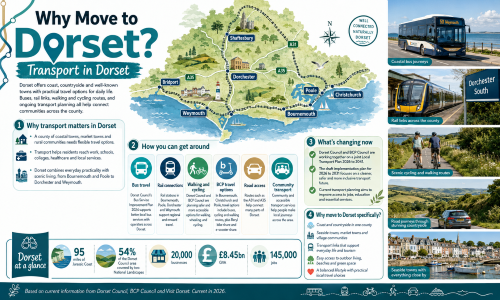
Dorset Transport Depends Heavily on Where You Choose to Live
Transport is an important part of the answer to why move to Dorset, but Dorset does not offer the same transport experience everywhere.
Bournemouth, Poole, Christchurch, Wareham, Dorchester and Weymouth sit on the rail route towards London Waterloo.
Sherborne and Gillingham also have rail services towards London Waterloo on a different route.
Road travel relies heavily on A-roads rather than motorways.
Important routes include:
- A31;
- A35;
- A37;
- A338;
- A354.
These connect Dorset with Hampshire, Wiltshire, Somerset, Devon and the wider South West.
Bournemouth Airport adds another travel option from the county’s eastern part.
Rural living can be very different.
A property may offer more space but require more driving for work, schools, shopping or healthcare.
Before moving, consider the whole journey:
- distance to the station;
- frequency of trains;
- road congestion;
- school runs;
- parking;
- fuel costs;
- hybrid-working patterns;
- whether the commute is daily or occasional.
A cheaper home further away may not always mean a cheaper household once travel is included.
Dorset Food, Culture and Everyday Life Reflect the Coast and Countryside
Mortgage data makes lifestyle hard to measure.
Yet it is often what determines whether a move feels successful.
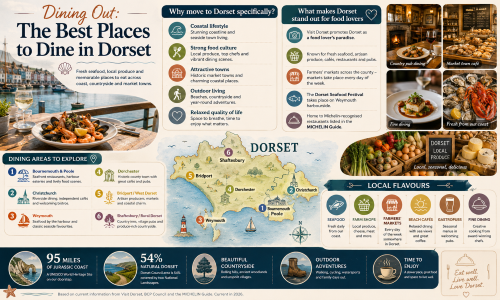
Dorset’s food culture is shaped by both the sea and the countryside.
Poole, Bournemouth and Christchurch provide a broad choice of restaurants, cafés and bars.
Weymouth, Lyme Regis, Swanage and Bridport have strong links with seafood and coastal dining.
Sherborne, Dorchester, Wimborne and Shaftesbury offer independent cafés, pubs, markets and local businesses.
The county also has a strong tradition of farm shops, local producers, cheese, cider, meat and seasonal food.
Culture varies by location too.
Bournemouth has major entertainment venues and events.
Poole combines the Quay, arts and harbour life.
Dorchester has museums and literary associations.
Sherborne and smaller market towns offer a more historic setting.
These things may look secondary during a property search.
After you move, they become part of everyday life.
Where you walk, eat, meet friends, or spend weekends can matter as much as the property’s square footage.
Dorset has a strong food identity. It is shaped by farmland, coastline, seafood, local producers, cafés, pubs, markets and farm shops.
Visit Dorset highlights local produce across the county. It highlights Dorset’s farmland, coastline, and strong food and drink scene. Fresh seafood, local cheeses, bakery produce, cider, meat, fruit and seasonal vegetables all play a part.
Poole, Bournemouth and Christchurch offer a wide range of restaurants, cafés and bars. Weymouth, Swanage, Lyme Regis and Bridport are known for coastal dining and seafood. Inland towns such as Dorchester, Sherborne, Shaftesbury and Wimborne offer pubs, tearooms, farm shops and independent restaurants.
For residents, this means plenty of choice. You can enjoy seafood near the harbour, a village pub lunch, a café in a market town, or local produce from a farm shop.
Dorset’s Attractions Give the County a Strong Sense of Place
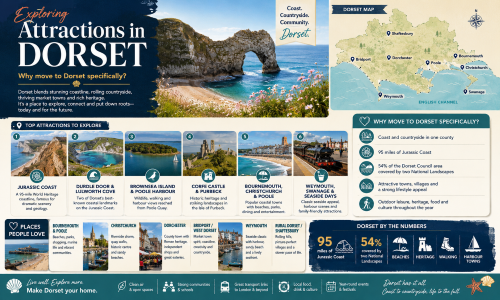
Dorset has something that many counties do not: a coastline of international geological significance.
The Dorset and East Devon Coast is a UNESCO World Heritage Site, with geology covering around 185 million years of Earth’s history.
Within Dorset, this includes well-known places such as:
- Durdle Door;
- Lulworth Cove;
- Lyme Regis;
- Charmouth;
- Swanage;
- Old Harry Rocks.
The county also includes:
- Corfe Castle;
- Brownsea Island;
- Poole Harbour;
- Weymouth seafront;
- The Tank Museum;
- Kingston Lacy;
- Abbotsbury;
- the South West Coast Path;
- extensive countryside within the Dorset National Landscape.
Outdoor life can include walking, cycling, sailing, paddleboarding, fossil hunting and beach days.
For some people, this is a weekend benefit.
For others, it is the main reason to ask why move to Dorset in the first place.
Dorset Can Make Sense at Several Different Stages of Life
The reasons to move to Dorset can change as priorities shift.
A graduate may choose Bournemouth for university, employment, or a larger social scene.
A first-time buyer may compare Bournemouth, Poole, Christchurch or one of the inland towns.
A family may prioritise space, schools and practical transport.
A professional may relocate for work in Poole, Bournemouth, Dorchester, or one of Dorset’s specialist industries.
A higher-value buyer may focus on Poole Harbour, Sandbanks or other premium coastal locations.
Someone approaching retirement may prefer Weymouth, Swanage, Bridport, Lyme Regis or a smaller market town.
There is no single Dorset lifestyle.
That is the advantage.
The county lets people choose between urban, harbour, coastal, market-town, and rural living without leaving the same wider area.
A good move should work on completion day.
A better move should still work when careers change, children grow older or financial priorities shift.
Browse Our Advisers that Covers Dorset
Once you have narrowed down where you want to live, the next decision is whether the mortgage fits both the property and the circumstances behind the move.
Connect Experts helps users compare advisers by location and relevant areas of experience.
The aim should not be simply to find the closest postcode.
It should be to find an adviser whose experience matches the decision being made.
Connect Experts is a mortgage adviser directory and matching platform. It does not provide mortgage advice directly. Advice is provided by the adviser or firm you choose.



People who found this page helpful also explored these related topics:

Sandbanks Mortgage Advice: Big BH13Decisions – HNW Expert Advice

Mortgage Broker in Lulworth – Trusted BH20 Mortgage Help

Mortgage Broker in Kimmeridge – Trusted Help for Coastal Property

Mortgage Brokers in Gillingham, Dorset – Trusted Local Help

Mortgage Broker in Wimborne Minster – Find the Right Adviser

Mortgage Broker in Bridport DT6: Find a Trusted Adviser
Neighbouring Counties
FAQs: Why Move to Dorset?
Is Dorset better suited to coastal living or countryside living?
It can offer both. Bournemouth, Poole, Christchurch, Weymouth, Swanage, and Lyme Regis offer different kinds of coastal living, while Dorchester, Sherborne, Blandford Forum, Shaftesbury, and many smaller villages offer more inland or rural options. The right area depends on whether access to work, rail services, schools, space or the coast matters most.
Is Dorset realistic for someone who still needs to travel to London?
Some parts are more practical than others. Bournemouth, Poole, Christchurch, Dorchester and Weymouth have rail services towards London Waterloo, while Sherborne and Gillingham sit on another London route. Regular travellers should compare actual door-to-door time, train frequency, and ticket costs rather than rely on distance alone.
Why can Dorset coastal property need extra mortgage consideration?
The issue is usually the individual property, not its proximity to the sea. Lenders or valuers may consider construction, condition, lease terms, marketability, insurance, exposure or flood information depending on the home. A harbour apartment, listed cottage and modern detached property can therefore require very different assessments.
Does Dorset work for people moving out of larger cities?
It can, particularly for people looking for more access to the coast, countryside or smaller communities. However, work patterns and transport matter. Bournemouth and Poole offer larger employment centres, while more rural areas may involve longer journeys and greater reliance on a car.
Are higher-value homes limited to Sandbanks?
No. Sandbanks is one of Dorset’s best-known high-value markets, but premium homes also appear in Canford Cliffs, Lilliput, parts of Christchurch, Purbeck, and selected rural or coastal locations. Borrowing requirements should be assessed against the specific property and the applicant’s income structure.
What should I compare before deciding where to live in Dorset?
Compare more than the purchase price. Consider property type, commuting, schools, childcare, coastal or rural access, local services, insurance where relevant, running costs and how much borrowing leaves room for other priorities. A move works best when the location and finances still fit after completion.