
Why move to Wiltshire? Because where we choose to live is rarely just a decision about bricks, bedrooms or a postcode; it is a decision about how much space we want around our lives and what we want that space to make possible.
Wiltshire offers a distinctive balance.
Salisbury provides cathedral-city living. Chippenham and the county’s north connect to the M4 corridor. Trowbridge, Melksham and Westbury sit within reach of Bath and the wider West Country. Marlborough, Devizes, Malmesbury and Bradford-on-Avon bring strong market-town identities, while villages around Pewsey, the Vale of Pewsey, Salisbury Plain and the county’s National Landscapes offer something altogether more rural.
The county is also home to Stonehenge and Avebury, two landscapes whose history stretches back thousands of years. Yet Wiltshire is not preserved in the past. It supports defence, science, advanced manufacturing, logistics, healthcare, professional services and modern hybrid working.
That contrast helps explain why move to Wiltshire remains an increasingly useful question for home movers.
The better question may be: which part of Wiltshire fits the life you are planning next?
When the move becomes a mortgage decision, you can explore Mortgage Brokers in Wiltshire and compare advisers covering different parts of the county.
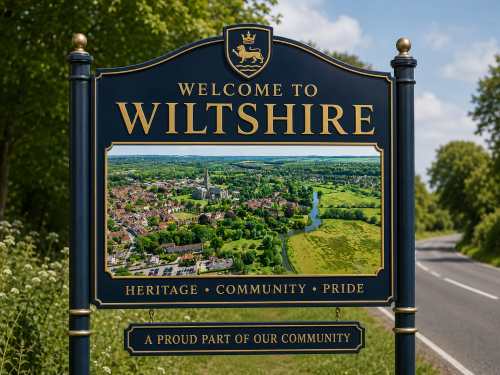
Cathedral City, Market Town or Village? Wiltshire Gives You Room to Choose
Wiltshire is hard to describe in one town because its communities offer very different ways of life.
Salisbury combines a historic city centre, cathedral quarter, employment, schools and direct rail connections.
Chippenham has a different character. Its position near the M4 and mainline railway makes it particularly relevant for people whose working lives extend to Bath, Bristol, Swindon, Reading, or London.
Trowbridge, the county town, sits close to Bradford-on-Avon, Westbury and Bath, giving residents access to both local services and the wider West Wiltshire area.
Marlborough has an established market-town identity, while Devizes sits centrally in Wiltshire, close to the countryside and the Kennet and Avon Canal.
Bradford-on-Avon is known for historic architecture, hillside streets and waterways. Malmesbury, Corsham, Calne, Warminster, Amesbury, Melksham and Royal Wootton Bassett each provide different combinations of heritage, employment, schools, transport and housing.
Further into the countryside, the choice changes again.
Someone considering why move to Wiltshire might be looking for:
- a city home in Salisbury;
- a commuter base near Chippenham;
- a period property in Bradford-on-Avon;
- a market-town home in Marlborough or Devizes;
- a family property around Trowbridge or Melksham;
- a village close to Pewsey;
- more land or space in a rural part of the county.
Wiltshire’s strength is not that every area offers the same thing.
It is that it gives home movers several very different answers within one county.

Wiltshire Housing: From City Terraces to Rural Homes
Housing is one of the clearest reasons the Wiltshire experience differs from neighbouring urban areas.
The county includes:
- Georgian and Victorian homes;
- traditional stone cottages;
- terraced houses;
- modern estates;
- converted agricultural buildings;
- village properties;
- new-build homes;
- flats and maisonettes;
- larger rural homes;
- properties with land or outbuildings.
The latest Office for National Statistics housing data for Wiltshire recorded an average house price of £329,000 in July 2026, up 2.6% over the year.
Average prices by property type were:
- Detached: £519,000
- Semi-detached: £328,000
- Terraced: £265,000
- Flats and maisonettes: £158,000
First-time buyers paid an average of £263,000, while home movers paid £392,000. Properties bought with a mortgage averaged £325,000.
Those figures provide useful context, but they don’t mean every Wiltshire location behaves the same way.
A listed cottage around Bradford-on-Avon may raise different mortgage questions from a new-build home near Chippenham. A rural property around Pewsey could involve acreage, private drainage or outbuildings. A Salisbury flat may involve leasehold considerations.
For someone asking why to move to Wiltshire, property choice is not only about what a home costs.
It is also about what type of property fits your finances and whether lenders are comfortable with its characteristics.
First-time buyers can also explore the First-Time Buyer Mortgage Guide for further information on deposits, affordability and the mortgage process.
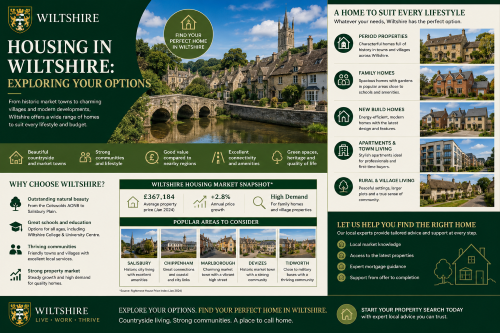
Education Can Shape Where Families Put Down Roots
For some households, education is one of the most important influences on where they live.
Wiltshire offers state education, further education, specialist provision and a strong independent-school tradition.
Independent education has a particularly visible presence in parts of the county.
Marlborough College has long been associated with Marlborough, while St Mary’s Calne describes itself as an independent boarding and day school for girls aged 11–18 in the heart of Wiltshire. St Mary’s Calne Warminster also has established connections to independent schools.
The county also has Wiltshire College & University Centre campuses and training opportunities across several locations.
But choosing an area because of education should involve more than a school name.
Families may need to consider:
- admissions and catchment arrangements;
- school journeys;
- childcare;
- rail and bus connections;
- whether both parents commute;
- school fees where applicable;
- how education expenditure affects disposable income;
- whether the chosen home will still work as children grow older.
If independent schooling is part of the longer-term plan, regular fees can affect overall household affordability.
Families considering how those costs might fit alongside other financial commitments can explore Education Finance.
A home and an education plan may look like separate decisions.
In practice, they can become part of the same household budget.

Wiltshire's Economy Gives People Reasons to Move In, Not Just Commute Out
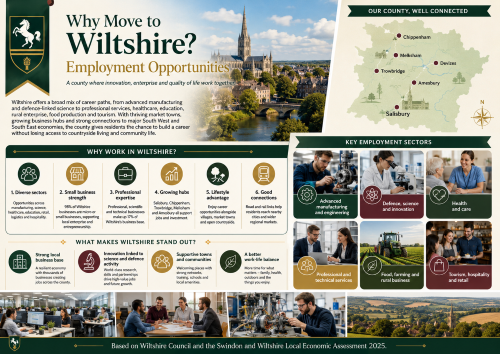
Not everyone moves to Wiltshire because they intend to work somewhere else.
The wider Swindon and Wiltshire economy supports activity across advanced manufacturing, professional services, construction, digital technology, distribution, logistics and pharmaceutical manufacturing. Swindon Borough Council also identifies employers across the wider economic area, including BMW, Nationwide, Intel, Siemens, Zurich, Network Rail and the Ministry of Defence.
Wiltshire itself has particularly strong links with defence and science.
Salisbury Plain has a substantial military presence, while Porton Down, north-east of Salisbury, supports nationally significant scientific and research activity. Wiltshire Council material describes the site as a concentration of highly skilled scientists and specialist science and technology employment.
Employment also extends across:
- healthcare;
- public administration;
- education;
- agriculture;
- tourism;
- hospitality;
- engineering;
- manufacturing;
- logistics;
- professional services;
- rural enterprise.
That diversity matters when arranging a mortgage.
Not every applicant receives a simple monthly salary.
Someone relocating to Wiltshire might receive:
- overtime;
- bonuses;
- commission;
- military allowances;
- contractor income;
- company-director income;
- dividends;
- retained profits;
- income from several sources.
A career move can therefore influence both where someone lives and how a lender assesses their income.
Planning the Mortgage Around the Wiltshire Move
A property search and a mortgage search are most useful when they develop together.
Wiltshire gives buyers a wide choice, but different areas and property types can alter the financial decision.
A buyer looking in Marlborough may face a different purchase price from someone considering Westbury.
A rural home may require a different lender assessment from a conventional estate property.
A listed building may involve different valuation considerations from a modern home.
Important factors can include:
- deposit;
- loan-to-value;
- affordability;
- existing borrowing;
- property construction;
- valuation;
- leasehold terms;
- private drainage;
- land or outbuildings;
- listed status;
- mortgage term.
If you are comparing several locations, Find a Mortgage Adviser by Location can help identify advisers serving the areas you are considering.
This is where the philosophical question of why you’re moving to Wiltshire becomes practical.
It is not merely:
“Can I afford this house?”
It is:
“Can I afford the life that comes with this house, and still have room for everything else I want to do?”
Larger Homes and Complex Borrowing in Parts of Wiltshire

High-net-worth borrowing should not be applied indiscriminately across Wiltshire.
However, in some areas, higher property values, larger homes, and more complex borrower circumstances can make specialist mortgage experience particularly relevant.
The ONS recorded an average price of £519,000 for detached homes in Wiltshire in July 2026, compared with £329,000 across all property types.
Higher-value homes can be found around areas such as:
- Marlborough;
- selected villages in the Vale of Pewsey;
- Bradford-on-Avon;
- parts of north Wiltshire;
- rural areas close to Bath;
- individual country properties elsewhere in the county.
Property value is only one part of the equation.
Some borrowers may receive:
- substantial bonuses;
- partnership income;
- investment income;
- dividends;
- retained company profits;
- income from multiple businesses;
- income from property portfolios.
In those circumstances, the nearest adviser may not necessarily be the most suitable adviser.
Experience with High-Net-Worth Mortgage Brokers can become relevant when borrowing size, assets, or income structure require a more specialist approach.
The purpose is not to label an entire town as wealthy.
It is to recognise when the mortgage itself requires a different level of expertise.
Later-Life Moves Can Change What Matters Most
Not every move is about gaining another bedroom or cutting down on a commute.
For some Wiltshire households, the next move may be about simplifying life.
Someone approaching or already in retirement might be:
- downsizing from a larger property;
- moving closer to family;
- reducing household running costs;
- relocating to a market town;
- moving from city life into a village;
- releasing capital by moving to a smaller home;
- considering how property wealth fits into retirement.
Wiltshire’s market towns and rural communities can appeal to people whose priorities have shifted from work and commuting towards space, community and everyday convenience.
But the financial questions also change.
Mortgage affordability in later life may depend more heavily on pension income, retirement age, outstanding borrowing and future plans.
Where equity release is being considered, it should be treated as a separate specialist decision rather than an ordinary residential mortgage.
Homeowners can explore Equity Release Advisers in Wiltshire where later-life borrowing is relevant.

Wiltshire's Transport Links Connect Rural Living With Wider Opportunity
A rural county does not necessarily mean living in isolation.
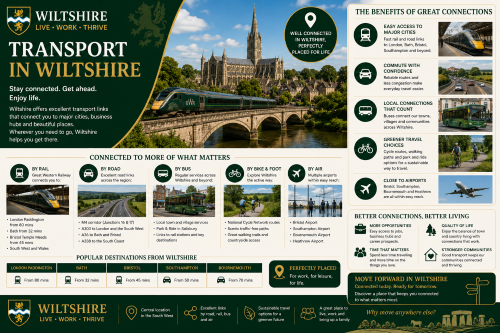
Wiltshire sits between London, the South West and the South Coast.
Visit Wiltshire identifies direct rail connections with London, Bristol, Bath, Southampton and Cardiff, with key stations including Salisbury, Swindon, Chippenham and Trowbridge. The county is also served by the M4, A303, A36 and A350.
Different parts of Wiltshire connect in different directions.
Chippenham and north Wiltshire benefit from access towards the M4.
Salisbury has direct rail services towards London Waterloo and connections towards Southampton and the South Coast.
Westbury is an important railway junction.
Trowbridge and Bradford-on-Avon provide links towards Bath and Bristol.
Pewsey provides direct services on the Great Western route.
Road access also shapes everyday life.
The A350 is particularly important through western Wiltshire, while the A303 crosses the county’s south and links to the South West.
For home movers, however, a railway map tells only part of the story.
Consider:
- actual door-to-door journey time;
- station parking;
- ticket costs;
- road congestion;
- school runs;
- hybrid-working patterns;
- how often the journey will be made.
A larger property further from work may cost less to buy but take more time and money to get to and from work.
That trade-off deserves to be considered alongside the mortgage.
Food, Markets and Everyday Life in Wiltshire
A place eventually becomes home through ordinary routines rather than headline attractions.
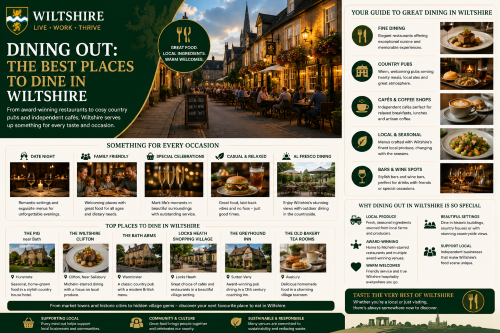
Wiltshire has a strong tradition of market towns, village pubs, independent cafés, farm shops, local producers and countryside hospitality.
Salisbury offers the broadest city-centre choice, with restaurants, pubs and cafés around the centre and cathedral.
Marlborough, Devizes, Corsham and Bradford-on-Avon have independent hospitality alongside established high-street businesses.
Rural Wiltshire adds another layer through village pubs, local food producers and farm shops.
The county’s food culture also reflects its agricultural surroundings.
For someone considering why move to Wiltshire, this matters because lifestyle is built from the places used every week:
- where you shop;
- where you meet friends;
- where children spend their weekends;
- where you walk;
- where you eat;
- whether you need to drive for everyday services.
These details may seem secondary while comparing mortgage rates.
After moving, they become part of whether the location actually works.
Wiltshire has a varied food scene. It includes village pubs, cafés, farm shops, fine dining, market stalls, bakeries, breweries, vineyards, and restaurants using local produce.
Visit Wiltshire highlights regular farmers’ markets, local produce, vineyards, breweries, micro-breweries, and Wadworth Brewery in Devizes. It also notes that Wiltshire has cafés, tearooms, pubs, inns, and restaurants across the county.
Salisbury offers city dining, cafés, pubs, and restaurants near the cathedral and market square. Bradford-on-Avon has riverside eateries and independent cafés. Marlborough, Devizes, and Corsham offer market town dining and local pubs.
For special occasions, Castle Combe and nearby countryside locations offer destination dining. Visitors and residents can also explore farm shops, food markets, and local producers across the county.
Ancient Landscapes and Modern Days Out
Wiltshire’s heritage gives the county an identity that is hard to replicate elsewhere.
Stonehenge and Avebury form a UNESCO World Heritage Site and are among Britain’s most significant prehistoric landscapes.
Salisbury adds another layer of history through its cathedral and medieval centre.
Other well-known destinations include:
- Longleat;
- Stourhead;
- Lacock;
- Castle Combe;
- Old Sarum;
- Bowood;
- Caen Hill Locks;
- the Kennet and Avon Canal;
- Wiltshire’s white horses.
Outdoor life is equally important.
Wiltshire contains or borders the Cotswolds, Cranborne Chase and North Wessex Downs National Landscapes, while Salisbury Plain, chalk valleys, canals and extensive footpaths provide different ways to spend time outdoors.
Visit Wiltshire highlights the county’s rolling countryside, market towns, and internationally recognised heritage.
Living near attractions is not the same as being a tourist.
The lasting benefit is having landscape, heritage, and open space as part of everyday life.
Why Wiltshire Can Suit More Than One Chapter of Life
The answer to why move to Wiltshire can change depending on when the question is asked.
A first-time buyer may be comparing value and transport around Trowbridge, Melksham or Westbury.
A professional may prioritise Chippenham and access to the M4.
A military family may focus on communities closer to Salisbury Plain.
A household working in science or defence may look towards Salisbury, Amesbury or Porton.
A family may consider schools and space around Marlborough, Calne, or other established towns.
Someone approaching retirement may prefer a quieter market town or village.
The county does not promise one ideal lifestyle.
Its advantage is choice.
City, market town, commuter corridor and countryside can all exist within relatively short distances of one another.
The right move should not only work on completion day.
It should continue to make sense when employment changes, children grow up, commuting patterns alter or financial priorities evolve.
That is ultimately the strongest answer to why move to Wiltshire: the county gives households several ways to adapt without necessarily having to leave the wider area behind.
Browse our Mortgage Brokers in Wiltshire
Once you have narrowed down where you want to live, the next question is whether your borrowing fits the property and the circumstances behind the move.
Connect Experts lets users compare mortgage advisers by location, specialism, language, and other preferences.
Use the Connect Experts adviser directory to compare advisers rather than simply selecting the closest postcode.
Connect Experts is a mortgage adviser directory and matching platform. Mortgage advice is provided by the adviser or firm selected by the client.

People who found this page helpful also explored these related topics:
Westbury Mortgage Advisers: Search by Your Needs
Mortgage Advice in Wingfield: Find Expert Local Adviser
Mortgage Broker in Trowbridge: Buying or Remortgaging Advice
Salisbury Mortgage Advice: Buying, Moving & Planning
Royal Wootton Bassett Mortgage Brokers: Adviser Search SN4
Mortgage Broker in Pewsey: Advice for Wiltshire Buyers
Neighbouring Counties
FAQs: Why Move to Wiltshire?
Is Wiltshire suitable if I want countryside without being completely disconnected?
Yes, depending on the location you choose. Wiltshire has extensive rural areas but also rail and road connections to London, Bath, Bristol, Southampton, and the wider South West. Chippenham, Salisbury, Trowbridge, Westbury and Pewsey are examples where rail access can be combined with countryside living. Actual commuting time and local transport should still be checked before moving.
Which Wiltshire areas might suit someone who regularly travels to Bath or Bristol?
Trowbridge, Bradford-on-Avon and Chippenham are among the most obvious places to consider. Chippenham has mainline rail and M4 access, while Trowbridge and Bradford-on-Avon have rail connections towards Bath and Bristol. The right choice depends on your budget, property type, and how often you need to travel.
Why can rural Wiltshire properties require different mortgage checks?
Rural properties may include land, outbuildings, private drainage, unusual access arrangements or non-standard construction. Some may also be listed or subject to agricultural restrictions. These characteristics can affect valuation and lender criteria, so the property itself should be considered before selecting a mortgage lender.
Does Wiltshire have opportunities outside commuting to another city?
Yes. Wiltshire has employment in defence, science, healthcare, manufacturing, logistics, education, tourism and professional services. Porton Down and the wider Salisbury area are particularly important for science, defence, and public-sector employment, while the wider Swindon and Wiltshire economy supports major employers in manufacturing, technology, and financial services.
What should I check before buying an older village home in Rutland?
Consider the survey, construction, listed status, roof and damp issues, drainage, access, boundaries, heating, broadband and any land or outbuildings. Mortgage lenders may also have different criteria for unusual or rural properties, so it helps to understand those requirements before you commit.
What should families compare before moving to Wiltshire?
Families should compare more than house prices. School admissions, childcare, commuting, transport costs, property size, access to services and future education expenditure can all affect whether an area remains suitable over time. If you’re considering independent education, school fees should also be part of your longer-term household affordability.
Is Wiltshire only suitable for people wanting rural life?
No. Salisbury provides city living, while towns including Chippenham, Trowbridge, Devizes and Melksham offer established services and employment. Wiltshire’s appeal comes from having urban, market-town and rural choices rather than requiring everyone to adopt the same lifestyle.