Why Move to Cornwall? Cornwall is one of the UK’s most distinctive places to live, offering a rare mix of coastline, countryside, heritage, creative culture, and strong local identity. From coastal communities such as St Ives, Falmouth, Padstow, Newquay, Penzance, and Looe to inland towns such as Truro, Bodmin, Launceston, Camborne, Redruth, and Wadebridge, Cornwall offers a wide range of lifestyles for home movers.
The county is known for its beaches, fishing villages, wild moorland, rural landscapes, and long stretches of protected coast. Cornwall Council highlights its wild moorland, varied coastline, attractive villages, and extensive protected landscapes, while Visit Cornwall describes the area as a destination of wild beaches, rolling moors, market towns, fishing villages, art colonies, seal colonies, and some of Britain’s strongest food culture.
Cornwall also has a unique economic identity. Its current Good Growth Plan groups key economic strengths into distinctive sectors such as minerals, renewables, space, and marine, alongside core sectors such as the visitor economy, agri-food, and creative and cultural industries.
Whether you are relocating for lifestyle, work, family, education, retirement, or investment, Cornwall offers a strong combination of scenery, community, opportunity, and property choice.
What to Expect Living in Cornwall
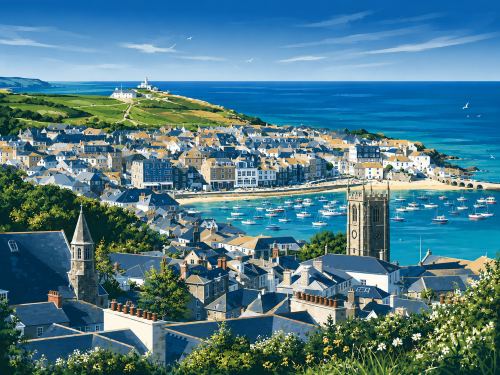
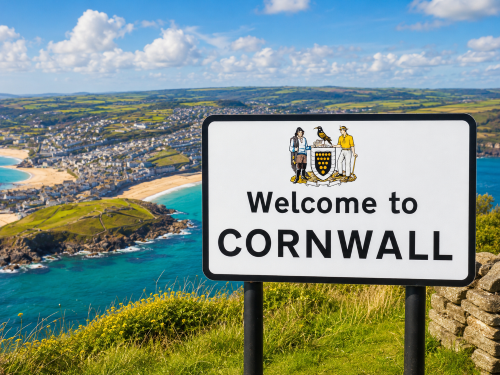
Cornwall offers a lifestyle shaped by the sea, countryside, heritage, and community. Coastal living is a major attraction, with sandy beaches, harbour towns, cliff paths, surfing beaches, fishing communities, and coastal villages forming a large part of everyday life. Visit Cornwall highlights Cornwall’s 300 miles of coastline, the South West Coast Path, the north coast’s Atlantic energy, and the softer south coast with wooded creeks, harbour towns, and maritime communities.
Life in Cornwall can vary significantly by location. Truro offers city amenities and employment links, Falmouth has a strong student, creative, and maritime identity, Newquay is known for beaches and surfing, St Ives is associated with art and tourism, while towns such as Bodmin, Redruth, Camborne, Wadebridge, Liskeard, and Launceston offer practical access to schools, shops, local services, and surrounding countryside.
Cornwall’s appeal is not limited to the coast. The county also includes Bodmin Moor, rural villages, former mining areas, agricultural communities, wooded valleys, estuaries, and historic market towns. Cornwall Council notes that Bodmin Moor and large parts of Cornwall’s coastline are protected landscapes, adding to the county’s quality of life and long-term environmental appeal.
For many people, moving to Cornwall means choosing a slower pace of life while still having access to schools, colleges, healthcare, local employers, hospitality, tourism, creative industries, public services, transport links, and independent businesses.
Housing in Cornwall: Exploring Your Options
Cornwall’s housing market is varied, with coastal apartments, terraced homes, stone cottages, converted buildings, rural houses, town-centre properties, family homes, and higher-value coastal homes. Buyers can find very different property markets depending on whether they are looking in Truro, Falmouth, Newquay, St Ives, Penzance, Bodmin, Camborne, Redruth, Padstow, Wadebridge, Looe, or more rural areas.
According to the latest ONS local housing data, the average house price in Cornwall was £274,000 in February 2026, down 2.6% from February 2025. Average private rent was £1,004 in March 2026, up 5.4% from March 2025. The same data shows average prices of £418,000 for detached homes, £276,000 for semi-detached homes, £227,000 for terraced homes, and £145,000 for flats and maisonettes.
This price spread means Cornwall can appeal to different buyer types, including first-time buyers, families, downsizers, retirees, remote workers, and buy-to-let investors. However, affordability can vary sharply between inland towns, rural villages, and high-demand coastal areas, particularly in locations with strong tourism, second-home demand, or limited housing supply.
Those moving to Cornwall should consider location carefully. Coastal towns may offer lifestyle appeal and holiday letting potential, while inland towns may provide better value, stronger year-round services, and easier access to work, education, and transport. A mortgage broker can help buyers understand affordability, deposit requirements, lender criteria, and whether the property type fits their plans.

Education in Cornwall: A Centre of Learning

Cornwall offers education from early years through to further and higher education. Cornwall Council provides support and information for school places, school transport, free school meals, pre-school and early years education, Special Educational Needs, adult education, and schools and colleges.
Families moving to Cornwall can access a mix of primary schools, secondary schools, academies, community schools, voluntary-controlled schools, foundation schools, trust schools, free schools, and voluntary-aided schools. Cornwall Council is the admission authority for community and voluntary-controlled schools, while academy trusts and governing bodies set admissions for other school types.
Further and higher education are also well represented. Cornwall Council lists providers including Callywith College in Bodmin, Cornwall College Group campuses, Duchy College, Falmouth Marine School, Truro and Penwith College, and the Combined Universities in Cornwall partnership. That partnership includes institutions such as Camborne School of Mines, Falmouth University, the University of Exeter, Plymouth University, Cornwall College, and Truro and Penwith College.
This gives students options across academic, vocational, creative, marine, land-based, technical, and university-level pathways. For families, young adults, and career changers, Cornwall’s education network can support both local learning and progression into employment.
Employment Opportunities
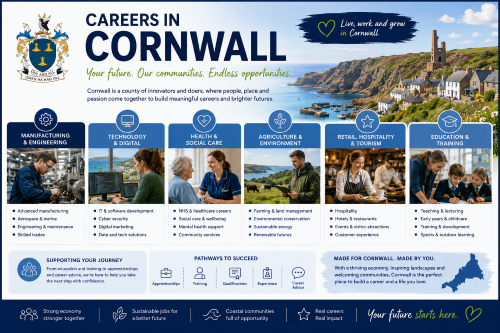
Cornwall has a distinctive employment landscape shaped by tourism, marine activity, agriculture, food production, public services, creative industries, renewable energy, space, minerals, and local enterprise. Cornwall Council’s Good Growth Plan identifies Cornwall’s economic sectors across three groupings: distinctive, core, and foundational. Distinctive sectors include minerals, renewables, space, and marine. Core sectors include the visitor economy, agri-food, and creative and cultural industries.
The county’s economy also reflects its geography. Coastal towns support tourism, hospitality, food, leisure, marine activities, and creative industries, while inland areas support agriculture, construction, logistics, public services, education, health, manufacturing, and small businesses.
Cornwall Council notes that Cornwall has historically important sectors, including tin mining, china clay extraction, fishing, and agriculture. It also highlights Newlyn as the largest fishing port in the UK by value of fish landed, alongside Cornwall’s strong food and drink reputation.
Key Employment Sectors in Cornwall
Minerals, Renewables, Space, and Marine
Cornwall’s distinctive sectors include minerals, renewables, space, and marine. These industries reflect Cornwall’s natural resources, coastal location, engineering heritage, and emerging innovation economy. The Good Growth Plan also identifies infrastructure challenges, including grid constraints, as key factors in unlocking Cornwall’s net-zero potential.
Visitor Economy
Tourism is one of Cornwall’s most visible employment sectors. Hotels, restaurants, cafés, attractions, holiday accommodation, surf schools, galleries, events, visitor services, and outdoor experiences all contribute to local employment. Visit Cornwall describes Cornwall as one of the UK’s best-loved holiday destinations, with beaches, moorland, festivals, culture, food, wildlife, and coastal activity attracting visitors throughout the year.
Agri-Food
Agriculture, fishing, food production, and local hospitality are central to Cornwall’s identity. Cornish produce, seafood, dairy, bakeries, drinks producers, farms, markets, and restaurants contribute to both employment and regional reputation. Cornwall Council specifically recognises agri-food as one of Cornwall’s core sectors.
Creative and Cultural Industries
Cornwall has a strong creative identity, particularly in places such as St Ives, Falmouth, Newlyn, Penzance, and Truro. Cornwall Council highlights the county’s cultural scene, including Tate St Ives, Newlyn School of Art, and the Barbara Hepworth Museum and Sculpture Garden.
Education, Healthcare, and Public Services
Schools, colleges, adult education, local government, healthcare, social care, emergency services, and community support roles provide important year-round employment. Cornwall Council’s schools and education pages show the breadth of education services across the county, while public services remain essential in supporting both residents and visitors.
Local Enterprise and Foundational Services
Cornwall is also home to many small businesses, trades, retailers, construction firms, professional services, transport providers, and community organisations. These foundational sectors support daily life across towns, villages, coastal communities, and rural areas.
Mortgage Brokers in Cornwall: Securing a Home

Cornwall’s property market can be competitive and location-sensitive, especially in coastal areas, rural villages, and popular towns. A mortgage broker in Cornwall can help buyers compare lenders, understand affordability, prepare documents, and choose suitable mortgage options.
Whether you are buying a flat in Newquay, a family home in Truro, a cottage near Wadebridge, a coastal property in St Ives, a terraced home in Penzance, or a rural property near Bodmin Moor, mortgage advice can help you understand how lenders may view the property, your income, deposit, and long-term plans.
Mortgage brokers can support first-time buyers, home movers, remortgage clients, buy-to-let investors, self-employed applicants, contractors, and buyers with complex income. In Cornwall, this can be especially useful where buyers are dealing with seasonal income, hospitality work, self-employment, rural properties, holiday-let considerations, or mixed-use property questions.
With expert support, securing a home in Cornwall can feel clearer and more manageable, allowing buyers to focus on finding the right location and property.
Dining Out: The Best Places to Dine in Cornwall
Cornwall has one of the UK’s most recognisable food scenes, shaped by its coast, farms, fishing heritage, local producers, and visitor economy. Food and drink in Cornwall ranges from beach cafés and traditional pubs to seafood restaurants, farm shops, bakeries, fine dining venues, and relaxed family-friendly places to eat. Visit Cornwall highlights Cornwall’s fresh harbour seafood, Cornish cream teas, local produce, homemade ice cream, Cornish pasties, beachside cafés, country pubs, and award-winning restaurants.
Seafood is a major part of Cornwall’s dining identity. Coastal towns such as Padstow, Newquay, Falmouth, St Ives, Penzance, Looe, and Fowey offer access to fish restaurants, harbour dining, and menus that often reflect the county’s fishing links. Visit Cornwall also notes that Cornwall produces a wide range of high-quality fresh produce from land and sea, helping local restaurants combine traditional Cornish food with modern British cooking.
For a relaxed weekend, Cornwall offers plenty of options. You might choose a cream tea after a coastal walk, a pasty from a local bakery, a pub lunch in a fishing village, or a seafood meal overlooking the water. Newquay’s Dune Restaurant, for example, is listed by Visit Cornwall as a seasonal-led dining space overlooking Fistral Beach, with menus rooted in its ocean-side location and local produce where possible.
Cornwall is also well suited to families and visitors who want flexible dining. Beach cafés, farm cafés, village pubs, market-town restaurants, fish and chip shops, bakeries, and independent coffee shops all contribute to the county’s everyday food culture. This gives residents plenty of choice, whether they live near the coast, in a rural village, or in one of Cornwall’s larger towns.

Exploring Attractions in Cornwall
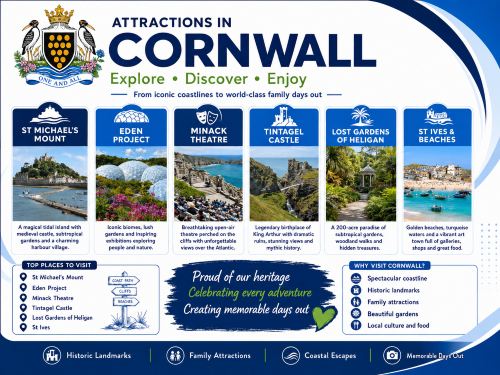
Cornwall offers a wide choice of attractions, from beaches and coastal paths to gardens, heritage sites, theatres, family days out, and historic landscapes. The National Trust describes Cornwall as a place to explore exotic gardens, ancient houses, mining history, and a much-loved coastline.
The coast is one of Cornwall’s strongest attractions. The National Trust highlights large open beaches, hidden coves, coastal walks, far-reaching views, rock pools, wildlife, surfing beaches, and places such as Pentire, Holywell, Chapel Porth, Sandymouth, Port Quin, St Agnes Head, Fowey Estuary, Whitsand Bay, the Roseland, Zennor, the Tin Coast, and the Lizard.
Cornwall is also known for major visitor destinations. The Eden Project, near Bodelva, transformed a former clay mine into a global garden with large covered Biomes, one of the world’s largest indoor rainforests, a Mediterranean Biome, Outdoor Gardens, artworks, performance, storytelling, food, and family activities.
For culture and scenery, the Minack Theatre is one of Cornwall’s most distinctive attractions. It is a cliffside theatre overlooking Porthcurno Bay, with gardens, an exhibition, guided tours, performances, and a café. The venue notes that its dramatic cliffside setting includes steps and uneven surfaces, so visitors should plan ahead before attending.
Cornwall’s mining heritage is another major attraction. The Tin Coast includes mining landscapes and engine houses, while Botallack, Cape Cornwall, Levant Mine and Beam Engine, and other sites form part of Cornwall’s wider historic identity. National Trust guidance describes the Tin Coast as a destination for some of Cornwall’s oldest mines and mining landscapes.
For families, Cornwall offers beaches, gardens, wildlife, harbours, castles, aquariums, farm attractions, boat trips, theatres, museums, cycling trails, and outdoor adventure. This makes the county appealing not only as a place to visit, but also as a place to live for people who want leisure, culture, and nature close to home.
Why Cornwall is the Perfect Place to Call Home
Cornwall offers a rare lifestyle balance. It combines dramatic coastlines, rural landscapes, historic towns, fishing communities, beaches, food culture, creative industries, outdoor activities, and strong local character.
Visit Cornwall describes Cornwall as a place of wild beaches, rolling moors, market towns, fishing villages, art colonies, seal colonies, and fresh food from land and sea. Cornwall Council also highlights world-class attractions including the Eden Project and the Minack Theatre, as well as cultural venues and festivals.
For those who enjoy the outdoors, Cornwall offers coastal walks, surfing, sailing, cycling, wildlife, gardens, moorland routes, heritage sites, and beaches. National Trust guidance highlights Cornwall’s coast and beaches across north, south, and west Cornwall, including the Tin Coast, the Lizard, and areas such as Pentire and Botallack.
Cornwall is also a place of heritage. The Cornwall and West Devon Mining Landscape World Heritage Site covers nearly 20,000 hectares and includes woodland, townscapes, coast paths, clifftops, and mining landscapes.
For families, professionals, retirees, remote workers, creatives, and entrepreneurs, Cornwall offers a lifestyle with character, beauty, and community. However, buyers should think carefully about housing affordability, transport, job location, school access, broadband, and seasonal pressures before choosing where to settle.

People who found this page helpful also explored these related topics:

Mortgage Broker St Ives TR26: Advice by Expert Advice

Truro Mortgage Guide: Clear Advice for Confident Decisions
Make a Smarter Mortgage Move in St Austell

Redruth Mortgage Advice: Confidence Before Commitment

Penzance Mortgage Advice: Strong Choices Start With Questions
Padstow Mortgage Advice: Think Beyond the Interest Rate
FAQ: Why Move to Cornwall
| Question | Answer |
|---|---|
| Why should I consider moving to Cornwall? | Cornwall offers a slower pace of life, stunning coastal scenery, and a strong sense of community. It’s ideal for families, remote workers, and retirees who want to enjoy outdoor living and a relaxed lifestyle. |
| What is the cost of living like in Cornwall? | While property prices vary by town, Cornwall is generally more affordable than southern cities like London or Bristol. Many residents find they can buy larger homes or coastal cottages for the same price as a city apartment. |
| Are there good job opportunities in Cornwall? | Yes — sectors such as tourism, renewable energy, digital technology, and marine industries are growing. Remote and hybrid work options have also expanded opportunities for professionals relocating from urban areas. |
| What is the local lifestyle like? | Life in Cornwall revolves around community, coastal living, and outdoor activities. Surfing, hiking, and local markets are part of daily life, and the region is known for its creative culture and artisan food scene. |
| Is Cornwall suitable for families? | Absolutely. Cornwall has excellent primary and secondary schools, low crime rates, and family-friendly communities. It’s a safe, scenic environment where children can enjoy the outdoors year-round. |
| What’s the transport and connectivity like? | Cornwall is well-connected via the A30, mainline rail services to London, and Newquay Airport. Fibre broadband and 5G are available in most major towns, supporting remote workers and small businesses. |
| How is the property market in Cornwall? | Cornwall’s housing market remains strong, with consistent demand for holiday lets and family homes. Seaside towns such as Falmouth, St Ives, and Newquay are especially popular with buyers seeking coastal living. |
| What are the best places to live in Cornwall? | Popular locations include Truro (for professionals), Falmouth (for students and creatives), and St Ives or Padstow (for coastal living). Each area offers a different mix of community, scenery, and lifestyle. |
| What makes Cornwall different from other UK regions? | Cornwall combines natural beauty with modern convenience. It’s the only county in England with a distinct Celtic heritage and language, giving it a unique identity and strong cultural pride. |
If you are Looking for a Mortgage Network
“Hi, I’m Liz Syms, Chief Executive Officer and founder of Connect Experts, Connect Mortgages, and Connect for Intermediaries.
If you are a UK mortgage broker based in Cornwall, joining our mortgage network can help you increase your visibility to clients actively searching for trusted, FCA-authorised advice. Brokers featured on our Cornwall mortgage brokers page are matched with clients who value clear communication and professional guidance, including those who prefer advice in a specific language.
Our platform is designed to support compliant, client-focused advisers and help you connect with the right audience across Cornwall.”
Choose the option that suits you best:
Option 1: Schedule a call with our Business Recruitment Manager
Option 2: Complete our contact form
Option 3: Call us