Mortgage Rate Change: A change in mortgage rates can alter your monthly payment, total borrowing costs, and future flexibility.
It often happens when a fixed, discounted or introductory mortgage period ends. Your mortgage may then move to the follow-on rate stated in your agreement. This is often a standard variable rate, although mortgage terms differ.
You may also be able to choose a new product with your current lender or remortgage with another lender.
The lowest advertised rate is not automatically the lowest-cost choice. Product fees, early repayment charges, mortgage balance and term can change the result.
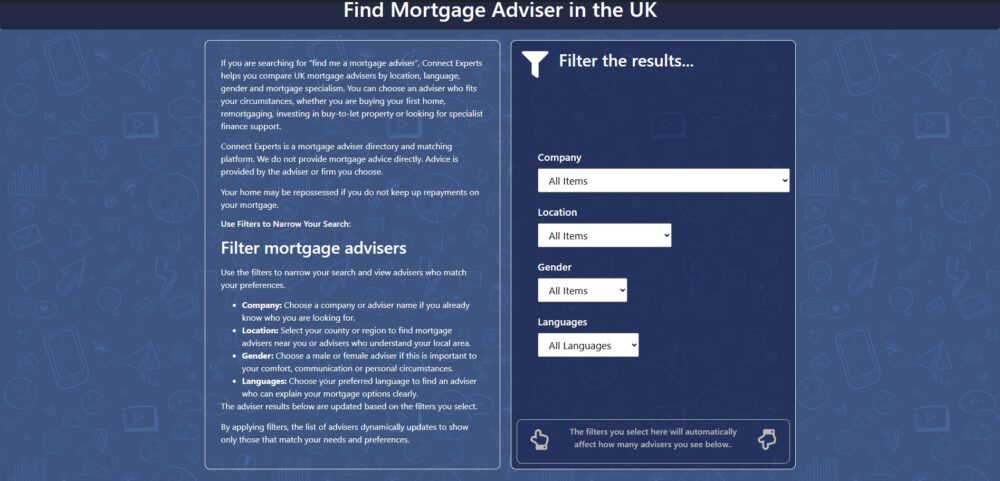
Connect Experts helps you find mortgage advisers who can review your circumstances and explain the available routes. Connect Experts is a directory and matching platform. It does not provide mortgage advice directly.
Find mortgage rate ending advisers
- Check the date your current mortgage deal ends.
- Confirm the rate that applies afterwards.
- Review your options several months before that date.
- Compare total cost rather than the interest rate alone.
- Check product fees, early repayment charges and valuation costs.
- Consider both your present lender and other lenders.
- Prepare updated income, expenditure and property information.
- Use Connect Experts to find an adviser with relevant remortgage experience.
What Is a Mortgage Rate Change?
A mortgage rate change occurs when the interest rate charged under your mortgage alters.
This can happen because:
- A fixed-rate period ends.
- A discounted-rate period finishes.
- A tracker rate changes with its reference rate.
- A variable-rate lender changes its rate.
- You transfer to another product.
- You remortgage to another lender.
A fixed-rate mortgage typically maintains the same interest rate for the agreed fixed period. Changes in wider market rates do not usually alter that fixed payment.
However, the mortgage contract states what happens when the fixed period ends. The follow-on rate may be higher or lower than the previous rate.
What Happens When a Fixed Mortgage Rate Ends?
If you take no action, your mortgage will normally move to the follow-on rate stated in your mortgage agreement.
Many lenders call this their standard variable rate. However, names and calculation methods differ.
Your monthly payment could rise when:
- The follow-on rate exceeds your current fixed rate.
- Your remaining mortgage balance is substantial.
- You have many years remaining on the term.
- The mortgage is on a repayment basis.
- You have more than one mortgage account or product part.
A higher payment is not the only consideration. A variable rate may offer greater flexibility or fewer early repayment restrictions.
The correct comparison depends on the whole mortgage structure.
When Should You Review an Ending Mortgage Deal?
Begin by finding the exact end date shown in your mortgage offer or latest statement.
It is sensible to start gathering information several months beforehand. This creates time to:
- Request a redemption or balance statement.
- Check your current lender’s available products.
- Review deals from other lenders.
- Confirm any early repayment charge.
- Prepare income and expenditure documents.
- Resolve errors in your credit information.
- Consider planned changes to your property or finances.
Customers of lenders participating in the Mortgage Charter may be able to secure a replacement deal up to six months before a fixed rate ends. Lender conditions still apply.
Starting early does not mean choosing immediately. It creates time for comparison.
What Are Your Main Options?
Stay on the Follow-On Rate
You could allow the existing mortgage to move onto its contractual follow-on rate.
This might offer flexibility. However, the rate can change and may be higher than available alternatives.
Check:
- The new interest rate.
- The estimated monthly payment.
- Whether the rate can change.
- Overpayment rules.
- Whether an early repayment charge applies.
- How long you expect to remain on that rate.
Complete a Product Transfer
A product transfer means moving to another mortgage product with your present lender.
It may involve less administration than changing lenders. Some transfers do not require a full property valuation or legal process.
However, the product should still be compared carefully. Remaining with the same lender does not prove that it offers the most suitable overall arrangement.
Consider:
- The new rate.
- Product fees.
- Incentives.
- Early repayment charges.
- Overpayment limits.
- The fixed or variable period.
- Whether you need to change the loan amount or term.
Remortgage to Another Lender
A remortgage replaces the existing mortgage with a new mortgage, usually from another lender.
This may provide a different rate, term or product structure. It may also require:
- An affordability assessment.
- Credit checks.
- Income evidence.
- A property valuation.
- Conveyancing work.
- Repayment of the existing mortgage.
- Payment of product or legal fees.
A new lender will assess the application under its current criteria. Previous acceptance does not guarantee future approval.
You can search for remortgage mortgage brokers through Connect Experts.
Product Transfer or Remortgage: What Is the Difference?
| Point to compare | Product transfer | Remortgage |
|---|---|---|
| Lender | Existing lender | Usually a new lender |
| Affordability review | May be limited in some cases | Usually required |
| Property valuation | May not be required | Often required |
| Legal work | Usually limited | Often required |
| Product range | Existing lender’s products | Products available through the new lender |
| Borrowing changes | May be restricted | Can sometimes include term or loan changes |
| Completion process | Often simpler | Usually involves more stages |
| Costs | Check product fees | Check product, legal, valuation and exit costs |
Neither route is automatically better. The outcome depends on cost, eligibility and your future plans.
Why the Lowest Mortgage Rate May Not Be the Cheapest
An interest rate is only one part of a mortgage product.
For example, a low-rate product may carry a substantial fee. That fee can reduce or remove the apparent saving, particularly on a smaller mortgage balance.
Compare:
- Monthly payments.
- Product fees.
- Valuation fees.
- Legal costs.
- Exit charges.
- Early repayment charges.
- Cashback or other incentives.
- Total cost during the product period.
- Remaining balance at the end of that period.
Also check whether a fee will be paid in cash or added to the mortgage. A fee added to the loan may attract interest.
The important question is not simply, “Which rate is lowest?”
It is, “Which suitable arrangement creates the right cost, risk and flexibility for these circumstances?”
How Loan-to-Value Can Affect Your Options
Loan-to-value compares the mortgage balance with the property’s assessed value.
For example, a £180,000 mortgage on a £300,000 property represents 60% loan-to-value.
A lower loan-to-value can sometimes provide access to a wider product range. However, lender thresholds and valuation methods differ.
Before relying on an estimated property value, remember:
- Online estimates are not formal valuations.
- Local sale prices can change.
- Property condition may affect value.
- A lender may use an automated or physical valuation.
- Different lenders may reach different valuation figures.
Paying down the balance before switching could alter the loan-to-value band. Any overpayment must remain within the existing mortgage conditions.
What Information Will an Adviser Need?
An adviser will normally need enough information to understand your mortgage, finances and future plans.
Prepare:
- Your latest mortgage statement.
- The current balance.
- The deal-end date.
- The follow-on rate.
- Details of early repayment charges.
- Recent payslips or accounts.
- Bank statements where requested.
- Details of loans, credit cards and other commitments.
- An estimate of the property value.
- Your preferred mortgage term.
- Details of planned borrowing changes.
- Information about expected income changes.
For a buy-to-let mortgage, the adviser may also require tenancy, rental and property information.
Company directors, contractors and sole traders may need an adviser who understands how lenders assess business income. Connect Experts lets users search for self-employed mortgage brokers.
Changes That Can Affect a New Application
Your circumstances may have changed since the existing mortgage began.
A new lender may consider:
- Reduced or increased income.
- A change of employment.
- Self-employment.
- Maternity or parental leave.
- New credit commitments.
- Missed or late payments.
- Changes in household expenditure.
- Dependants.
- Property alterations.
- Lease length.
- Construction type.
- Planned retirement.
- A request for additional borrowing.
Tell the adviser about relevant changes before an application is submitted.
A declined application can delay the process. Understanding the case first helps reduce unsuitable lender approaches.
Should You Wait for Mortgage Rates to Fall?
Future mortgage pricing cannot be predicted with certainty.
Waiting could result in a lower available rate. It could also leave less time to complete an application before the existing deal ends.
Rather than basing the decision on a forecast alone, compare:
- The present options.
- The cost of the follow-on rate.
- Application and completion times.
- Whether a selected product can be changed before completion.
- Whether any fee is refundable.
- Your tolerance for payment changes.
- Your expected time in the property.
A mortgage decision concerns more than tomorrow’s interest rate. It also concerns the cost of delay, the value of certainty and the consequences of being unprepared.
How to Find an Adviser for a Mortgage Rate Review
Look for an adviser whose experience reflects the mortgage you need to review.
Before proceeding, ask:
- Does the adviser regularly handle remortgages?
- What lender range can the adviser consider?
- Will the adviser compare a product transfer with a remortgage?
- What fees could become payable?
- When are those fees payable?
- How will the adviser communicate with you?
- Who provides the regulated mortgage advice?
- How can the firm’s regulatory status be checked?
Use the FCA Firm Checker to check the firm’s regulatory information.
Connect Experts allows users to compare advisers by mortgage expertise, location, language and gender. You can also find a mortgage adviser by location.
Connect Experts does not choose a mortgage product for you. The adviser or firm you select assesses your circumstances and provides any regulated advice.
Questions to Ask Before Accepting a New Mortgage Product
Ask the adviser to explain:
- Why the recommended product suits your circumstances.
- The initial monthly payment.
- The total cost during the initial product period.
- The product fee and how it will be paid.
- The interest rate after the product ends.
- Early repayment charges.
- Overpayment allowances.
- Portability rules.
- Whether the mortgage term is changing.
- Whether fees are refundable.
- What happens if completion is delayed.
- Whether another suitable rate can be requested before completion.
The explanation should connect the recommendation to your circumstances.
What If the New Payment Is Unaffordable?
Contact your lender as early as possible if you believe you may struggle with mortgage payments.
Do not wait until a payment is missed before starting the conversation.
Depending on the circumstances, the lender may discuss available support. Any change can have costs and longer-term effects, so ask for a clear explanation.
Independent information about mortgage switching and payment difficulties is available through MoneyHelper’s remortgaging guidance.
Frequently Asked Questions
What happens when my fixed mortgage rate ends?
Your mortgage normally moves to the follow-on rate stated in your agreement unless another product completes. This may be your lender’s standard variable rate or another reversion rate.
How early should I review my mortgage?
Start gathering information several months before the deal ends. Some lenders permit customers to reserve a replacement product up to six months beforehand. Conditions vary.
Is a product transfer the same as a remortgage?
No. A product transfer changes the product with your current lender. A remortgage normally replaces the mortgage with borrowing from another lender.
Will I need another affordability assessment?
A new lender will normally complete an affordability assessment. The process for an existing-lender product transfer can differ. It may also depend on whether the loan, term or repayment basis changes.
Can I change products after reserving a mortgage rate?
Some lenders may permit a change before completion when another qualifying product becomes available. Rules, fees and deadlines differ. Check before committing.
Should I choose the mortgage with the lowest rate?
Not necessarily. Compare fees, incentives, early repayment charges, mortgage balance and total cost during the product period.
Can I remain with my current lender?
Possibly. Your lender may offer a product transfer. Compare its costs and conditions with other suitable routes before deciding.
Does Connect Experts provide mortgage advice?
No. Connect Experts is a mortgage adviser directory and matching platform. Any mortgage advice is provided by the adviser or firm you select.
How can I check whether a mortgage firm is authorised?
Use the FCA Firm Checker and confirm that the firm’s details and permissions match the service offered.
Can I search for an adviser near me?
Yes. Connect Experts lets you search by town, city, county or postcode. You can also compare expertise, language, gender and appointment preferences.
Find a Mortgage Adviser Before Your Rate Changes
A mortgage rate ending creates a decision point.
You can accept the contractual follow-on rate, request another product from your existing lender or investigate a remortgage. Each option has different costs, checks and conditions.
Connect Experts helps you find mortgage advisers with experience relevant to your mortgage needs.
Search by:
- Mortgage expertise.
- Location.
- Adviser language.
- Adviser gender.
- Company or adviser name.
- Online, telephone or face-to-face preferences.
Connect Experts is a directory and matching platform. Mortgage advice is provided by the adviser or firm you choose.
Find a Mortgage Rate Ending Adviser