Check an Equity Release Adviser: An equity release adviser should hold the appropriate regulatory permissions and have an understanding of later-life lending.
Before making contact, check the adviser’s firm, regulatory status, specialist knowledge, fees and available appointment methods.
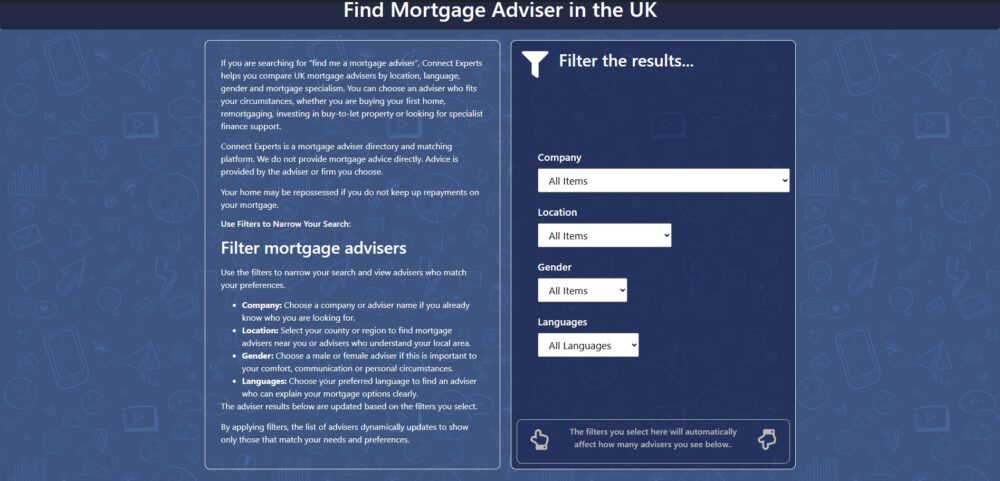
The Connect Experts equity release mortgage adviser directory lets you review adviser profiles before deciding who to approach.
An adviser search should begin with evidence
Equity release may affect the future value of your estate, your benefit entitlement, and your housing choices.
Therefore, choosing an adviser should involve more than finding the nearest name.
A directory can organise the search. However, each customer must still assess whether an adviser fits their circumstances.
Connect Experts helps users search for advisers. It does not provide equity release advice directly.
Advice is provided by the adviser or firm selected by the user.
Check whether the firm is regulated
Start by checking the adviser or firm through the Financial Conduct Authority.
The register can show:
- The firm’s regulatory status
- Its registered trading names
- Its contact details
- Its permitted activities
- Whether any restrictions apply
- Details of appointed representatives
A firm appearing on the register does not mean every employee holds every specialist permission.
Therefore, confirm that the adviser can provide advice covering the type of equity release being considered.
MoneyHelper also recommends checking an adviser through the FCA before proceeding with a lifetime mortgage enquiry.
Ask about specialist equity release knowledge
Standard residential mortgage knowledge does not automatically cover every later-life lending issue.
An equity release adviser may need to consider:
- Lifetime mortgages
- Home reversion plans
- Retirement interest-only mortgages
- Existing mortgage repayment
- Downsizing
- Future care requirements
- Means-tested benefits
- Estate and inheritance objectives
- Property eligibility
- Early repayment charges
The FCA’s equity release rules require suitable advice based on the customer’s circumstances.
They also require advisers to consider suitable alternatives and possible effects on benefits or tax.
Ask how frequently the adviser handles equity release enquiries. Also ask which later-life lending areas they regularly assess.
Understand the role of Equity Release Council membership
The Equity Release Council is an industry body rather than the statutory regulator.
Its standards include product safeguards and professional expectations for members.
Products meeting its standards must include a no negative equity guarantee. Subject to the plan’s conditions, an estate should not owe more than the property’s eventual value.
Council membership may be useful information when comparing advisers. However, it should not replace checking FCA status and permissions.
Ask whether:
- The adviser is a Council member
- The recommended provider follows Council standards
- The proposed plan includes a no negative equity guarantee
- Voluntary repayments are available
- The plan may be moved to another suitable property
- Independent legal advice will form part of the process
Do not assume membership from a general statement. Check the individual or firm where possible.
Review the adviser’s directory profile
A useful adviser profile should help users understand who they may be contacting.
Look for:
- Adviser location
- Areas covered
- Later-life lending experience
- Languages spoken
- Appointment methods
- Professional qualifications
- Firm name
- Regulatory information
- Contact details
- Relevant customer feedback
Users can also search the wider mortgage broker directory when they want to compare other mortgage specialisms.
Profile information supports comparison. It does not replace a suitability assessment.
Ask how the adviser searches the market
Not every adviser works with the same lenders or products.
Ask the adviser:
- Which providers can you consider?
- Are any providers excluded?
- Do you work from a limited panel?
- Can you advise on home reversion plans?
- Can you assess retirement interest-only mortgages?
- How will you compare alternatives?
- How are you paid?
The answers help define the service before detailed personal information is shared.
A larger panel does not automatically produce suitable advice. Suitability depends on how well the recommendation fits the customer’s needs.
Check fees before committing
Possible costs can include:
- Adviser fees
- Provider arrangement fees
- Valuation fees
- Legal fees
- Completion fees
- Early repayment charges
- Interest added during the plan
Some costs may be payable immediately. Others may be added to the mortgage balance.
Request a written explanation covering:
- The amount charged
- When payment becomes due
- Whether the fee is refundable
- Whether commission may also be received
- What happens if the application does not complete
The cheapest initial fee should not be assessed in isolation.
A lower fee could sit beside a more expensive long-term product. Equally, a higher fee does not prove better advice.
Look for evidence of a careful process
A responsible first conversation should explore the customer’s goals before discussing a product.
The adviser may ask about:
- The reason money is required
- The amount needed
- Current income and expenditure
- Existing mortgages or debts
- Savings and investments
- Pension income
- State benefit entitlement
- Health and future care
- Moving plans
- Family or inheritance objectives
- Property condition and value
The process may feel detailed. That detail is necessary because the decision may last for the customer’s lifetime.
The FCA has previously raised concerns about unsuitable later-life mortgage advice and unclear promotions.
Warning signs to consider
Pause before proceeding when:
- Regulation cannot be verified
- Costs are not explained clearly
- The discussion immediately centres on a maximum release
- Alternatives are dismissed without assessment
- Benefit entitlement is ignored
- Family involvement is discouraged without reason
- Risks are presented only after a recommendation
- The adviser creates unnecessary urgency
- Future moving or care plans are not discussed
An adviser should not promise that equity release will be appropriate before completing an assessment.
Frequently asked questions
Does an equity release adviser need FCA authorisation?
The firm providing regulated equity release advice should hold the relevant FCA status and permissions.
Check the firm using the Financial Services Register before proceeding.
Is Equity Release Council membership the same as FCA regulation?
No. The FCA is the statutory regulator.
The Equity Release Council is an industry body that sets standards for its members.
Should I use the nearest adviser?
Location may help with face-to-face meetings. However, permissions, experience, communication and service scope may be more important.
Can Connect Experts tell me which adviser to choose?
Connect Experts helps users search and compare adviser profiles.
The user decides who to contact. Mortgage advice comes from the selected adviser or firm.
Should an adviser discuss alternatives?
Yes. A suitable assessment should consider relevant alternatives instead of assuming equity release is the correct answer.
How Connect Experts supports the search
Connect Experts is a directory and matching platform.
Users can compare available profiles and select who they want to contact.
The directory does not decide whether equity release is suitable. It also does not provide the final product recommendation.
To begin, view the equity release mortgage advisers shown in the directory.