Yiddish & German Mortgage Broker in London: Finding mortgage advice in a familiar language can make a complex financial decision easier to understand.
Connect Experts helps users find mortgage advisers who may offer support in Yiddish or German across Greater London.
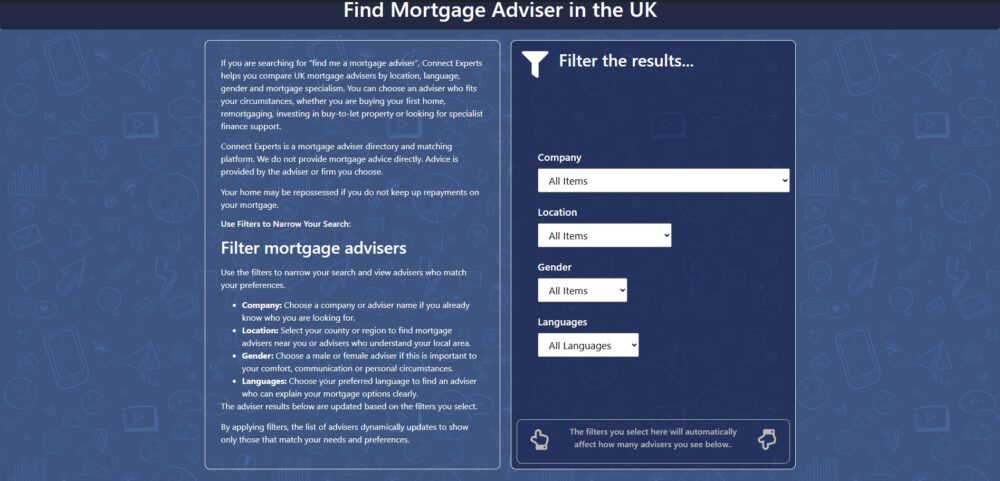
You can search by language, location and mortgage type. You can then choose an adviser whose experience suits your circumstances.
Connect Experts is a mortgage adviser directory and matching platform. It does not provide mortgage advice directly.
Mortgage advice is provided by the adviser or firm you select.
Find a Yiddish or German-Speaking Mortgage Adviser
At a Glance
A Yiddish or German-speaking mortgage broker in London can explain mortgage terms, lender requirements and application stages in your preferred language.
The adviser may assist with residential, remortgage, buy-to-let, bridging, commercial or high-value property finance.
Speaking another language does not change lender criteria. However, it may improve communication when reviewing costs, risks and supporting documents.
Use Connect Experts to compare advisers by language, location and mortgage type.
Mortgage Advice in Yiddish or German
Mortgage agreements contain technical terms that can affect both monthly costs and long-term financial plans.
Language support may help when discussing:
- Fixed, tracker and variable interest rates
- Repayment and interest-only mortgages
- Deposits and loan-to-value calculations
- Lender arrangement and valuation fees
- Early repayment charges
- Affordability assessments
- Mortgage terms and repayment periods
- Property surveys and legal work
- Buy-to-let rental calculations
- Bridging loan exit strategies
The mortgage offer, legal contract and regulated documents will normally remain in English.
Therefore, applicants should still review all formal documents carefully before proceeding.
A multilingual adviser can explain mortgage terminology. However, independent legal or tax advice may still be required.
The FCA’s guidance places importance on communication and support that respond to individual customer needs. Read the FCA’s guidance on treating vulnerable customers fairly.
How London Mortgage Applications Are Assessed
A London mortgage application is assessed using the borrower’s finances, the property and the proposed loan structure.
Higher property values do not automatically produce higher borrowing limits. The lender must still consider affordability and risk.
| Assessment area | What a lender may review |
|---|---|
| Income | Salary, bonuses, commission, dividends, profits or rental income |
| Employment | Employment history, contract type and probation periods |
| Self-employment | Accounts, tax calculations, business performance and retained profits |
| Deposit | Deposit amount, source of funds and gifted deposit evidence |
| Credit profile | Existing borrowing, missed payments and financial commitments |
| Property | Value, construction, condition, lease length and intended use |
| Monthly costs | Loans, credit cards, childcare, maintenance and regular expenditure |
| Loan structure | Repayment method, mortgage term and requested loan-to-value |
| Residency | UK status, overseas residence and address history |
| Currency | Currency used for earnings, assets and mortgage repayments |
Each lender applies its own criteria. An adviser can identify which lenders may consider the full circumstances before an application is submitted.
Residential Mortgages in London
Residential mortgages are used to buy or refinance a property that will be your main home.
Common requirements include:
- Buying a first home
- Moving to another London property
- Remortgaging an existing home
- Raising money against available equity
- Buying a leasehold flat
- Purchasing a property with unusual construction
- Applying with complex or variable income
London applications can involve high property values, service charges and shorter leases.
Flats above commercial premises may also require more detailed lender assessment.
Before applying, an adviser may review your affordability, deposit, credit history and proposed property type.
People seeking wider local coverage can also search for a mortgage adviser in London.
Mortgages for Self-Employed Applicants
Self-employed borrowers are not assessed through one universal calculation.
A lender may consider:
- Sole trader net profit
- Partnership income
- Salary and dividends
- Limited company net profit
- Retained profit
- Recent trading performance
- Contractor day rates
- Tax calculations and tax year overviews
- Business bank statements
- Accountant-prepared accounts
Some lenders use the latest year’s figures. Others may average two or three years.
A reduction in profit may require an explanation. Recent business growth may not always be accepted immediately.
Preparing the documents early can reveal potential problems before a property purchase reaches a critical stage.
Buy-to-Let and Portfolio Finance
London landlords may use buy-to-let finance for individual properties, limited companies or larger portfolios.
Lenders usually assess the expected rent against a stressed mortgage payment.
They may also examine:
- The borrower’s personal income
- Existing rental properties
- Portfolio borrowing
- Property condition
- Tenant type
- Licensing requirements
- Ownership structure
- Landlord experience
- Service charges
- Lease restrictions
Houses in multiple occupation can require planning, licensing and specialist valuation evidence.
Limited company applications may also involve personal guarantees from directors.
Borrowers purchasing a property that needs work may require short-term financing before securing a standard mortgage. The buy-to-let bridging loan guide explains how this structure may work.
Tax treatment depends on individual circumstances. Applicants should obtain suitable tax advice before selecting an ownership structure.
High-Value and Complex London Mortgages
London property finance may involve larger mortgages, multiple income sources or substantial assets.
A large loan is not assessed using price alone. The lender will consider the borrower’s full financial position.
Complex cases may include:
- Borrowing above £1 million
- Prime London property
- Business ownership
- Significant bonus income
- Investment income
- Overseas assets
- Foreign currency earnings
- Interest-only borrowing
- Several mortgaged properties
- Trust or family wealth structures
- Refinancing and capital raising
Some applications may be considered by specialist lender teams or private banks.
The appropriate route depends on income, assets, liabilities and the proposed repayment strategy.
Clients with substantial or complex financial needs can search for high-net-worth mortgage brokers.
Overseas Income and International Applicants
London attracts buyers whose income or assets are held outside the UK.
Applications involving overseas income may require:
- Foreign payslips
- Overseas bank statements
- Tax records
- Employment contracts
- Certified translations
- Evidence of residency
- Currency conversion
- Deposit transfer records
- Source of wealth evidence
- UK credit information
Currency movements can affect affordability. Some lenders may apply a reduction to foreign earnings before calculating borrowing.
Applicants should also allow time for identity checks and source-of-funds verification.
A Yiddish or German-speaking adviser can explain the mortgage process. However, translated documents may still require certification.
Bridging and Short-Term Property Finance
Bridging finance is a short-term loan secured against property.
It may be considered for:
- Auction purchases
- Chain breaks
- Properties needing refurbishment
- Time-sensitive completions
- Buying before another property sells
- Lease extensions
- Development preparation
- Refinancing an existing bridge
The lender will normally require a credible exit strategy.
Possible exits include selling the property, refinancing onto a mortgage or receiving funds from another verified source.
Bridging finance can cost more than a standard mortgage. Interest, legal costs, valuation fees and arrangement charges should be assessed together.
The repayment plan should be realistic before any borrowing begins.
Later-Life Mortgage and Equity Release Support
Older homeowners may want to review retirement interest-only mortgages, standard residential borrowing or equity release.
These products are not interchangeable.
Eligibility may depend on:
- Age
- Income
- Property value
- Existing mortgage balance
- Health
- Estate planning
- Future housing plans
- Intended use of the money
Equity release can reduce the value of an estate. It may also affect means-tested benefits.
London homeowners seeking specialist later-life guidance can read about Equity Release Advisers in London.
Equity release requires specialist regulated advice.
Documents to Prepare
Preparing documents before speaking with an adviser can reduce avoidable delays.
You may need:
- Passport or identity document
- Proof of address
- Recent payslips
- Bank statements
- P60
- Accounts
- Tax calculations
- Tax year overviews
- Evidence of deposit
- Gifted deposit letter
- Existing mortgage statement
- Credit commitment details
- Property portfolio schedule
- Tenancy agreements
- Company documents
- Evidence supporting overseas income
The required evidence depends on the lender and mortgage type.
Do not submit altered or incomplete documents. Lenders may verify information through several independent sources.
How to Find a Yiddish or German-Speaking Adviser
Step 1: Select your language
Choose Yiddish or German as your preferred communication language.
Step 2: Confirm your location
Enter London or the relevant Greater London district.
Step 3: Select your mortgage requirement
Choose residential, remortgage, buy-to-let, bridging, commercial or another relevant service.
Step 4: Review adviser information
Check the adviser’s language, location, mortgage permissions and specialist areas.
Step 5: Verify the firm
Check the adviser or firm through the Financial Services Register before proceeding.
Step 6: Discuss fees and communication
Confirm how advice will be provided. Ask whether any broker fee will apply.
Users can also search the wider mortgage broker by language directory.
Questions to Ask Before Choosing an Adviser
Consider asking:
- Do you provide mortgage discussions in Yiddish or German?
- Can you explain formal English documents in my preferred language?
- Which mortgage types do you advise on?
- Do you work with self-employed or company-director income?
- Can you review overseas earnings?
- Do you handle high-value London property?
- What broker fee may apply?
- How are you paid by lenders?
- Will advice be provided online, by telephone or face to face?
- Which documents should I prepare?
Clear questions establish whether the adviser’s service matches your circumstances.
FAQs: Yiddish and German Mortgage Broker in London
Can I complete the whole mortgage process in Yiddish or German?
Advice discussions may be available in Yiddish or German. Formal lender and legal documents will usually be written in English.
Does speaking Yiddish or German affect mortgage eligibility?
No. Lenders assess affordability, credit history, income, deposit and property risk. Language support helps applicants understand the process.
Can a multilingual adviser help with translated documents?
An adviser can explain which documents are required. A lender may request translations completed or certified by an accepted translator.
Can I apply using overseas income?
Some lenders consider overseas earnings. They may assess the currency, country, employment, tax position and supporting evidence.
Can a Yiddish or German-speaking adviser help with buy-to-let?
Potentially. Check that the adviser has suitable buy-to-let experience and the relevant permissions before requesting advice.
Are London mortgage applications harder?
Not necessarily. However, higher prices, leasehold properties, service charges and complex income can increase the assessment required.
Can an adviser help with a mortgage above £1 million?
Some advisers specialise in larger mortgages, private banks and complex income. Check their stated experience before making contact.
Does Connect Experts provide mortgage advice?
No. Connect Experts is a directory and matching platform. Advice is provided by the selected adviser or firm.
Find Mortgage Advice in Your Preferred Language
Search Connect Experts for mortgage advisers covering Greater London who may provide support in Yiddish or German.
Compare advisers by location, language and mortgage type before deciding who to contact.