How Social Media Helps You Find a Mortgage Adviser: Social media can introduce people to mortgage topics, advisers, and services. However, visibility alone does not prove expertise, regulatory status or suitability.
Effective social media marketing should help people understand a subject before taking the next step. The Connect Experts mortgage broker directory then provides a structured way to search and compare UK mortgage advisers.
At a Glance
Social media can help you discover mortgage advisers and learn about different mortgage needs. However, posts, followers and video views should not determine your final choice.
Check the adviser’s identity, firm, regulatory position, mortgage experience, fees and service options. You can then use Connect Experts to compare advisers by location, expertise, language and other relevant factors.
What Is Social Media Marketing for Mortgage Advisers?
Social media marketing is the publication and distribution of mortgage-related content on social media platforms.
Content may include:
- Explanations of mortgage processes
- Answers to common borrower questions
- Property and lending updates
- Short educational videos
- Information about adviser services
- Links to longer mortgage guides
- Invitations to arrange an initial discussion
Its purpose should extend beyond attracting attention. Good mortgage content helps people recognise their needs and understand what information may be required.
A useful post creates clarity. A poor post creates urgency without enough explanation.
Why Social Media Influences Adviser Discovery
People often begin researching a mortgage before contacting an adviser. They may search for information about deposits, affordability, remortgaging or specialist lending.
Social platforms can surface relevant content to people during this research stage. A post may introduce a mortgage term, answer an early question or highlight a situation requiring specialist support.
UK adults spent an average of four hours and 30 minutes online each day during May 2025. This included personal use across smartphones, tablets and computers. The figure illustrates why online content plays an important role in financial research. However, time spent online does not make every source reliable.
Social media should therefore be treated as a point of discovery, not proof of suitability.
How Social Media Can Support Your Mortgage Research
It can help define your mortgage need
A useful post may help you recognise that your circumstances require particular experience.
For example, you may need support with:
- Buying your first home
- Moving to another property
- Reviewing an existing mortgage
- Self-employed income
- Adverse credit
- Buy-to-let borrowing
- Commercial property finance
- Bridging finance
- Expat or overseas income
- Sharia-compliant property finance
Once the need is clearer, you can search for an adviser with relevant permissions and experience.
It can explain unfamiliar mortgage language
Mortgage terminology can make early research difficult. Short videos, diagrams and plain-English posts may explain terms before a formal conversation.
Useful content should explain both the opportunity and the limitation. A post about affordability should not imply that one calculation guarantees acceptance.
It can show how an adviser communicates
Social content may indicate whether an adviser explains subjects clearly. It may also show which mortgage areas they discuss most frequently.
However, communication style should be considered alongside formal checks. A confident presenter is not automatically the most suitable adviser.
It can direct you towards detailed information
A social post rarely has enough space for complete mortgage guidance. Responsible content should link to fuller explanations where appropriate.
The next step may be a detailed guide, a regulatory source or a directory profile.
Which Social Platforms Are Used for Mortgage Content?
Different platforms support different forms of communication. No platform independently proves adviser quality.
LinkedIn often contains professional commentary, industry updates and business-related mortgage content.
It may be useful for people researching commercial finance, property investment or company-director income. However, professional presentation should still be checked against regulatory information.
Facebook supports local groups, longer posts, videos and community discussions.
It may help people discover advisers serving a particular area. Recommendations within groups can be useful starting points, but personal experiences do not guarantee identical results.
Instagram is commonly used for visual explanations, short videos and question-based content.
Mortgage information can be simplified effectively through graphics. Yet important qualifications should not disappear because a visual format has limited space.
YouTube
YouTube supports longer explanations of mortgage processes and borrowing situations.
A detailed video may reveal how clearly a subject is explained. Publication dates should be checked because lending criteria and market conditions can change.
TikTok and short-form video
Short-form video can introduce a subject quickly. It can also remove important context.
Treat absolute claims, guaranteed outcomes and extreme urgency with caution. Mortgage eligibility depends on individual circumstances and lender criteria.
How to Assess Mortgage Content on Social Media
Check whether the information is balanced
Good content explains relevant conditions, risks and limitations.
Be cautious when a post:
- Promises guaranteed acceptance
- Suggests one option suits everyone
- Focuses only on a low headline rate
- Omits fees or eligibility conditions
- Uses pressure without factual explanation
- Presents forecasts as certainty
- Encourages action before proper assessment
A mortgage is a long-term financial commitment. The quality of a message matters more than its popularity.
Look for a clear identity
A mortgage-related account should clearly state who is communicating.
Check for:
- The adviser’s full name
- The firm’s name
- A professional website
- Contact information
- Regulatory wording where required
- A consistent identity across platforms
Anonymous or unclear accounts provide fewer ways to verify the information.
Distinguish education from personal advice
General posts explain broad mortgage principles. They do not normally account for your full circumstances.
Personal mortgage advice requires information about matters such as income, expenditure, credit commitments, deposit, property and future plans.
A useful social post may help you prepare questions. It should not replace a regulated suitability assessment.
Check when the content was published
Mortgage rates, lending criteria and regulations can change.
A post may remain useful for explaining a general process. However, numerical claims and market statements require a visible publication date and current context.
Mortgage Social Media and FCA Standards
Mortgage promotions on social media may fall within UK financial promotion rules.
The Financial Conduct Authority states that financial promotion requirements are technology-neutral. This means the rules can apply across posts, videos, stories and other social formats.
Promotions should remain fair, clear and not misleading. Important information should be presented prominently enough for the audience and format.
Read the FCA’s guidance on financial promotions through social media for the regulatory position.
Consumers should not assume that a disclaimer corrects an otherwise misleading headline. The whole communication must provide a balanced impression.
How to Verify an Adviser Found Through Social Media
Discovery and verification are different stages.
Use the following process before deciding who to contact.
1. Identify your mortgage requirement
Decide whether you need general residential support or a more specialist service.
This prevents you from choosing someone based only on popularity.
2. Confirm the adviser and firm details
Check that the name, company and contact information remain consistent.
Look for a real business address, website and privacy information.
3. Review the adviser’s regulatory position
Check the firm and relevant permissions through official regulatory information.
Some forms of buy-to-let and commercial finance may not be regulated by the FCA. The adviser should explain the position that applies to your case.
4. Compare relevant experience
An adviser who mainly discusses first-time buyers may not have the right experience for complex commercial finance.
Look for evidence that the adviser regularly handles circumstances comparable to yours.
5. Ask about fees and service
Before proceeding, ask:
- Whether an adviser fee applies
- When any fee becomes payable
- What service the fee covers
- How meetings are conducted
- Which documents may be required
- Whether the adviser provides ongoing support
Clear commercial information supports a better comparison.
6. Search through an established directory
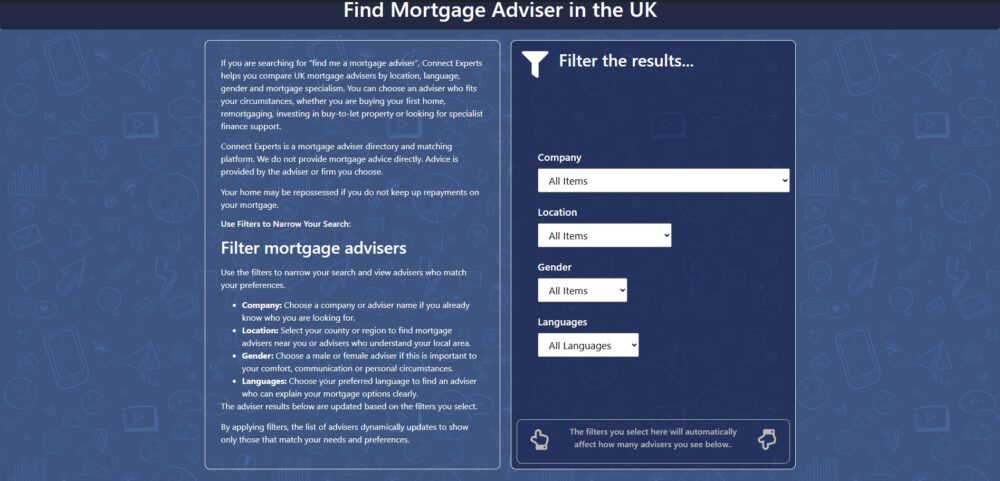
Use the Find a Mortgage Adviser Near You service to compare advisers using practical criteria.
A directory search can help you move beyond a single social account. You can consider location, mortgage expertise, language and appointment preferences.
Using the Connect Experts Directory
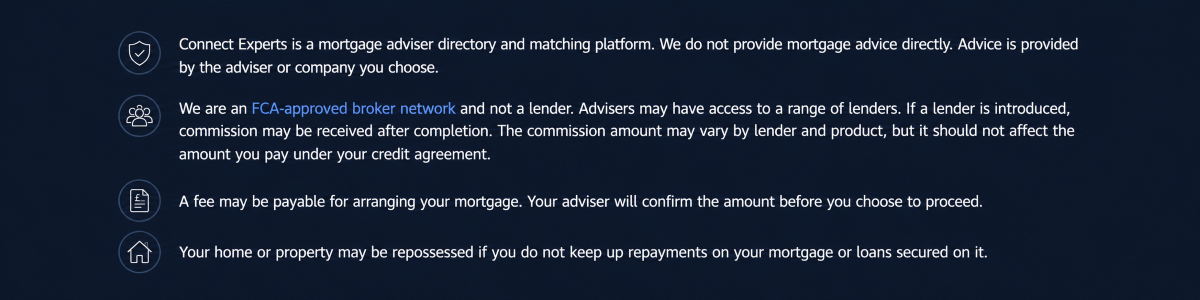
Connect Experts is a directory and matching platform. It does not provide mortgage advice directly.
Advice is provided by the adviser or firm you select.
You can use the directory to search by:
- Town, city, county or postcode
- Mortgage type
- Adviser expertise
- Language
- Gender
- Adviser or company name
Begin with the factor most important to your circumstances. Then review each available profile before making contact.
For a location-led search, use the mortgage adviser location directory.
For a broader alphabetical search, visit the A–Z mortgage broker directory.
Social Proof: Useful Evidence or Marketing Signal?
Reviews, testimonials and engagement can provide context. They should not be treated as complete evidence.
A review may describe communication, responsiveness or service. It cannot confirm that the same outcome will apply to another borrower.
Consider:
- Whether reviews appear recent
- Whether they contain specific service details
- Whether the reviewer platform explains its process
- Whether positive claims appear realistic
- Whether criticism receives a professional response
Follower counts and video views measure attention. They do not measure mortgage suitability.
Trust should be assembled from several facts rather than borrowed from one metric.
What Responsible Mortgage Marketing Should Achieve
Responsible social media marketing should help users make a more informed decision.
It should:
- Explain rather than pressure
- Identify the intended audience
- Separate general information from advice
- Present risks and limitations clearly
- Use current and checkable information
- Provide a clear route to further research
- Avoid promising outcomes
- Respect personal information
Where social advertising uses personal data or targets identifiable individuals, UK data protection and direct marketing requirements may apply. The Information Commissioner’s Office provides direct marketing guidance.
Questions to Ask an Adviser You Discover Online
A social media account may begin the conversation. Your questions should determine whether it continues.
Consider asking:
- Which mortgage areas do you advise on?
- Have you handled circumstances similar to mine?
- Which firm provides the advice?
- What fees could apply?
- How will you assess my mortgage options?
- Will meetings be online, by telephone or face-to-face?
- Which documents should I prepare?
- How will my personal information be used?
- Are any parts of the service unregulated?
- What happens after an application is submitted?
Clear answers are more valuable than polished promotional language.
Frequently Asked Questions
Can I find a mortgage adviser through social media?
Yes. Social media can introduce you to advisers and mortgage subjects. You should still verify the adviser, firm, permissions, experience and fees.
Does a large social media following mean an adviser is better?
No. A large following measures reach, not suitability. Compare regulatory information, relevant experience, communication and service terms.
Is mortgage information on social media personal advice?
Usually not. General posts do not normally assess your full financial circumstances. Personal recommendations require a detailed fact-finding and suitability process.
How can I compare mortgage advisers?
Define your mortgage need first. Then compare advisers by expertise, regulatory position, fees, location, language and meeting options.
Does Connect Experts provide mortgage advice?
No. Connect Experts is a directory and matching platform. Mortgage advice is provided by the adviser or firm you choose.
What should I do after finding an adviser online?
Check their identity and firm details. Review their experience, ask about fees and use an adviser directory to compare other suitable options.
Find a Mortgage Adviser
Social media may help you discover a question, subject or adviser. A directory helps you turn that discovery into a structured search.
Use Connect Experts to find UK mortgage advisers by location, expertise, language and other relevant criteria.