How Much Mortgage Protection Cover Do You Need?
The mortgage balance is only the starting point.
A suitable protection calculation may also include income, household bills, debts, dependants, savings and workplace benefits.
Different policies solve different financial problems. Therefore, each cover amount should be calculated separately.
Protection is a calculation, not a standard package
A mortgage statement can show the amount owed to the lender.
It cannot show how much money a family would need after death, illness or an extended absence from work.
That figure depends on the household.
Two borrowers with identical mortgages may need very different protection arrangements.
One may have substantial savings and employer benefits. The other may support children through one main income.
Protection planning should begin with financial consequences rather than a predetermined policy amount.
Start with the mortgage
Record:
- Current mortgage balance
- Mortgage type
- Remaining term
- Monthly payment
- Interest-only commitments
- Any linked repayment plan
- Expected changes in borrowing
A repayment mortgage usually reduces over time.
An interest-only mortgage may retain a larger balance until the end of its term.
This difference can affect whether level or decreasing cover deserves consideration.
Decide what the policy must achieve
Possible objectives include:
- Repaying the whole mortgage
- Reducing the mortgage to an affordable level
- Replacing lost household income
- Covering essential bills
- Funding childcare
- Clearing other debts
- Providing recovery time
- Protecting a surviving partner’s housing position
Each objective requires a separate figure.
A policy designed solely to repay a mortgage may not cover broader family expenses.
Calculate essential monthly expenditure
Review actual spending rather than relying on a rough estimate.
Include:
- Mortgage repayments
- Council tax
- Utilities
- Food
- Transport
- Childcare
- Insurance
- Minimum debt payments
- Essential subscriptions
- Property maintenance
Separate essential costs from discretionary spending.
This creates a more reliable minimum-income figure.
Measure the income gap
The income gap is the difference between required spending and money that would still enter the household.
Potential continuing income might include:
- A partner’s earnings
- Employer sick pay
- State support
- Rental income
- Pension income
- Investment income
- Existing policy benefits
Do not assume every income source will continue unchanged.
Rental income may stop during void periods. Employer benefits may have time limits.
Review available savings
Accessible savings can support a household before an insurance benefit begins.
However, savings may also be reserved for:
- Emergencies
- Home repairs
- Education
- Tax liabilities
- Business costs
- Retirement
Using every available pound as a protection reserve may create another financial weakness.
The purpose of insurance is not always to replace savings. It may help stop one event from consuming them.
Consider dependants
A dependant is not limited to a young child.
Financial support may also be provided to:
- A non-working partner
- An adult child
- An elderly parent
- A relative with care needs
- A former partner
- A business associate
Consider how long that support may continue.
A five-year need produces a different calculation from support required throughout a mortgage term.
Calculating life cover
A broad starting formula could be:
Mortgage amount + other debts + family support needs – available assets and existing cover
This is not a personal recommendation.
The appropriate figure depends on whether the policy should only repay debt or provide wider family support.
Existing workplace death benefits should be checked carefully. They may end when employment changes.
Calculating critical illness cover
Critical illness cover may be designed to provide money for:
- Mortgage reduction
- Household expenses
- Medical or rehabilitation costs
- Home adaptations
- Travel for treatment
- Time away from work
A full mortgage-sized benefit may be suitable for some households. Others may choose a smaller sum for defined costs.
The policy definitions remain as important as the insured amount.
Calculating income protection
Income protection is normally based on a proportion of earnings.
The calculation should consider:
- Net monthly income
- Essential monthly costs
- Employer sick pay
- Other household income
- Deferred period
- Maximum benefit period
- Inflation options
- Occupational definition
The 2026–27 Statutory Sick Pay rate is £123.25 weekly or 80% of average weekly earnings, whichever is lower.
This statutory payment should be compared with the mortgage and total household budget.
Avoiding underinsurance
Underinsurance can occur when:
- Cover only matches an old mortgage balance
- Household costs have increased
- A child has been born
- One income has become more important
- Existing workplace cover has ended
- Inflation has reduced the real value of a benefit
- New debts have been taken
A low premium does not demonstrate adequate cover.
It only shows the price of the selected policy terms.
Avoiding unnecessary cover
More cover is not automatically appropriate.
Premiums must remain affordable throughout the policy term.
An adviser should account for:
- Existing protection
- Savings
- Employer benefits
- Other household income
- Reduced future debts
- Changing family responsibilities
The aim is a defensible calculation, not the largest possible policy.
Information to prepare
Bring:
- A recent mortgage statement
- Payslips or income records
- Employer benefit details
- Existing insurance schedules
- Household expenditure
- Debt balances
- Savings information
- Details of financial dependants
- Relevant medical information
Accurate information helps an adviser calculate needs and approach suitable insurers.
Frequently asked questions
Should life insurance always equal the mortgage?
No. Some people want only mortgage repayment cover.
Others also require money for family living costs and other debts.
Should both borrowers have cover?
That depends on the financial effect of either person dying or becoming ill.
A non-earning person may still provide childcare or unpaid household work.
Can I change the amount later?
Some policies include alteration options. Others require a new application and underwriting.
Check the policy terms before relying on future changes.
Does a larger payout always cost more?
Usually, but other factors also affect premiums.
These include age, health, occupation, term and policy type.
Where can I learn about general insurance choices?
MoneyHelper provides independent guidance about life, critical illness and income protection insurance.
Using an adviser directory
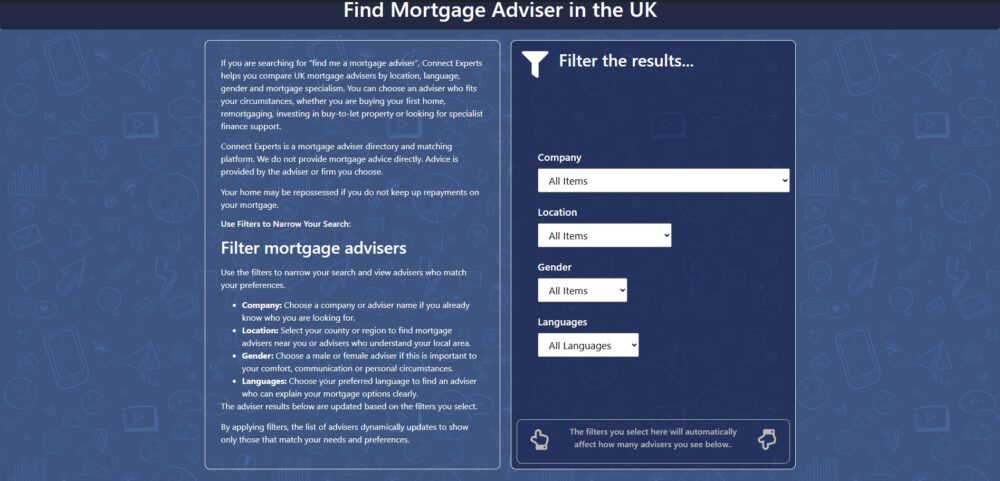
Connect Experts helps users compare advisers by expertise, location, language and gender.
You can find mortgage advisers and review their stated areas of service.
For protection-specific support, search the directory of protection mortgage brokers.