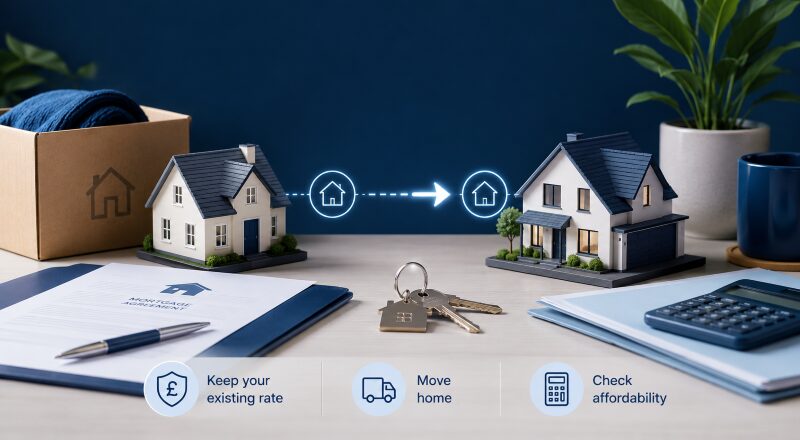
Mortgage Porting When Moving Home: Mortgage porting sounds like a simple transfer.
In practice, the lender normally closes the mortgage on one property and creates another mortgage on the next property.
The product may move. The original mortgage security does not.
This distinction matters because homeowners can wrongly assume that portability guarantees approval.
It does not.
At a Glance
- Porting usually requires a complete mortgage application.
- The lender reassesses the borrower and the new property.
- Additional borrowing may use a separate mortgage product.
- Early repayment charges can apply between sale and purchase.
- Porting is not always cheaper than changing lender.
- An adviser can compare the total cost of both routes.
What Does Porting a Mortgage Mean?
A mortgage is secured against a specific property.
When that property is sold, the mortgage is normally repaid from the sale proceeds.
Porting allows an eligible borrower to apply an existing mortgage product to borrowing secured against another home.
The retained features may include:
- The interest rate.
- The product end date.
- The early repayment charge period.
- Some product conditions.
The lender will issue a new mortgage account or lending arrangement.
Therefore, the process remains a property purchase and mortgage application.
Why Portability Is Not Guaranteed
A mortgage offer may state that the product is portable.
That statement typically means the lender permits applications to be ported. It does not require the lender to approve every application.
The lender may reconsider:
- Income.
- Employment.
- Household spending.
- Existing credit.
- Credit conduct.
- Mortgage term.
- Age at the end of the term.
- Deposit.
- Loan-to-value.
- Property construction.
- Property condition.
- Location.
- Intended occupation.
A borrower’s circumstances can change considerably during a fixed-rate period.
The lender’s rules may also have changed.
A product feature cannot override current lending criteria.
What Happens When More Money Is Needed?
Homeowners often move to a more expensive property.
The existing mortgage may not provide enough finance for the purchase.
Suppose a homeowner wants to port £160,000 but needs total borrowing of £230,000.
The lender may arrange:
- £160,000 on the existing product.
- £70,000 on a new product.
The extra part may have a different interest rate and product expiry date.
This can create two mortgage sub-accounts.
The monthly payments may be collected together. However, their contractual terms remain separate.
Why Different Product End Dates Matter
Separate end dates can complicate a later remortgage.
One part may become eligible for switching while the other still carries an early repayment charge.
The borrower could:
- Leave one part on a follow-on rate.
- Pay an early repayment charge.
- Wait until both products can be changed.
- Review product transfers with the existing lender.
The initial port may still be suitable. However, the future refinancing position should form part of the comparison.
A decision should consider tomorrow’s restrictions as well as today’s rate.
What Happens to Early Repayment Charges?
An early repayment charge may become payable when the current home is sold.
Some lenders waive the charge when the sale and purchase complete together.
Others collect the charge and refund it after an eligible new mortgage completes.
The refund may depend on:
- Completing within a stated period.
- Borrowing at least the previous mortgage amount.
- Keeping the required product.
- Using the same borrowers.
- Meeting all new lending conditions.
A smaller replacement mortgage may lead to only a partial refund.
Written lender terms should be checked before contracts are exchanged.
Can You Port After Selling First?
Some lenders allow a gap between selling and buying.
The permitted period varies.
During the gap, the mortgage has already been repaid. Therefore, the borrower may need to fund any early repayment charge temporarily.
A later refund might be available after completion.
However, a future purchase still requires approval.
Property availability, changed finances or changed lending rules could prevent the port from completing.
Selling first can improve negotiating flexibility. It can also remove certainty about retaining the existing mortgage product.
When Porting May Be Beneficial
Porting may be financially useful when:
- The existing rate is competitive.
- A large early repayment charge applies.
- The lender accepts the required borrowing.
- The new property meets its criteria.
- The additional borrowing terms are suitable.
- Product end dates remain manageable.
These factors should be considered together.
A competitive existing rate can be offset by an expensive additional borrowing rate.
When Switching Could Cost Less
Changing lender may deserve consideration when:
- The existing lender restricts affordability.
- Another lender accepts income more favourably.
- The new property falls outside current criteria.
- The total mortgage can use one product.
- The new arrangement offers a lower overall cost.
- A different term better suits the household budget.
The correct comparison should include:
- Interest over the comparison period.
- Product fees.
- Early repayment charges.
- Valuation costs.
- Legal costs.
- Adviser fees.
- Cashback or incentives.
- Follow-on rates.
- Future product end dates.
The lowest headline rate does not always create the lowest total cost.
How an Adviser Can Assess Porting
A mortgage adviser can review the original mortgage illustration and current redemption statement.
They can also compare the existing lender’s porting route with alternative mortgage products.
Useful documents include:
- Latest mortgage statement.
- Original mortgage offer.
- Redemption estimate.
- Payslips or accounts.
- Bank statements.
- Credit commitments.
- Sale memorandum.
- Property details.
- Evidence of deposit funds.
Connect Experts provides a mortgage broker directory where users can compare advisers by expertise and personal preferences.
The platform does not provide mortgage advice directly. Advice is provided by the adviser or firm selected.
Questions to Ask Before Porting
Ask the lender or adviser:
- Is the product portable?
- Will a new affordability assessment apply?
- How long can pass between sale and purchase?
- Will an early repayment charge be collected?
- When would any refund be paid?
- Can the mortgage amount increase?
- What rate applies to additional borrowing?
- Will the mortgage have separate product end dates?
- Are there property restrictions?
- What happens if completion is delayed?
Clear answers should be obtained before the transaction becomes legally binding.
Frequently Asked Questions
Does porting avoid a new application?
No. Most lenders require a new mortgage application and fresh assessment.
Can a lender refuse the new property?
Yes. Portability does not remove valuation, construction or property eligibility rules.
Can I port only part of my mortgage?
This may be possible. Early repayment charges may apply to the amount not ported.
Can I port to a cheaper property?
Possibly. The lower borrowing amount could produce a partial early repayment charge.
Can I port to a more expensive property?
Possibly. Any additional borrowing remains subject to affordability and product availability.
The Practical Principle
A portable mortgage offers continuity, not certainty.
It preserves the possibility of retaining a product while requiring a new decision about the borrower and property.
That is why porting should be tested, costed and compared before it is treated as the chosen route.