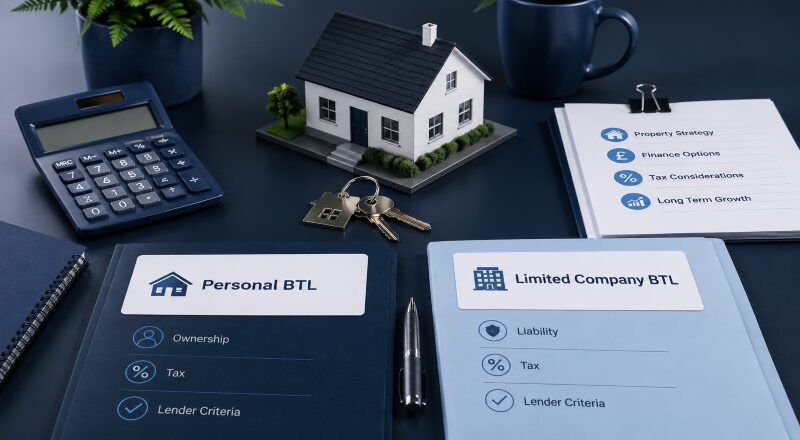
Personal or Limited Company Buy-to-Let: A buy-to-let property can be financed in a personal name or through a company, subject to lender criteria.
The two routes may involve different mortgage products, documents, guarantees, costs and tax treatment.
A mortgage adviser can explain lender requirements. A qualified tax adviser should assess the tax consequences.
Ownership Structure Changes the Application
Choosing how a rental property will be owned is not an administrative detail.
It can affect the borrower named on the mortgage, the lenders available, the documents required and how profits are taxed.
A personal buy-to-let mortgage is normally arranged in the individual landlord’s name.
A limited company mortgage is arranged in the company’s name. The directors and shareholders may still be closely assessed.
Neither structure is automatically better.
The suitable route depends on the landlord, the property, the intended holding period and wider financial plans.
How Personal Buy-to-Let Applications Work
For personal ownership, the lender assesses the individual applicant.
The review may include:
- Credit history.
- Personal income.
- Deposit source.
- Residential status.
- Landlord experience.
- Existing properties.
- Expected rent.
- Tax position.
- Financial commitments.
The mortgage and legal title will normally be held in the applicant’s personal name.
The individual is responsible for the mortgage obligations.
How Limited Company Applications Work
With a limited company mortgage, the company buys or owns the property.
Many lenders prefer a special-purpose vehicle established primarily for property activities. However, accepted company structures and SIC codes differ.
The lender may assess:
- The company’s registration details.
- Its trading activity.
- Directors and shareholders.
- Existing company debts.
- Company accounts.
- The property portfolio.
- Deposit source.
- The directors’ personal credit profiles.
- Previous landlord experience.
- The proposed rent.
A newly formed company may still be considered by some lenders. The lack of trading history does not mean that the directors will avoid personal assessment.
Why Personal Guarantees May Be Required
A limited company is a separate legal entity.
However, many buy-to-let lenders require personal guarantees from directors or significant shareholders.
A guarantee can make an individual personally responsible if the company does not meet its mortgage obligations.
The legal effect should be explained by a solicitor before completion.
A company mortgage should not be viewed as a simple way to separate every personal financial risk.
Mortgage Rates and Fees
Limited company products may differ from personal buy-to-let products.
Differences can include:
- Interest rates.
- Arrangement fees.
- Valuation fees.
- Legal costs.
- Minimum loan sizes.
- Deposit requirements.
- Early repayment charges.
- Product availability.
A lower tax liability does not automatically mean a lower total cost.
Likewise, a mortgage with a higher rate may still form part of a suitable structure after tax and business advice.
Mortgage and tax decisions should be considered together and made by appropriately qualified professionals.
Tax Treatment Requires Separate Advice
Property income is subject to tax rules that depend on the ownership structure and the landlord’s circumstances.
HMRC treats income generated from UK land and property as property business income. Company property income can fall within corporation tax rules, whereas individual ownership is normally subject to income tax rules.
The treatment of finance costs can also differ between individuals and companies.
Landlords should seek tax advice before selecting a structure. A mortgage adviser should not present a company as a universal tax solution.
Official guidance on working out rental income is available from GOV.UK.
Can an Existing Property Be Moved Into a Company?
Moving a personally owned property into a company is not usually a simple mortgage transfer.
The transaction may involve:
- A sale from the individual to the company.
- A new company mortgage.
- A property valuation.
- Legal work.
- Stamp Duty Land Tax considerations.
- Capital Gains Tax considerations.
- Early repayment charges.
- New lender criteria.
The property owner should obtain legal and tax advice before taking action.
A mortgage adviser can review possible company borrowing, but cannot determine the full tax outcome.
Questions a Lender May Ask
A company lender may want to know:
- Why the company structure is being used.
- Whether the company already owns property.
- Who controls the company.
- Where the deposit came from.
- Whether another company is involved.
- Whether the directors have landlord experience.
- Whether personal guarantees will be provided.
- How the property will be managed.
- Whether the rent supports the mortgage.
Complex ownership chains, recent share transfers or trading activities may reduce the number of available lenders.
Frequently Asked Questions
Is a limited company mortgage always cheaper?
No. Rates, fees, legal costs and tax treatment must all be considered.
Can a new company obtain a buy-to-let mortgage?
Some lenders consider newly formed property companies, subject to checks on directors, shareholders, deposits, and property.
Will directors be credit checked?
Usually. The lender may assess directors and shareholders even though the company is the named borrower.
Is a personal guarantee common?
Many lenders require guarantees. Applicants should obtain legal advice about their effect.
Can a broker give tax advice?
Mortgage advisers explain mortgage criteria. Tax advice should come from a suitably qualified tax professional.
Finding a Suitable Adviser
A landlord considering company borrowing should seek an adviser with relevant experience in lending and documentation.
Connect Experts offers a dedicated search for limited company mortgage advisers.
For a broader search, use Find Mortgage Advisers UK and compare each adviser’s stated specialisms.
Before choosing an adviser, ask:
- Which company structures do lenders accept?
- Will personal guarantees be required?
- Does the lender accept newly formed companies?
- What documents will directors need?
- How are existing properties assessed?
- Which costs differ from personal borrowing?
- When should tax and legal advice be obtained?
The structure should serve the investment plan. The investment plan should not be redesigned merely to fit one mortgage product.