
Multi-Unit Freehold Block Mortgages: A multi-unit freehold block comprises several separate homes held under a single freehold title.
It may include converted flats, purpose-built units or several self-contained residences.
Standard buy-to-let lenders may not accept this structure. Specialist lenders can assess the block, individual rents and overall marketability.
Connect Experts helps landlords find advisers with relevant property finance experience.
What is a multi-unit freehold block?
A multi-unit freehold block is usually one building containing several self-contained residential units.
The whole building remains registered under one freehold title.
A typical example could contain:
- two self-contained flats;
- a house converted into three flats;
- a purpose-built block with several units;
- separate dwellings sharing one freehold;
- residential units with communal access.
The defining point is not simply the number of tenants. It is the legal and physical structure of the property.
How is an MUFB different from an HMO?
An HMO usually contains tenants who rent individual rooms and share facilities.
An MUFB contains separate homes. Each unit will normally have its own kitchen, bathroom and living space.
The distinction matters because lenders may apply different:
- valuation methods;
- experience requirements;
- rental calculations;
- loan-to-value limits;
- licensing checks;
- property standards;
- legal requirements.
A property can sometimes contain features of both structures. The valuer and lender will decide how they classify it.
Why standard buy-to-let products may not fit
Many ordinary buy-to-let products are designed for a single dwelling on a single title.
An MUFB introduces several further questions.
The lender may need to know:
- whether every unit is self-contained;
- whether planning consent is correct;
- whether building regulations were followed;
- whether separate council tax assessments exist;
- whether the conversion is lawful;
- how utilities are arranged;
- whether every unit is lettable;
- how easily the property could be sold.
A property producing several rents can appear attractive. However, income alone does not resolve structural or legal concerns.
How do lenders calculate rental income?
A valuer may assess each unit’s expected rent separately.
The lender may then use:
- the combined monthly rent;
- a percentage of the total rent;
- a stressed interest rate;
- an interest coverage ratio;
- an assumed vacancy allowance;
- the lower of current and market rent.
Some lenders consider the block as one investment. Others apply limits based on the number of units.
Existing tenancy agreements may be reviewed. However, a lender may still rely on the valuer’s market-rent opinion.
How is an MUFB valued?
Valuation can be one of the most important parts of the case.
Possible approaches include:
Bricks-and-mortar value
This considers the property’s physical value as one building.
Investment value
This considers rental income and likely investor demand.
Aggregate unit value
This estimates the combined value of the separate units.
However, the lender may not accept the full combined value where the units cannot be sold separately.
The title structure can therefore affect both valuation and loan size.
Planning and building documentation
A lender may require evidence that the property can lawfully operate as several homes.
Documents might include:
- planning permission;
- lawful development certificates;
- building-control completion certificates;
- floor plans;
- tenancy agreements;
- fire-risk assessments;
- electrical reports;
- energy performance certificates;
- council tax records;
- building insurance.
Missing paperwork can restrict lender choice even when the property has operated successfully for years.
Ownership structure
An MUFB can be owned personally or through a limited company.
A company application may require:
- suitable company activity codes;
- director information;
- shareholder details;
- personal guarantees;
- company bank statements;
- existing property schedules.
Ownership should be discussed with a qualified tax adviser before purchase. Changing ownership later can create tax, legal and mortgage consequences.
When commercial or semi-commercial finance may apply
An MUFB is not always treated as ordinary residential buy-to-let.
Commercial or semi-commercial finance could be relevant where:
- part of the building has business use;
- the property contains a shop with flats;
- the number of units exceeds lender limits;
- the building has unusual construction;
- tenancy arrangements are not standard;
- the block forms part of a larger investment.
Landlords considering mixed-use buildings can compare commercial mortgage brokers.
Multi-unit freehold block FAQs
Is an MUFB the same as a block of leasehold flats?
No. An MUFB normally holds all units under one freehold title.
Can a first-time landlord finance an MUFB?
Possibly. However, many lenders prefer applicants with previous landlord experience.
Does each unit need a separate tenancy?
This will depend on the property and tenancy arrangements. The lender may review every agreement.
Can the flats be sold separately?
Not usually while they remain under one freehold title. Legal restructuring may be required.
Are MUFB mortgages more expensive?
They can carry different rates and fees because fewer lenders may accept the property structure.
Risk warning: Your property may be repossessed if you do not keep up repayments on a mortgage secured against it. Some forms of buy-to-let lending are not regulated by the Financial Conduct Authority.
Finding an adviser for an MUFB mortgage
A suitable adviser should first understand the property structure.
Useful questions include:
- Have you arranged finance for multi-unit blocks?
- Which documents should I prepare?
- How may the property be valued?
- Will the number of units restrict lenders?
- Can the lender accept the current title?
- Does the lender require landlord experience?
- Can the mortgage support future refurbishment?
Connect Experts lets users compare advisers by mortgage expertise, location and communication preferences.
Explore the UK mortgage adviser directory before deciding who to contact.
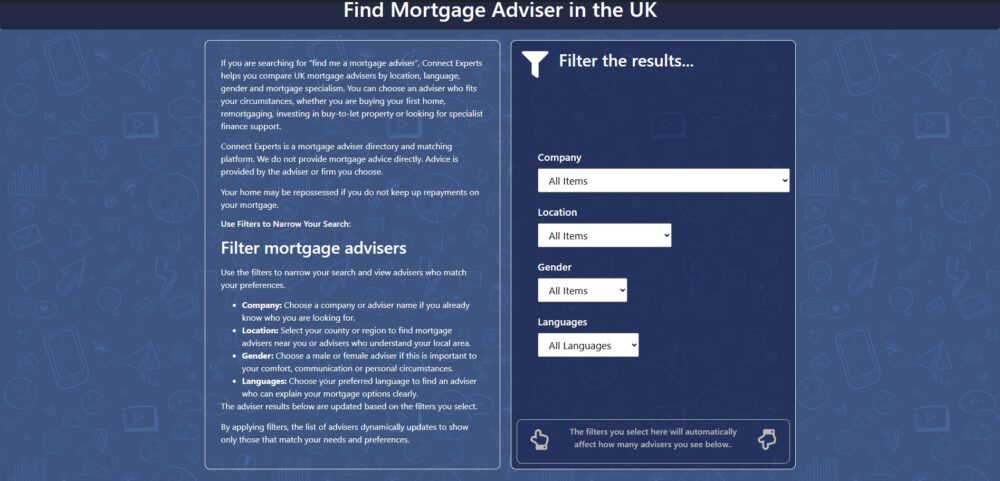
Connect Experts does not provide the mortgage recommendation. Advice comes from the selected adviser or firm.