Islamic Home Finance Deposits and Affordability: Islamic home finance providers assess whether payments appear affordable and sustainable. They may examine income, expenditure, credit history, deposit evidence and property details. A larger contribution may widen the available choices, but provider criteria still differ.
Connect Experts helps users find advisers who understand Islamic home finance and affordability assessments.
Affordability Comes Before Product Selection
Many applicants begin by looking at the property price or expected monthly payment.
Providers begin with evidence.
They need to understand whether the proposed arrangement remains affordable after considering income, household expenditure and existing commitments.
This can include:
- Basic salary.
- Overtime and bonuses.
- Self-employed income.
- Benefits accepted by the provider.
- Rental income.
- Credit commitments.
- Childcare costs.
- Maintenance payments.
- Dependants.
- Remaining income after essential expenditure.
The central question is not simply what you pay today. It is whether the commitment appears sustainable over time.
What Is the Initial Contribution?
The initial contribution is the money supplied by the customer towards the property purchase.
It performs a similar practical function to a mortgage deposit. However, the legal structure may be different because the provider could acquire part of the property.
A provider may set:
- A minimum contribution percentage.
- A maximum finance-to-value ratio.
- A minimum property value.
- A minimum finance amount.
- Separate requirements for residential and rental property.
These rules can change. Applicants should obtain current criteria from an adviser or provider before making an offer.
Why a Larger Contribution Can Help
A larger contribution can reduce the provider’s share of the purchase.
This may:
- Reduce required finance.
- Lower rental exposure.
- Improve affordability.
- Widen the available product range.
- Create more resilience if property values fall.
- Reduce the total amount paid over the term.
However, using every available pound as a contribution may leave too little for legal fees, moving costs or emergencies.
Deposit planning should consider the whole purchase, not merely the minimum threshold.
Acceptable Sources of Funds
Providers will normally require evidence showing where the money came from.
Possible sources can include:
- Personal savings.
- A gift from a close family member.
- Sale proceeds from another property.
- Inheritance.
- Investments that have been sold.
- Business funds, where accepted.
- Equity from an existing home.
Gifted contributions may require a signed declaration. The donor may need to confirm that the money is not repayable and gives them no ownership interest.
Solicitors must also complete anti-money laundering checks.
How Income May Be Assessed
Income treatment depends on employment status and provider policy.
An employed applicant may need:
- Recent payslips.
- Bank statements.
- A P60.
- Employment confirmation.
- Evidence of bonuses or overtime.
A self-employed applicant may need:
- Finalised accounts.
- Tax calculations.
- Tax year overviews.
- Business bank statements.
- Accountant details.
- Evidence of contracts.
- Salary and dividend records.
Applicants with multiple income sources may require a provider that considers their full financial situation.
Credit History Still Matters
Avoiding interest does not remove financial risk assessment.
Providers may review:
- Missed payments.
- Defaults.
- County Court judgments.
- Existing borrowing.
- Credit card balances.
- Payment arrangements.
- Electoral roll information.
- Recent credit applications.
A past credit problem does not always prevent an application. However, its age, amount, cause and current status can affect provider choice.
Do not make several speculative applications. Each application should follow a review of current criteria.
Stress Testing and Payment Changes
Some Home Purchase Plans include rental payments that can be reviewed.
Applicants should ask:
- What reference or method controls reviews?
- How often can payments change?
- Is there a cap?
- What notice will be given?
- Can the term be extended?
- Can extra ownership units be purchased?
Affordability should be tested against possible payment increases, not only the starting amount.
Property Costs Beyond the Plan
Prepare for other costs, including:
- Valuation.
- Survey.
- Solicitor fees.
- Search fees.
- Land Registry charges.
- Buildings insurance.
- Moving costs.
- Product fees.
- Broker fees where charged.
- Tax due on the transaction.
HM Land Registry publishes specific guidance about the registration of Islamic financing arrangements.
See HM Land Registry’s Islamic financing guidance for technical registration information.
Preparing Before Contacting an Adviser
Create a simple information pack containing:
- Proof of identity.
- Proof of address.
- Three months of bank statements.
- Income evidence.
- Deposit evidence.
- Existing credit balances.
- Details of dependants.
- Expected property value.
- Preferred purchase location.
- Required completion date.
Good preparation does not guarantee acceptance. It helps the adviser identify unsuitable routes before an application is submitted.
Finding an Adviser for Affordability Support
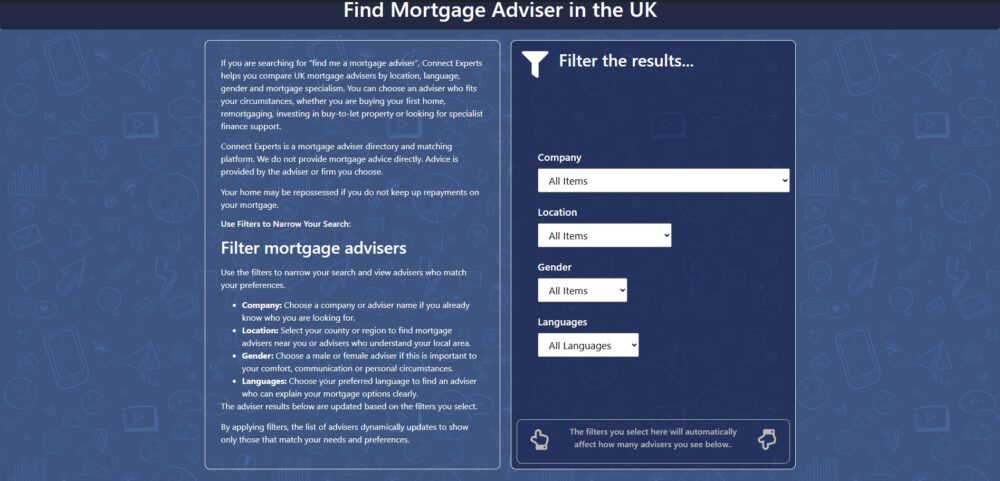
Use the mortgage broker directory to search by specialism, location, language and personal preference.
A suitable adviser can help you:
- Estimate a practical purchase range.
- Review provider criteria.
- Identify missing documents.
- Explain likely fees.
- Compare payment structures.
- Prepare the case for submission.
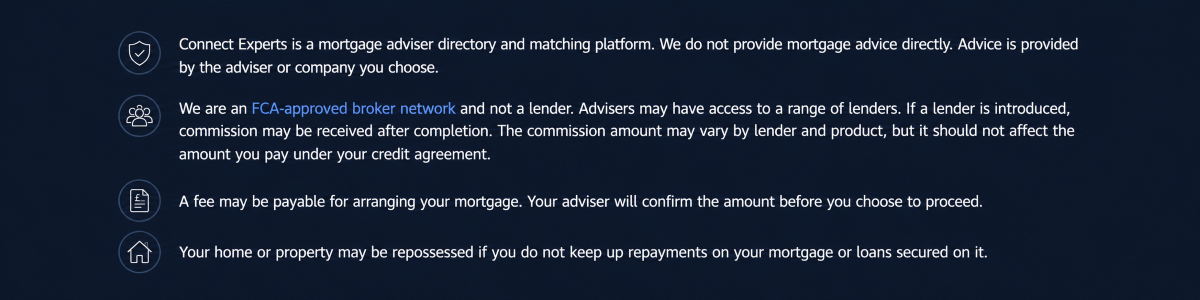
Connect Experts does not assess affordability or recommend a product. The chosen adviser or firm provides the regulated advice.
Questions to Ask
Before proceeding, ask:
- What initial contribution is required?
- Which income sources can be included?
- How will commitments be treated?
- Can the rental payment change?
- What emergency reserve should remain?
- Which costs must be paid before completion?
- Is the property acceptable to the provider?
- How long is the decision valid?
Affordability is not a single calculation. It is the relationship between income, commitments, property, time and uncertainty.
Search for Suitable Advice
Find a mortgage adviser by expertise and compare profiles before making contact.