Legal Ownership in Islamic Home Finance: Islamic home finance can involve shared ownership, leasing or a purchase at an agreed profit. The legal title, beneficial interest and customer’s right to occupy the property depend on the contract. A solicitor experienced in the relevant structure should review the documents before exchange.
A mortgage adviser can explain financial suitability. A solicitor explains the legal effect.
Why Ownership Needs Separate Attention
Most homebuyers think about ownership as a simple question: “Is the property mine?”
Islamic home finance can require a more detailed answer.
Depending on the structure:
- The provider may hold legal title.
- The customer and provider may share beneficial ownership.
- The customer may occupy the property under a lease.
- Ownership may transfer gradually.
- Ownership may transfer after the final payment.
- The provider may hold security over the property.
The exact position must be confirmed from the legal documents.
Legal Title and Beneficial Ownership
Legal title identifies the registered owner shown at HM Land Registry.
Beneficial ownership concerns who receives the property’s economic benefits.
These interests can be held differently. Therefore, customers should not assume that a percentage shown in a finance illustration will appear in the same form on the Land Register.
Ask the solicitor to explain:
- The registered proprietor.
- The provider’s interest.
- The customer’s interest.
- Any lease.
- Any charge or restriction.
- How further ownership is acquired.
- What changes after final payment.
Ownership Under Diminishing Musharaka
Under a Diminishing Musharaka arrangement, the provider and customer may initially share an interest in the property.
The customer then purchases further units from the provider.
The agreement should explain:
- Each party’s starting share.
- The price of future units.
- How often units can be purchased.
- Whether additional purchases are optional.
- How rent changes when ownership increases.
- When the provider’s interest ends.
Do not assume that every provider uses the same unit-purchase method.
Occupation Rights
Where the provider owns all or part of the property, the customer needs a clear right to live there.
This may be created through a lease or another contractual arrangement.
Review:
- Length of occupation rights.
- Responsibility for maintenance.
- Restrictions on letting.
- Restrictions on alterations.
- Insurance responsibilities.
- Events that could end the agreement.
- Procedures following missed payments.
The right to occupy is central to the transaction. It should not be treated as a minor schedule.
Repairs and Maintenance
Responsibility for repairs can vary.
The customer may be responsible for routine maintenance. The provider may retain obligations connected with its ownership. Contractual documents may allocate particular costs between the parties.
Ask who pays for:
- Structural repairs.
- Routine repairs.
- Service charges.
- Ground rent.
- Buildings insurance.
- Major works.
- Damage not covered by insurance.
- Compliance with leasehold obligations.
This is especially important when purchasing a flat or leasehold property.
What Happens When You Sell?
The agreement should describe the process for selling before the finance term ends.
Questions include:
- Must the provider approve the sale?
- Who appoints the estate agent?
- How is the provider’s share valued?
- Which balance is paid first?
- Who receives any increase in value?
- Who bears a loss?
- Are early settlement fees charged?
- How quickly can the provider complete its release?
Selling should be understood before buying. Exit terms often reveal the practical character of the agreement.
Refinancing an Existing Property
Moving from a conventional mortgage into Islamic home finance may require:
- Redemption of the existing mortgage.
- A new valuation.
- Fresh affordability checks.
- New legal documentation.
- Transfer or restructuring of property interests.
- Land Registry applications.
- Payment of provider and solicitor fees.
The adviser should assess whether the new arrangement is financially suitable. The solicitor should confirm how the change affects ownership.
Selecting the Solicitor
The solicitor must be acceptable to the finance provider.
Some providers use approved conveyancing panels. A solicitor without relevant experience may need additional time to understand the documentation.
Ask:
- Has the firm completed this provider’s transactions before?
- Is it on the provider’s panel?
- Will separate representation be required?
- Who reviews the lease and acquisition agreement?
- What happens if the provider changes its documents?
- Is the quoted fee fixed?
HM Land Registry maintains a practice guide covering registration requirements for Islamic finance transactions.
The Adviser’s Role
A mortgage adviser can help identify providers whose property, income and deposit criteria fit the case.
They may also coordinate with:
- The provider.
- The solicitor.
- The estate agent.
- The valuer.
- The accountant, where income is complex.
However, the adviser does not replace independent legal advice.
Use the Connect Experts UK mortgage guides to understand the wider buying process before selecting an adviser.
Information to Request Before Application
Request:
- A product illustration.
- A payment breakdown.
- Draft legal documents where available.
- A schedule of charges.
- Rental review information.
- Unit-acquisition rules.
- Early settlement terms.
- Property eligibility rules.
- Sharia governance information.
- Complaint procedures.
Documents should be read as a connected system. A reassuring sentence in one document cannot override an obligation elsewhere.
Questions for the Adviser and Solicitor
- Who holds legal title?
- What ownership interest do I receive?
- How do I buy further shares?
- What rights allow me to occupy the property?
- Who pays for major repairs?
- What happens if I sell early?
- How is the provider’s share valued?
- What remains registered after final payment?
- Will separate legal representation be required?
- Are all documents consistent with the illustration?
Understanding ownership is not merely about identifying a name on a register. It is about understanding rights, duties and change throughout the agreement.
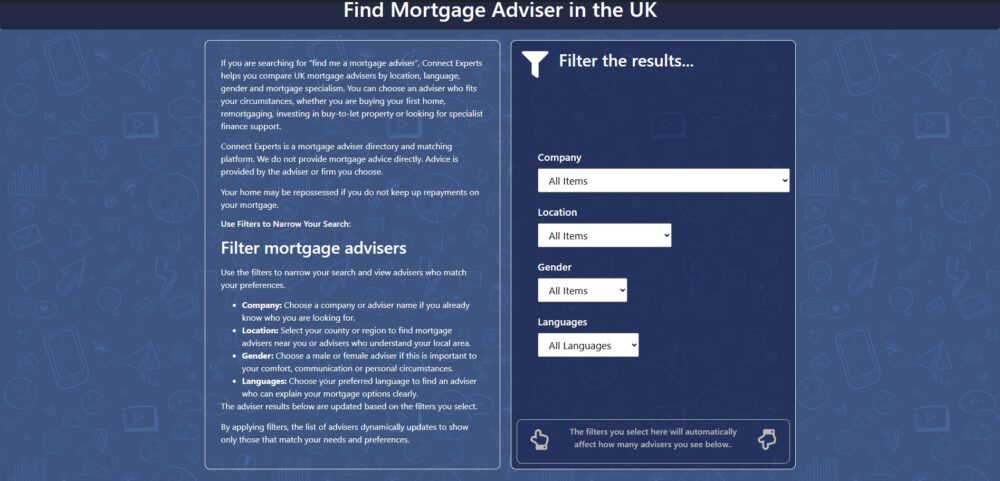
Find an Adviser
Connect Experts allows users to compare advisers by mortgage expertise, language, location and appointment preference.
Search for a UK mortgage broker who may understand Islamic home finance structures.