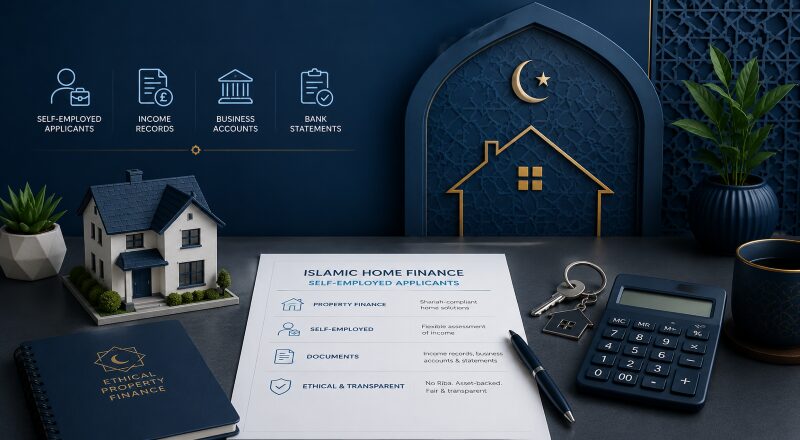
Islamic Home Finance for Self-Employed: Self-employed applicants can qualify for Islamic home finance, but income must be evidenced in accordance with the provider’s criteria. Sole traders, directors, contractors and business partners may be assessed differently. Accounts, tax documents, contracts and business bank statements can all be relevant.
A suitable adviser can identify which providers are more likely to understand the applicant’s income structure.
Strong Income Can Still Be Difficult to Evidence
A business owner may earn enough to support the required payments but draw only a modest salary.
A contractor may have a strong daily rate but limited employment history.
A sole trader may show rising turnover while taxable profit remains lower after business expenses.
These cases are not necessarily weak. They require an assessment method that reflects how the income is generated.
Sole Traders
A sole trader may be assessed using taxable profit shown in tax records or accounts.
Providers may request:
- SA302 tax calculations.
- Tax year overviews.
- Finalised accounts.
- Business bank statements.
- Personal bank statements.
- Accountant details.
- Evidence of current trading.
Some providers use an average across several years. Others may use the latest year where the business is growing and the case meets their rules.
Limited Company Directors
A company director’s personal income can include:
- Salary.
- Dividends.
- Pension contributions.
- Benefits.
- Share of company profit.
Some providers may consider salary and dividends. Others may assess retained profit or the director’s share of net profit.
This difference can materially affect the available finance.
Prepare:
- Company accounts.
- Personal tax calculations.
- Business bank statements.
- Company ownership details.
- Dividend vouchers.
- Accountant confirmation.
- Current management figures where accepted.
Contractors
Contractors may be assessed using:
- Contract day rate.
- Remaining contract term.
- Contract history.
- Annualised income.
- Taxable income.
- Limited company accounts.
Providers can have different rules for fixed-term workers, agency workers and contractors operating through companies.
Ask whether gaps between contracts are acceptable.
Partnerships and Professional Firms
Partners may receive drawings and profit shares rather than a standard salary.
The provider may review:
- Partnership accounts.
- Individual tax records.
- Profit allocation.
- Capital account.
- Future profit expectations.
- Partnership agreement.
- Time in the partnership.
Newly appointed partners may face different criteria from established partners.
Multiple Income Sources
Applicants can receive income from several places, including:
- Employment.
- Self-employment.
- Rental property.
- Investments.
- Pensions.
- Overseas employment.
- Bonuses.
- Commission.
- Maintenance.
- Benefits.
A provider may accept some income sources fully, partly or not at all.
The adviser should establish which income is sustainable, evidenced and permitted under current rules.
Recent Trading History
Some applicants have less than two years of completed accounts.
Possible examples include:
- A professional becoming self-employed.
- A contractor moving from employment.
- A director purchasing an established business.
- A sole trader changing business structure.
- A professional forming a limited company.
Options may exist, but provider choice can be smaller.
Do not submit an application based on a general claim that “one year of accounts is accepted”. The complete case still matters.
Business Health
Providers may look beyond personal drawings.
They may consider:
- Turnover trend.
- Profit trend.
- Cash reserves.
- Business liabilities.
- Director’s loans.
- Tax due.
- Sector risk.
- Dependence on one customer.
- Recent changes in ownership.
- Accountant comments.
Taking a large deposit from the business shortly before applying could also affect liquidity.
Discuss withdrawals with an accountant before moving funds.
Evidence Quality
Documents should tell a consistent story.
Check that:
- Names match.
- Addresses are current.
- Tax records correspond with accounts.
- Bank credits match stated income.
- Deposit transfers are traceable.
- Business activity matches the declared occupation.
- Current figures support the application.
An unexplained difference can delay underwriting even when the income itself is strong.
Finding an Adviser
Use the Self-Employed Mortgage Brokers page to compare advisers experienced with non-standard income.
During the first conversation, explain that you require Islamic home finance. This allows the adviser to consider both provider structure and income criteria.
Connect Experts helps users find advisers. It does not assess the application or provide advice itself.
Preparing an Adviser Brief
Provide:
- Business type.
- Trading start date.
- Ownership percentage.
- Latest turnover.
- Latest profit.
- Salary.
- Dividends.
- Retained profit.
- Current contracts.
- Initial contribution.
- Property value.
- Existing commitments.
- Preferred completion date.
This gives the adviser enough information to begin researching suitable providers.
Questions to Ask
- How will my income be calculated?
- Will retained profit be considered?
- How many years of accounts are required?
- Can current management figures be used?
- Are contractor day rates accepted?
- How will rental income be treated?
- Does the provider accept overseas income?
- Will a recent company change cause a problem?
- Which documents should be prepared?
- Should I delay changing my salary or dividends?
The challenge is rarely that self-employed income has no value. The challenge is translating business performance into evidence a provider accepts.
Compare Adviser Profiles
Find self-employed residential mortgage advisers through the Connect Experts directory