
Protection Adviser in South London: Financial protection begins with a practical question: what would happen to your household finances if income, health or life changed unexpectedly?
For people living across South London, including SW and SE postcode areas, the answer may depend on mortgage commitments, earnings, savings, dependants, employment benefits and existing insurance.
A protection adviser can examine those individual risks before explaining the types of cover that may be suitable.
Connect Experts helps you find advisers who serve South London and have experience with protection needs. You can compare advisers and decide who you want to contact.
Connect Experts is a directory and matching platform. It does not provide direct protection advice. Any advice or recommendation is provided by the adviser or firm you choose.
At a Glance
A protection adviser may consider:
- Your income and employment status
- Your mortgage or rent commitments
- Household expenditure
- Dependants and family responsibilities
- Existing life insurance
- Employer death-in-service benefits
- Employer sick pay
- Savings and emergency funds
- Outstanding debts
- Health and medical history
- Occupation and working arrangements
- Smoking or lifestyle information
- The amount of cover required
- How long protection may be needed
The purpose is not simply to buy an insurance policy.
It is to identify a financial risk, measure its possible consequences and consider which form of protection could address it.
What Does a Protection Adviser in South London Do?
A protection adviser reviews the financial consequences that could arise following death, serious illness or an inability to work.
The adviser can then explain different protection policies, how they operate and which risks they are designed to cover.
This may include:
- Life insurance
- Critical illness cover
- Income protection
- Family income benefit
- Mortgage protection
- Business protection
These policies are not interchangeable.
Life insurance generally responds to death during the insured term.
Critical illness cover normally depends on diagnosis of an illness that meets the insurer’s specified definition.
Income protection is designed to provide regular income following eligible incapacity rather than a single lump-sum payment.
Understanding the event each policy covers is an essential part of comparing protection.
For a wider explanation of available cover, see Protection Options.
Finding a Protection Adviser Across South London
South London covers a large and varied area rather than one single financial or housing market.
Searches can include parts of SW and SE London, as well as locations within the CR, BR, and SM postcode areas.
People may be looking for advice in areas such as:
- Battersea
- Brixton
- Clapham
- Croydon
- Dulwich
- Greenwich
- Kingston
- Lewisham
- Peckham
- Putney
- Richmond
- Southwark
- Sutton
- Tooting
- wands-worth
- Wimbledon
Location can matter when you want face-to-face advice, although many protection discussions can also take place over the telephone or via video.
The more important question is whether the adviser can properly assess your protection requirements.
A nearby adviser is useful.
A suitable adviser is more important.
What Should a Protection Adviser Assess?
Protection advice should begin with the financial situation rather than with a particular insurance product.
An adviser may calculate what would happen under several different scenarios.
For example:
If you died:
Would your family need to repay a mortgage, replace income or meet other financial commitments?
If you became critically ill:
Would savings be sufficient to cover reduced earnings, treatment-related costs or changes to the home?
If illness or injury stopped you working:
How long would employer sick pay, savings or other resources support your household?
This distinction matters because each risk may require a different solution.
A £300,000 mortgage does not automatically mean that £300,000 of every form of protection is appropriate.
The adviser may need to examine the mortgage, income, expenditure, savings, dependants and existing cover before calculating an appropriate level and duration of protection.
Life Insurance in South London
Life insurance can provide a lump sum or, depending on the policy structure, another agreed benefit following death during the insured period.
A protection adviser may discuss:
Level Term Life Insurance
The sum assured normally remains unchanged during the selected policy term.
This may be considered where a household wants a fixed amount of protection for family commitments or an interest-only mortgage.
Decreasing Term Life Insurance
The amount of cover reduces over time.
This structure is commonly associated with a repayment mortgage because the outstanding mortgage balance may also decline.
The policy and mortgage do not necessarily reduce at exactly the same rate, so the terms should still be checked carefully.
Family Income Benefit
Instead of a lump sum, family income benefit can provide regular payments for the remainder of an agreed term following a valid claim.
This may help households plan around continuing living costs.
You can explore this area further through Life Insurance Advisers.
Critical Illness Cover
Critical illness cover is designed to pay a benefit following diagnosis of a specified serious illness that satisfies the policy’s definition.
The policy wording is critical.
Having an illness with a familiar medical name does not automatically mean a claim will qualify. Insurers specify the illnesses covered and the conditions that must be met.
An adviser may therefore compare:
- Conditions covered
- Definitions
- Severity requirements
- Exclusions
- Children’s cover where available
- Additional payment features
- Policy term
- Sum assured
- Premium basis
A policy should be understood by what it promises contractually, not simply by its headline name.
Learn more about how these policies work through Critical Illness Cover Advisers.
Income Protection in South London
Income is often the mechanism that keeps every other financial commitment functioning.
Mortgage payments, rent, utilities, food, transport, childcare and everyday costs usually continue even when somebody becomes unable to work.
Income protection is designed to replace a portion of eligible earnings following illness or injury, subject to the policy’s terms.
Several technical features can affect the cover’s value.
Deferred Period
The deferred period is the time between the beginning of an eligible incapacity and the benefit becoming payable.
An adviser may compare this with:
- Employer sick pay
- Savings
- Other household income
- Existing insurance
Someone receiving six months of full occupational sick pay may have different requirements from a self-employed person with no contractual sick pay.
Benefit Amount
Policies typically limit the proportion of earnings that can be insured.
The precise calculation and maximum benefit depend on the provider and policy.
Benefit Period
Some policies can pay an eligible benefit for a limited period.
Others may provide longer-term protection, potentially contingent on the policy end date and ongoing eligibility.
Occupation
An insurer may consider what work you perform, how duties are structured and the occupational risks involved.
The definition used to determine incapacity is therefore an important feature to understand.
For a dedicated explanation, visit Income Protection Advisers.
Income Protection or Critical Illness Cover?
Income protection and critical illness cover address different financial needs.
Critical illness cover generally provides a lump sum following an eligible diagnosis that satisfies the policy definition.
Income protection generally provides regular payments following eligible incapacity that prevents you from working.
A person might become unable to work without suffering one of the illnesses listed by a critical illness policy.
Equally, someone receiving a critical illness payment may have financial needs that extend beyond monthly income replacement.
For that reason, deciding between protection policies should begin with the risk being protected rather than the product name.
Mortgage Protection in South London
For homeowners, mortgage debt can be one of the largest financial commitments in the household.
Protection planning may therefore examine how mortgage payments or the outstanding balance would be managed following death, serious illness or prolonged incapacity.
An adviser might assess:
- Current mortgage balance
- Remaining mortgage term
- Repayment or interest-only structure
- Joint or sole borrowing
- Household earnings
- Dependants
- Existing life insurance
- Emergency savings
- Employer benefits
People arranging or reviewing borrowing can compare advisers separately using the Mortgage Broker in South London guide.
Mortgage and protection advice remain separate assessments, even when considered together.
Protection for Self-Employed People
Self-employed workers can have a particularly direct relationship between their ability to work and their household income.
A protection review may therefore investigate:
- Trading history
- Personal drawings or earnings
- Business structure
- Savings
- Existing insurance
- How long the business could continue during illness
- Whether another person could perform essential duties
- Personal and business financial commitments
Income protection may be particularly relevant to this discussion, but suitability depends on individual circumstances and insurer requirements.
Business owners may also need to distinguish personal protection from protection intended for the company.
Protection for Families
Protection requirements often change as family responsibilities change.
A household may need to consider:
- Mortgage debt
- Childcare
- Education costs
- Everyday household spending
- Lost earnings
- Existing savings
- Existing life cover
- Employer benefits
- The contribution of each adult to the household
Financial dependence is not limited to salary.
An adult who provides childcare or other unpaid support may also make an important economic contribution to the household.
A protection review can therefore examine the consequence of losing either income or practical support.
When Should Protection Be Reviewed?
Protection does not necessarily remain suitable simply because a policy remains active.
A review may be appropriate following a significant change such as:
- Buying a home
- Moving home
- Remortgaging
- Marriage
- Divorce or separation
- Having children
- Changing employment
- Becoming self-employed
- A significant change in income
- Taking additional borrowing
- Starting or selling a business
- Repaying substantial debt
- Existing cover reaching the end of its term
The question is whether the original protection still reflects the financial reality it was intended to protect.
Protection and Later-Life Planning
Protection needs may also change later in life as mortgages are reduced, children become independent, and retirement approaches.
Some households move from primarily protecting income towards considering debt, estate planning, long-term housing and retirement finances.
These are distinct financial questions and should not be treated as the same product journey.
London homeowners specifically considering later-life property wealth can explore Equity Release Advisers in London separately.
Equity release is not a substitute for protection insurance and has different risks, eligibility requirements and long-term consequences.
What Information Should You Prepare?
Giving an adviser accurate information can make the protection discussion more useful.
You may want to prepare details of:
- Gross and net income
- Monthly household costs
- Mortgage balance
- Mortgage term
- Loans and other debts
- Savings
- Existing life insurance
- Existing critical illness cover
- Existing income protection
- Employer death-in-service benefits
- Employer sick pay
- Dependants
- Occupation
- Working hours
- Existing medical conditions where requested
Insurers may request additional medical, occupational or lifestyle information during underwriting.
Questions should be answered accurately.
Material information can affect the insurer’s decision, premiums, exclusions and the validity of future claims.
What Can Affect the Cost of Protection?
Protection premiums can vary depending on the policy and the applicant.
Depending on the cover, insurers may consider factors including:
- Age
- Health
- Medical history
- Smoking status
- Occupation
- Sum assured
- Policy term
- Type of protection
- Additional options
- Underwriting outcome
The cheapest premium is therefore not automatically the most useful comparison.
Policy definitions, exclusions, benefit periods and other contractual features can materially affect what the policy provides.
How to Choose a Protection Adviser in South London
When comparing advisers, consider practical factors rather than relying only on distance.
Ask:
- Does the adviser regularly discuss the type of protection I need?
- Will they assess my existing policies first?
- Can they explain differences between providers and policy definitions?
- How will they calculate the level of cover?
- Will they explain exclusions and limitations?
- What fees, if any, apply?
- How is the adviser or firm regulated?
- Can meetings take place face-to-face, by telephone or online?
- Will the protection be reviewed if my circumstances change?
Clear communication matters because a protection recommendation can involve medical, financial and family information.
You should understand what is being recommended, why it is being recommended and what could prevent a future claim.
Checking an Adviser or Firm
Before using a financial-services firm, you can use the FCA Firm Checker to check whether the firm is authorised and has permission to provide the relevant service.
The Financial Conduct Authority states that its Insurance Conduct of Business Sourcebook applies to general insurance and protection-policy sales. Its guidance requires suitable advice and clear, fair information.
Regulation does not remove financial risk, but checking the firm and understanding its permissions are sensible parts of choosing who provides your advice.
Using Connect Experts to Find a Protection Adviser in South London
Connect Experts helps users search for advisers rather than selecting one specific broker for them.
Your search can consider factors such as:
- Location
- Protection requirements
- Adviser expertise
- Language
- Gender
- Contact preferences
Review the profiles available and consider which adviser appears most relevant to your circumstances before making contact.
For broader adviser searches, you can also use the Find Mortgage Advisers directory.
Connect Experts does not provide direct protection or mortgage advice. Advice is provided by the adviser or firm you choose.
Frequently Asked Questions
What does a protection adviser in South London do?
A protection adviser assesses financial risks connected with death, serious illness or inability to work. They can explain appropriate protection options based on your income, debts, household commitments, dependants, existing insurance and other relevant circumstances.
What types of insurance can a protection adviser discuss?
Depending on their services and permissions, protection discussions can include life insurance, critical illness cover, income protection, family income benefit, mortgage protection and business protection.
Is life insurance the same as income protection?
No. Life insurance generally provides a benefit following death during the insured term. Income protection is designed to provide regular payments following eligible illness or injury that prevents you from working.
Is critical illness cover the same as income protection?
No. Critical illness cover usually provides a lump sum after an eligible diagnosis that meets the policy definition. Income protection generally provides regular payments following eligible incapacity.
Do I need to live in an SW or SE postcode?
Not necessarily. South London extends beyond the SW and SE postcode districts and can include locations within the CR, BR, and SM areas. Adviser coverage should be checked against your precise location.
Can I speak with a South London protection adviser online?
Many advisers can communicate by telephone or video as well as through face-to-face meetings. Check the individual adviser’s profile and service options.
Should I review existing protection before buying another policy?
Yes. Existing life insurance, employer benefits, income protection, critical illness cover, and savings should be included in the assessment. This can help identify gaps or unnecessary duplication.
How much protection do I need?
There is no universal amount. An adviser may consider your income, mortgage, debts, dependants, household spending, savings, existing insurance and the period for which financial support would be required.
How can I check a protection adviser’s firm?
You can check the relevant firm on the Financial Conduct Authority’s Firm Checker and confirm that it has the appropriate permissions for the services it offers.
Find a Protection Adviser in South London
Protection is ultimately concerned with consequences.
A policy is a financial contract. Its value depends on whether the benefit, term, definitions, and conditions match the risk you are trying to protect against.
For one household, the central concern may be repaying a mortgage after death.
For another, the greater vulnerability may be several years without earned income.
For someone else, a serious illness could create an immediate requirement for capital.
Understanding that difference is the foundation of effective protection planning.
Search protection advisers serving South London.
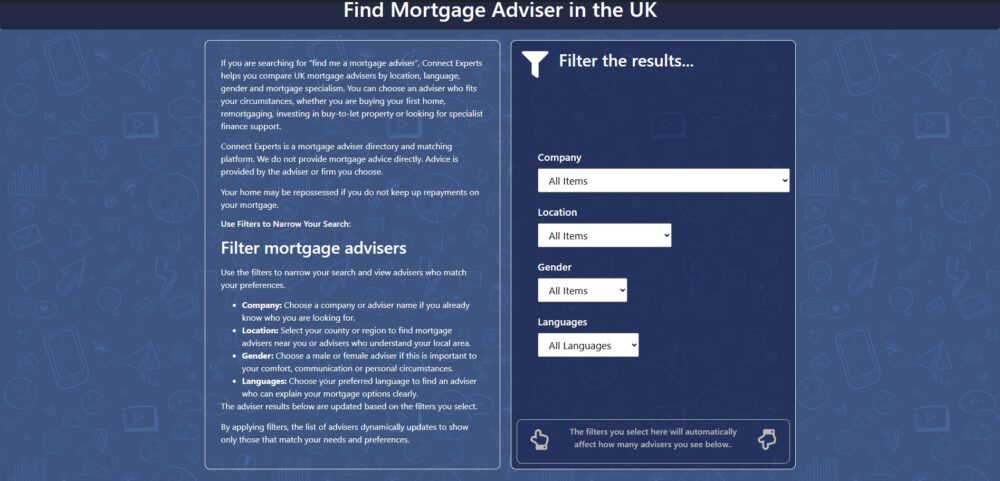
Use Connect Experts to search for protection advisers who cover South London, compare their profiles and choose who you would like to contact.