Mortgage Broker in Henley-on-Thames searches often begin with a property, but in this part of Oxfordshire, the more important question can be how the property fits into the rest of your financial life.
Henley combines comparatively high property values with historic housing, riverside geography and established conservation areas. Families may also be balancing mortgage commitments with private education or other substantial household expenditure.
That changes the mortgage conversation.
A straightforward salary and conventional house may fit standard lender criteria. A larger property purchase, an older home, business-owned income, or a substantial bonus structure may require a different assessment.
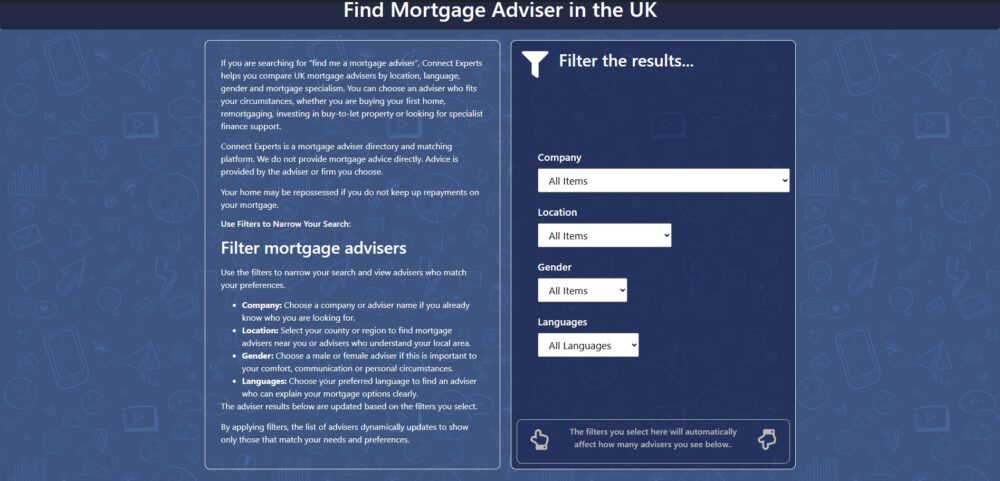
Connect Experts helps you search for mortgage advisers covering Henley-on-Thames and the wider Oxfordshire mortgage market. You compare the available profiles and choose who you would like to contact.
Connect Experts is a mortgage adviser directory and matching platform. It does not provide mortgage advice directly.
At a Glance
Henley-on-Thames combines higher property values with period homes, conservation areas and a local independent-school presence. That can make the mortgage calculation broader than price alone. Property characteristics, borrowing size, income structure, school-fee commitments and deposit strategy may all matter. Connect Experts helps you compare mortgage advisers whose experience reflects the property and financial circumstances you need to discuss.
Henley’s property price changes the size of the mortgage question
The average property figure for a district can hide substantial differences between individual towns.
The Office for National Statistics recorded an average South Oxfordshire house price of £476,000 in July 2026. First-time buyers across the district paid an average of £383,000, while home movers averaged £562,000.
Henley itself sits noticeably above that wider district picture.
Rightmove’s completed-sales data reports an overall Henley-on-Thames average of around £748,000 during the previous year. Detached homes averaged more than £1.16 million, while terraced homes averaged around £639,000.
Those figures are market context, not individual valuations.
However, they explain why mortgage questions in Henley can move quickly from basic affordability towards:
- larger deposit requirements;
- substantial mortgage balances;
- more detailed underwriting;
- complex income assessment;
- repayment strategy;
- property valuation;
- liquidity and existing assets.
A buyer moving from another part of Oxfordshire may therefore find that the property changes faster than their income does.
That gap matters.
Historic Henley can make the property itself part of the underwriting
Mortgage affordability is only one side of an application.
The lender must also be comfortable with the property being offered as security.
South Oxfordshire District Council’s Henley Conservation Area Appraisal identifies the historic town, riverside, medieval street pattern and surviving Georgian and Victorian development as important parts of Henley’s character. Henley Main Conservation Area dates from 1979, while the St Mark’s Road and Reading Road conservation areas were designated in 2005.
This does not mean a home in a conservation area is difficult to mortgage.
It does mean buyers of older or altered properties may need to understand exactly what they are purchasing.
Depending on the property, lenders or valuers may consider matters such as construction, condition, previous alterations and whether unusual characteristics affect saleability.
Listed status can also introduce separate planning and maintenance considerations.
A lender’s mortgage valuation should not be confused with a detailed building survey. The valuation primarily helps the lender decide whether the property provides acceptable security for the mortgage.
For a historic Henley property, understanding that distinction before exchange can be particularly useful.
Higher-value homes do not automatically create a high-net-worth mortgage
Henley’s property values justify discussing high-value borrowing, but two ideas should not be confused.
An expensive house is not, by itself, evidence that its owner or buyer meets the regulatory definition of a high-net-worth mortgage customer.
The Financial Conduct Authority currently defines a high-net-worth mortgage customer as someone with annual net income of at least £300,000 or net assets of at least £3 million, including certain guaranteed borrowing arrangements.
However, Henley’s higher-value property market can make specialist borrowing considerations more relevant.
A buyer could have substantial financial strength but an income structure that does not fit neatly into a standard salary model.
That may include:
- salary and annual bonuses;
- company dividends;
- retained company profits;
- partnership income;
- investment income;
- rental income;
- overseas earnings;
- significant assets with comparatively modest regular drawings.
Different lenders may assess these sources differently.
That is why someone requiring larger borrowing or presenting complex wealth may benefit from comparing High Net Worth Mortgage Brokers rather than assuming the largest high-street lender will necessarily offer the most appropriate underwriting route.
Not every large Henley mortgage needs a private bank. Some borrowers may still fit a mainstream lender’s criteria.
The question is how the lender assesses the whole financial position, not how prestigious the property appears.

Independent schools make household affordability a longer calculation
Henley’s connection with independent education is strong enough to warrant consideration within the mortgage discussion.
The Independent Schools Council lists Rupert House School in Henley-on-Thames, while Shiplake College is an independent co-educational day and boarding school near Henley. Shiplake says many of its day pupils live within roughly 50 minutes, with one identified pupil cluster in Henley-on-Thames. Independent Schools Council
For parents considering fee-paying education, the mortgage and the school decision should not be treated as entirely separate budgets.
Mortgage affordability can involve committed expenditure and wider household costs.
Private education may represent a significant recurring commitment over several years, particularly where more than one child attends at the same time.
A household may therefore need to consider:
mortgage payments + school fees + existing commitments + future expenditure + emergency reserves
rather than deciding the property budget first and considering education later.
For eligible homeowners considering whether property equity could support longer-term school-fee planning, Connect Mortgages provides further information about Education Finance for school fees.
Borrowing secured against a home increases the debt attached to the property. Eligibility and suitability depend on individual circumstances and lender criteria.
Does commuting change what a Henley buyer can afford?
Henley-on-Thames has its own railway station. Great Western Railway operates the station, and the local route connects towards Twyford, where passengers can access wider rail services.
That connectivity can influence where somebody chooses to live, but a transport link should not be treated as evidence of future property-price growth.
Its more immediate relevance is household expenditure.
Someone choosing between a Henley property and another location may need to compare more than the mortgage payment.
Regular costs could include commuting, parking, working arrangements, childcare and the number of journeys made each week.
This creates an important distinction:
The property you can mortgage is not necessarily the same as the property that creates the most comfortable monthly budget.
An adviser assesses the borrowing. The household still needs to decide how that borrowing fits with everyday life.
Moving into Henley can make existing equity important
For established homeowners, affordability can look very different from that of a first-time buyer.
A home mover may arrive with equity from an existing property, reducing the loan-to-value required on the next purchase.
However, equity should not automatically be treated as freely available cash.
Selling costs, legal fees, property taxes, surveys, removals and any early repayment charges may reduce the amount available for the next deposit.
A larger Henley purchase can therefore make it useful to separate:
- existing property equity;
- cash available for the transaction;
- the deposit required;
- the new mortgage amount;
- money retained after completion.
This becomes particularly important when the new mortgage is only one part of a wider financial plan.
For some applicants, retaining liquidity may matter as much as achieving an acceptable loan-to-value.
Protecting substantial commitments requires more than looking at property value
A larger mortgage does not automatically mean somebody needs more insurance.
Protection should reflect the financial exposure behind the borrowing.
For a household with significant mortgage commitments, dependent children, private education expenditure, business interests or variable income, the relevant question may be what happens if the income supporting those commitments suddenly changes.
A protection review might therefore consider:
- outstanding mortgage liabilities;
- income dependency;
- existing life cover;
- serious illness;
- business ownership;
- dependants;
- continuing education commitments;
- accessible savings and investments.
This can be particularly important where wealth exists, but much of it is tied up in property, businesses or longer-term investments.
Clients whose circumstances genuinely involve substantial assets, larger liabilities or complex family commitments can explore High-Net-Worth Protection Services.
Protection needs should always be based on individual circumstances, not the Henley postcode or the value of a house.
What should you look for in a mortgage adviser for Henley-on-Thames?
The closest adviser isn’t automatically the adviser whose experience best matches your mortgage.
For a Henley property, it can be more useful to ask whether the adviser understands the combination of borrower, property and borrowing structure.
For example:
- Does the adviser regularly work with larger mortgages?
- Can they explain how lenders treat bonus or dividend income?
- Have they dealt with older or unusual properties?
- Can they assess mainstream and specialist lender criteria?
- Do they understand your intended repayment strategy?
- Can they explain fees and lender access clearly?
- Can they support your preferred communication style?
Connect Experts allows you to search by location and mortgage requirement, then review available adviser profiles before deciding who to approach.
It does not select a mortgage for you or guarantee that a lender will accept an application.
FAQs: Mortgages in Henley-on-Thames
Is Henley-on-Thames a high-net-worth mortgage area?
Henley has a higher-value property market, with recent average sold prices materially above the wider South Oxfordshire average and detached homes averaging above £1 million. However, an expensive property does not automatically make its buyer an FCA-defined high-net-worth mortgage customer. The borrower’s income, assets and borrowing circumstances determine that classification.
Can an older Henley property affect mortgage choice?
Potentially. Henley’s historic centre includes conservation areas and older housing. Lenders may consider construction, condition, alterations, valuation and saleability. This does not mean an older property is inherently unsuitable for a mortgage, but lender criteria can differ.
Do private school fees affect mortgage affordability?
They can. Lenders assess household financial commitments alongside income and borrowing requirements. Parents paying independent-school fees should normally disclose relevant ongoing expenditure during an affordability assessment.
Do I need a private bank for a large Henley mortgage?
Not necessarily. Some larger mortgages still fit mainstream lender criteria. Others may require specialist or relationship-led underwriting. The appropriate route depends on loan size, income, assets, property, deposit and repayment strategy.
Does my mortgage adviser need to live in Henley-on-Thames?
No. Local knowledge can help, especially with property characteristics, but relevant mortgage experience may matter more than distance. Connect Experts lets you compare advisers and choose the one whose experience best matches your circumstances.
Find an Adviser for Your Henley Property Plans
Henley-on-Thames can create very different borrowing requirements depending on whether you are buying a town-centre period home, moving into a larger property, arranging substantial borrowing or balancing a mortgage with longer-term family commitments.
Connect Experts helps you compare advisers rather than directing you towards one named broker.
Consider the property, borrowing amount, income structure and financial commitments you need the adviser to understand. Then use the directory to find someone whose stated experience fits those circumstances.
Explore Mortgage Advisers for Henley-on-Thames