A Mortgage Broker in Gortin can turn a simple truth into a practical plan: the right mortgage isn’t just the cheapest rate; it’s the one that fits the property, the borrower, and the life being built around both.
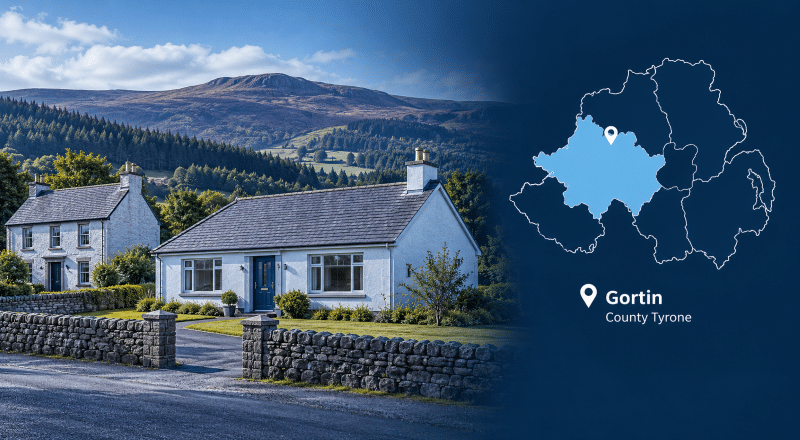
Gortin sits in a distinctive part of County Tyrone. The village lies close to Gortin Glen Forest Park and at the south-western gateway to the Sperrin Area of Outstanding Natural Beauty. That setting is part of its appeal, but it can also mean a mortgage application needs to describe a property carefully, particularly when land, outbuildings, private access, non-standard services, or a rural location form part of the security.
The purpose of advice is therefore not to make the application sound simpler than it is. It is to make it accurate enough for the right lenders to assess.
At a glance: Mortgage Broker in Gortin
- Gortin is a village in County Tyrone in the BT79 postcode area.
- Gortin Glen Forest Park is around six miles from Omagh.
- The village sits at the south-western gateway to the Sperrin Area of Outstanding Natural Beauty.
- Rural setting, access, acreage, outbuildings and property condition can all matter to lender assessment.
- The average house price across Fermanagh and Omagh was £202,000 in April to June 2026, up 11.0% year-on-year.
- Average advertised private rent in South West Northern Ireland was £662 a month in July 2026.
- A local postcode is useful context, but adviser experience with the borrower and property type can be more important than physical distance.
Why the property should shape the mortgage search
A Gortin mortgage adviser should begin with the property as well as the person buying it.
A straightforward modern home on a recognised residential road may fit many lenders’ standard criteria. A detached home with several acres, agricultural buildings, a shared lane, private drainage, or mixed residential and business use may require a more selective lender search.
Before an adviser compares products, it is useful to establish:
- the full property address and tenure;
- the purchase price or current estimated value;
- construction type and approximate age;
- the amount of land included;
- whether there are barns, workshops, annexes or other outbuildings;
- the access arrangements and whether any road is private or shared;
- whether water, drainage or other services are private;
- whether any part of the property is used for a business or let separately;
- deposit size, income, commitments and credit history.
This information helps prevent a low headline rate from becoming a poor match later in the process.
Buying a home in and around Gortin
Buying in a rural village can raise different questions than buying a standard suburban property.
The lender will still assess affordability and creditworthiness, but the valuer may also need to consider the property’s marketability and the exact extent of the security.
This becomes particularly relevant when a home has a larger site, substantial outbuildings, unusual access arrangements, or features that don’t fit a lender’s standard residential appetite.
For first-time buyers, the practical priority is to understand the total cost before making an offer. Deposit, legal costs, valuation requirements, product fees and a realistic monthly payment should all be considered together.
A decision in principle can indicate what may be affordable, but it is not a mortgage offer and does not confirm the lender will accept a particular property.
That distinction matters. Knowing what you can borrow is only half the equation; the property must also meet the lender’s criteria.
When your existing mortgage rate is ending
A fixed or discounted deal ending creates a useful decision point rather than an automatic reason to move lenders.
If your current deal is approaching expiry, advice on mortgage rate endings can help you compare a product transfer with your existing lender against remortgage options elsewhere.
The comparison should include more than the interest rate. Consider:
- arrangement and product fees;
- valuation and legal costs;
- cashback or other incentives;
- early repayment charges;
- the remaining mortgage term;
- changes to monthly payments;
- the total cost over the period you expect to keep the new deal.
A Mortgage Broker in Gortin can also consider whether your circumstances have changed since the original mortgage.
New employment, self-employment, additional borrowing, a lower loan-to-value, changes in household income or alterations to the property may influence which route is suitable.
Sometimes staying with the existing lender is appropriate. Sometimes a wider remortgage search produces a better overall result. The useful question is not simply “Which rate is lower?” but “Which option works better after the full cost and criteria are considered?”
Buy-to-let in a smaller rural market
A property you intend to let needs a different assessment from a home you will occupy yourself.
Rental demand, achievable rent, property type and likely tenant profile all matter.
The latest ONS data places average advertised private rent at £662 a month in South West Northern Ireland in July 2026. That is a broad rental-market statistic rather than a rental valuation for an individual Gortin property. A lender or surveyor will normally consider the rent realistically achievable for the specific property.
First-time landlords may benefit from first-time landlord mortgage advice.
An experienced investor with several mortgaged properties may instead require portfolio landlord mortgage advice, particularly where the lender must assess borrowing across an existing portfolio.
If you’re considering a company structure, limited company buy-to-let advice can explain the mortgage implications.
Mortgage advice and tax advice are different disciplines. Borrowers considering personal versus company ownership should obtain appropriate tax advice before deciding how a property should be held.
In a smaller rural rental market, the exit strategy also deserves attention. A property should not be selected solely because a theoretical rental yield appears attractive. Location, future demand, maintenance, resale prospects and the lender’s valuation all contribute to the wider picture.
Land, building work and short-term finance
Not every property fits neatly into a standard residential mortgage from the beginning.
A property requiring substantial works, one with an unusual existing use, or one purchased as part of a larger building project may require specialist funding.
Depending on the circumstances, relevant routes may include short-term bridging finance or development finance.
With short-term borrowing, the exit strategy is particularly important.
A lender will normally want to understand how the borrowing is expected to be repaid, whether through:
- sale of the completed property;
- refinance onto a longer-term mortgage;
- repayment from another evidenced source; or
- another clearly defined strategy acceptable to the lender.
The same principle applies to rural property more generally: flexibility should not be confused with suitability.
Short-term finance can carry higher rates and fees than conventional mortgage borrowing. Its purpose, cost, duration and repayment strategy should therefore be understood before proceeding.
Business premises and mixed-use property
Homes, small businesses and rural enterprises can sometimes sit surprisingly close together.
That means the description of the property matters.
If premises are primarily being used for trading rather than as a home, a conventional residential mortgage may not be appropriate.
Borrowers purchasing or refinancing premises used for their own business can seek owner-occupied commercial mortgage advice.
If the need is working capital or another business purpose rather than property purchase, business loan advice may be more relevant.
Mixed-use cases need particular care.
A lender may want to understand:
- how much of the property is residential;
- how much is used commercially;
- whether customers visit the premises;
- whether employees work there;
- whether there are separate leases;
- whether business buildings form part of the title;
- access arrangements; and
- how a valuer is likely to assess the property.
Giving an adviser the complete picture at the outset is usually more useful than discovering a material property feature after a lender has already been approached.
Compare mortgage rates, but compare the whole deal
A rate can attract attention; suitability is what makes it useful.
You can compare UK mortgage rates and costs to review current products, estimated repayments and lender fees.
Treat those results as a starting point rather than evidence that a particular lender will approve either the applicant or the property.
A Mortgage Broker in Gortin can then help narrow the market according to factors such as:
- income and employment structure;
- deposit or equity;
- credit history;
- loan-to-value;
- property construction;
- land and outbuildings;
- intended property use;
- mortgage term;
- lender affordability calculations; and
- individual underwriting criteria.
Two products displaying similar interest rates can have very different fees, incentives, early repayment charges and eligibility rules.
The most useful comparison is therefore not necessarily the product appearing first on a rate table. It is the mortgage that remains suitable after you consider cost, criteria, property, and personal circumstances together.
Protection advice should sit beside the mortgage conversation
A mortgage is a long-term commitment. The discussion should therefore extend beyond obtaining the loan.
Protection and mortgage insurance advice can help clients consider how mortgage payments or household finances might be affected by death, serious illness, or loss of income, depending on the policy type and its terms.
A Mortgage Broker in Gortin may discuss protection requirements alongside the mortgage while making clear that any recommendation should reflect the client’s:
- existing protection;
- employment benefits;
- household income;
- dependants;
- outstanding borrowing;
- budget; and
- personal priorities.
Protection policies can contain exclusions, qualifying periods, limits and eligibility requirements.
The value of protection lies in understanding what it does and does not cover before you need it, rather than treating insurance as an automatic addition to a mortgage application.
Later-life borrowing and equity release in County Tyrone
For some homeowners, the next financial decision may be less about buying another property and more about how an existing home fits future plans.
Connect Lifetime provides information about equity release advisers in County Tyrone, including lifetime mortgages and the property considerations that can arise with later-life borrowing.
For a home in or around Gortin, a property assessment may still be important. Acreage, outbuildings, access, construction and marketability can influence whether a property meets a provider’s criteria.
Equity release can reduce an estate’s value and may affect entitlement to means-tested benefits.
With a lifetime mortgage, interest can also be added to the loan when it is not paid monthly, meaning the amount owed can increase over time.
Alternatives, future borrowing needs, moving plans and the longer-term effect on the homeowner and their estate should therefore be considered before proceeding.
What to prepare before speaking to an adviser
A productive mortgage conversation starts with facts, not assumptions.
Depending on your circumstances, consider gathering:
- recent payslips;
- evidence of bonuses, overtime or commission;
- self-employed accounts or tax information where applicable;
- recent bank statements;
- details of loans, credit cards and other commitments;
- proof of deposit and evidence of its source;
- your existing mortgage statement when remortgaging;
- property particulars;
- information about land or outbuildings;
- details of unusual construction;
- information about private access or services;
- details of any planned letting;
- information about business use; and
- identification and address evidence.
For a rural property, clear estate-agent particulars, title information, or plans showing the property’s extent can help an adviser understand the case before deciding which lenders may be appropriate.
Preparation does not guarantee approval. However, it can make the initial lender search more precise.
Choosing mortgage advice for Gortin
The closest adviser is not automatically the best adviser.
Local knowledge can help, but relevant experience may matter more.
Ask whether an adviser regularly deals with the kind of borrowing and property involved.
For a conventional home, strong knowledge of residential lenders may be sufficient. For rural, landlord, commercial, bridging, or development cases, specialist experience may matter more.
Before proceeding, consider asking:
- Which lenders and mortgage products can you consider?
- Do you regularly advise on properties similar to mine?
- How will unusual property features be presented to a lender?
- What fees will I pay and when?
- How will you communicate with me?
- What documents do you need before making a recommendation?
- What happens if the first lender does not accept the property?
- Does the adviser or firm hold the appropriate regulatory permissions?
A Mortgage Broker in Gortin should make the process easier to understand without pretending every case is simple.
Good advice connects three things that cannot sensibly be separated: the borrower’s plans, the lender’s rules and the property’s actual characteristics.
Start with the right questions
Gortin’s landscape helps give the village its identity. The same individuality can apply to the properties within and around it.
Before focusing on a rate, understand the property.
Before focusing on maximum borrowing, understand the monthly commitment.
Before choosing an adviser, understand whether their experience matches the case.
That sequence can turn a mortgage search from a list of products into a clearer financial decision.
Most buy-to-let mortgages and commercial lending are not regulated by the Financial Conduct Authority. Regulatory treatment can depend on the transaction’s circumstances.