Buy-to-Let Mortgages for Non-UK Residents: Living outside the UK does not necessarily prevent you from financing a UK rental property.
However, lenders may assess a non-UK resident application differently from a standard UK buy-to-let case. Your country of residence, income currency, deposit, UK connections and intended ownership structure may all affect the available options.
Connect Experts helps overseas landlords and property buyers find mortgage advisers with relevant buy-to-let and international lending experience.
Find a buy-to-let mortgage adviser
A non-UK resident may be able to obtain a buy-to-let mortgage for a UK property.
However, the available lenders and products may be more limited. Lenders can examine:
- Your country of residence
- Your nationality and residency status
- Your income and its currency
- The source of your deposit
- Expected rental income
- Your UK credit history and bank account
- The property type and location
- Whether you are buying personally or through a company
- Your experience as a landlord
The property must usually produce enough rent to satisfy the lender’s rental affordability calculation.
You should also consider UK tax, purchase costs and landlord responsibilities separately from mortgage eligibility.
What is a non-UK resident buy-to-let mortgage?
A non-UK resident buy-to-let mortgage is used to buy or refinance a UK property that will be rented to tenants.
It may be suitable for:
- British expatriates living or working abroad
- Foreign nationals investing in UK property
- UK nationals who have moved overseas
- Returning expatriates buying before moving home
- Overseas portfolio landlords
- Applicants receiving income in a foreign currency
- Directors of overseas companies
- Buyers using a UK limited company
The term “non-UK resident” refers to an applicant’s place of residence. It does not automatically describe their nationality or tax status.
A British citizen living in Dubai may be a non-UK resident. A foreign national living and working in the UK may be assessed as a UK resident.
Lenders establish residency using their own criteria. Tax residency is a separate matter and should be discussed with a qualified tax professional.
Can a non-UK resident obtain a UK buy-to-let mortgage?
Yes. Some lenders consider applications from people living outside the UK.
However, eligibility is not universal. A lender may only accept applicants from certain countries or receiving income in approved currencies.
The assessment can also depend on:
- How long you have lived overseas
- Your employment or business history
- Whether you previously lived in the UK
- Your existing UK assets
- Your experience of owning rental property
- The proposed tenancy
- The property’s expected rent
- The size and source of your deposit
Applicants should not assume that acceptance by one lender means acceptance across the market.
A mortgage adviser can compare your circumstances against individual lender criteria before an application is submitted.
How lenders assess an overseas applicant
Non-UK resident applications often involve two connected assessments.
The first considers whether the borrower is acceptable. The second considers whether the property and expected rent support the proposed borrowing.
Country of residence
Some lenders maintain lists of accepted countries.
They may consider local financial regulation, identity verification, sanctions requirements and their ability to complete checks in that jurisdiction.
Acceptance can change. Therefore, an applicant should confirm current lender criteria before paying valuation or legal fees.
Nationality and residency status
A lender may distinguish between:
- British expatriates
- Foreign nationals
- Applicants with indefinite leave to remain
- People holding temporary visas
- Dual nationals
- Returning UK residents
British citizenship can help with some lenders, but it does not guarantee approval.
Overseas income
Lenders may review salary, bonuses, commission, business profits, pensions or investment income received overseas.
They can request:
- Employment contracts
- Payslips
- Bank statements
- Tax returns
- Accounts
- Employer references
- Evidence of continuing employment
Documents may need certified translations where they are not written in English.
Foreign currency income
Income paid in another currency can create exchange-rate risk.
A lender may convert the income into sterling and apply a reduction before using it within its assessment. This provides an allowance for currency movements.
The currencies a lender accepts can vary. Income in a widely traded currency does not guarantee that every lender will accept it.
UK credit history
A limited UK credit record can reduce the number of suitable lenders.
Some lenders may look for:
- A UK correspondence address
- A UK bank account
- Existing UK borrowing
- Previous UK mortgage history
- Electoral roll information
- Evidence of earlier UK residence
Other lenders may consider applicants without an established UK credit footprint.
Deposit and source of funds
Non-UK-resident applicants may need to pay a larger deposit than some UK-based landlords require. The required amount depends on the lender and application.
The lender and solicitor will also need to establish the source of the funds.
Acceptable evidence may include:
- Savings statements
- Property sale documents
- Investment account statements
- Business income records
- Inheritance documents
- Gifted deposit evidence
Money moving between several accounts or countries may require further explanation.
How is buy-to-let affordability calculated?
Buy-to-let affordability usually focuses on the rent the property could reasonably achieve.
The lender compares the expected monthly rent with a stressed mortgage payment. This is often called an interest coverage ratio assessment.
The calculation may be affected by:
- The expected monthly rent
- The mortgage balance
- The lender’s stress rate
- The applicant’s tax position
- Whether the product has a fixed rate
- Whether the applicant owns other rental properties
- The proposed ownership structure
For example, the lender may require the rent to cover more than the calculated monthly mortgage interest. The exact percentage and stress rate vary.
A higher rent does not always result in a higher loan amount. The property value, the product loan-to-value limit, and the lender’s policy also place limits on borrowing.
The valuer normally provides an opinion of the property’s market rent. An estate agent’s estimate may help with planning but does not bind the lender.
For a broader explanation, read the non-UK resident buy-to-let mortgage guide.
What documents may be required?
Document requirements differ, but applicants should prepare for a more detailed verification process.
A lender or adviser may request:
- Passport or national identity document
- Overseas residential address evidence
- Visa or residency documents
- Recent personal bank statements
- Evidence of employment
- Payslips or overseas tax returns
- Company accounts for business owners
- Proof of deposit
- Evidence showing the source of funds
- UK bank account statements
- Existing mortgage statements
- A schedule of owned properties
- Current tenancy agreements
- Rental income statements
- Details of personal and business debts
The solicitor may ask for separate information to meet identity, source-of-funds and anti-money-laundering requirements.
Preparing documents early can reduce delays. However, documents should remain current at the time of application submission.
Does the type of property matter?
Yes. Lenders assess both the borrower and the proposed security.
A lender may have restrictions concerning:
- Flats above commercial premises
- Ex-local authority properties
- High-rise buildings
- Short leases
- Studio flats
- Houses in multiple occupation
- Multi-unit properties
- Holiday lets
- New-build properties
- Properties requiring substantial work
- Unusual construction methods
The property must normally be suitable for letting and sale within the lender’s chosen market.
Licensing rules may also apply. These can vary between local authorities and should be checked before purchase.
Buying personally or through a limited company
Some overseas landlords buy property in their personal name. Others consider a UK limited company.
The two routes can produce different mortgage, tax, legal and administrative consequences.
A lender assessing a limited company may examine:
- The company’s registered activities
- Directors and shareholders
- Ownership percentages
- Personal guarantees
- The deposit source
- The directors’ countries of residence
- The property’s rental income
- Existing company borrowing
Many property companies used for buy-to-let are Special Purpose Vehicles. However, definitions of lenders and accepted company structures differ.
A limited company is not automatically more tax-efficient. Applicants should obtain independent tax and legal advice before deciding how to buy.
Read the limited company BTL mortgage guide for expats for a focused explanation.
What costs should overseas buyers consider?
The deposit is only one part of the required budget.
A non-UK resident may also need to consider:
- Mortgage arrangement fees
- Adviser fees
- Property valuation fees
- Conveyancing costs
- International money transfer charges
- Currency conversion costs
- Property searches
- Landlord insurance
- Letting and management fees
- Maintenance costs
- Licensing expenses
- Tax advice
- Purchase taxes
Some fees may be added to the mortgage, subject to lender criteria. This increases the balance and can increase the total interest paid.
Currency movements can also change the sterling value of the deposit, fees and mortgage payments.
Stamp Duty Land Tax for non-UK residents
A non-UK resident purchasing residential property in England or Northern Ireland may need to pay a non-resident Stamp Duty Land Tax surcharge.
Higher rates may also apply when the buyer owns another residential property. The detailed tests can depend on the buyer, the transaction, and the ownership structure.
Scotland and Wales operate different property transaction taxes.
Applicants should check the current Stamp Duty Land Tax rules for non-UK residents and obtain professional tax advice before exchanging contracts.
Mortgage advisers can explain the mortgage process. They should not replace advice from a qualified tax specialist or solicitor.
Tax on UK rental income
Someone living overseas can still have UK tax responsibilities when receiving rent from a UK property.
HMRC’s Non-resident Landlords Scheme applies where a landlord’s usual place of abode is outside the UK. It can affect how tax is deducted from rental income by a letting agent or tenant.
A landlord may apply to receive rent without tax being deducted. This does not remove the responsibility to report taxable rental income or pay any tax due.
Read HMRC’s guidance on the Non-resident Landlords Scheme.
Tax treatment depends on personal circumstances and can change. Independent tax advice is important before proceeding.
British expats and foreign national applicants
The terms “expat” and “non-UK resident” often overlap, but they are not interchangeable.
An expat is commonly a person living outside their home country. Within UK mortgage lending, it often refers to a British national living abroad.
A foreign national living overseas may be assessed under separate lender criteria.
Applicants who are British citizens living abroad can search for expat mortgage brokers with experience of overseas income and UK property finance.
The correct adviser category depends on the applicant’s residency, nationality, income, and intended use of the property.
Common reasons applications become more complex
An application may require closer assessment where:
- The deposit comes from several countries
- Income is received in multiple currencies
- The applicant is self-employed overseas
- The property is an HMO
- The buyer has no UK credit history
- The applicant lives in a country outside a lender’s accepted list
- The property is being purchased through a company
- The applicant owns several UK rental properties
- The tenancy is not a standard assured shorthold tenancy
- The property has an unusual construction or lease
- The applicant intends to return to the UK soon
- The property will sometimes be occupied by family
These circumstances do not automatically prevent borrowing. However, they may reduce the number of lenders willing to consider the application.
How a mortgage adviser can help
Non-UK resident mortgage criteria can differ substantially between lenders.
A suitably experienced adviser can:
- Establish which lenders accept your country of residence
- Check whether your income currency is acceptable
- Review likely deposit requirements
- Explain lender rental calculations
- Identify required documents
- Consider personal and company borrowing routes
- Review property restrictions
- Explain likely mortgage fees
- Prepare the case before submission
- Communicate with the lender during underwriting
An adviser cannot guarantee approval. The lender makes the final decision after completing its checks, valuation and underwriting.
Frequently asked questions
Can I get a UK buy-to-let mortgage while living abroad?
Some lenders accept applications from people living abroad. Eligibility depends on the country of residence, income, deposit, property and lender criteria.
Do I need to be a British citizen?
Not always. Some lenders consider foreign nationals living outside the UK. The available options may differ from those offered to British expatriates.
Do I need a UK bank account?
Some lenders require one, while others may accept an account opened before completion. The adviser should check this at the start.
How much deposit will I need?
The required deposit varies. Non-UK residents may face lower maximum loan-to-value limits than some UK residents. Property and borrower details also affect the requirement.
Can overseas rental income support the application?
Lenders usually focus on the expected rent from the UK property being mortgaged. They may also review other rental income and personal income.
Can I buy through a UK limited company?
Some lenders accept UK limited companies owned or directed by overseas residents. Company structure, personal guarantees and country of residence may affect eligibility.
Will the lender accept foreign currency income?
Possibly. Each lender maintains its own accepted currency policy and may reduce converted income to allow for exchange-rate movements.
Can a first-time landlord living abroad apply?
Some lenders accept first-time landlords living overseas. Others require previous landlord or property ownership experience.
Is a non-UK resident mortgage more expensive?
Rates and fees can differ from standard UK resident products because fewer lenders may compete for this business. Pricing depends on the application and market at the time.
Does Connect Experts provide mortgage advice?
Connect Experts helps users find mortgage advisers. The selected adviser assesses the applicant’s needs and provides regulated advice where applicable.
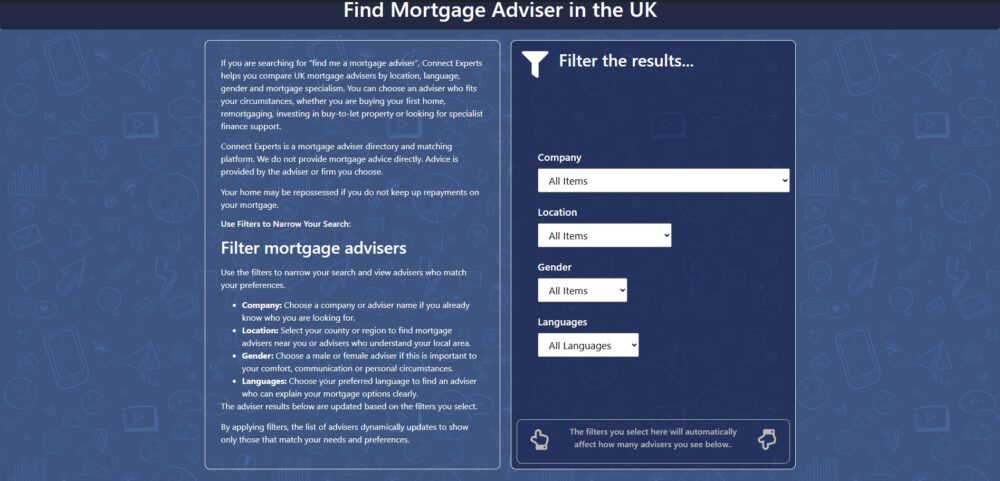
Find an adviser through Connect Experts
Connect Experts is a directory of mortgage advisers.
You can use the directory to search for an adviser by:
- Mortgage expertise
- Location
- Language
- Gender
- Communication preference
- Relevant experience
The directory does not assume that one adviser will suit every overseas applicant. Mortgage decisions are shaped by the details behind the application.
Residence is one fact. Currency, property, rent, deposit and future plans complete the picture.
Search for buy-to-let mortgage brokers