
Buying Your First Home Without the Uncertainty: A first-home purchase becomes easier to manage when each decision is made in the correct order.
Before viewing properties, check affordability, your credit records, deposit source and likely purchase costs. Then use the Connect Experts directory to compare first-time buyer mortgage advisers.
Why Does Buying a First Home Feel Complicated?
A mortgage application sits inside a wider legal and financial transaction.
The buyer must consider:
- Mortgage affordability
- Deposit evidence
- Property condition
- Legal searches
- Survey findings
- Insurance
- Tax, where applicable
- Completion funds
These stages often overlap. Therefore, uncertainty usually comes from timing rather than any single document.
The practical answer is to separate the purchase into decisions.
Stage One: Establish a Realistic Buying Budget
A lender’s maximum loan is not necessarily a comfortable personal budget.
Lenders may examine:
- Basic salary
- Overtime, commission or bonuses
- Self-employed income
- Credit commitments
- Childcare
- Student loan deductions
- Dependants
- Household expenditure
- Mortgage term
- Expected interest-rate stress
A buyer should also estimate future ownership costs.
These may include Council Tax, utilities, insurance, service charges and repairs.
A mortgage adviser can review lender criteria. However, the buyer must still decide what monthly commitment feels sustainable.
Stage Two: Prepare the Deposit Evidence
The deposit must normally be evidenced before the mortgage completes.
A lender or solicitor may ask for:
- Savings statements
- Investment statements
- Evidence of a Lifetime ISA
- Gifted-deposit documentation
- Proof of inheritance
- Evidence from a property sale
- An explanation of large account transfers
Moving funds repeatedly between accounts can create avoidable questions.
Keep a clear record showing where the money came from and how it accumulated.
Stage Three: Check Your Credit Information
Credit reports can contain old addresses, linked accounts or errors.
Reviewing them early gives time to correct inaccurate information.
Avoid making several speculative credit applications. Multiple searches can complicate a later assessment.
An Agreement in Principle may involve a soft or hard search. The method depends on the lender.
Stage Four: Request an Agreement in Principle
An Agreement in Principle provides an early indication of potential borrowing.
It is not a mortgage offer.
The lender can still reconsider the case after reviewing:
- Full documents
- The property valuation
- The application details
- Updated credit information
- Changes in circumstances
Treat the agreement as a budgeting tool rather than a guarantee.
Stage Five: Assess the Property
A buyer can be financially suitable while the property remains unacceptable to the lender.
Possible concerns include:
- Short leases
- Non-standard construction
- Structural movement
- High-rise cladding
- Restrictive covenants
- Unusual planning arrangements
- Significant commercial use nearby
- New-build incentives
Tell the adviser about the property before paying non-refundable fees.
Stage Six: Submit the Full Application
The mortgage application should accurately reflect the evidence provided.
Avoid changing jobs, increasing borrowing or taking new credit without first considering the effect on the application.
A lender may repeat checks before completion.
A More Useful Way to Think About the Process
Fear grows when every part of the purchase appears to require an immediate decision.
In practice, the process has an order:
- Understand the budget.
- Evidence the deposit.
- prepare the documents.
- Obtain an early lending indication.
- Find a suitable property.
- Complete the legal and mortgage checks.
Buying a home remains a major commitment. However, preparation replaces uncertainty with defined questions.
How Can Connect Experts Help?
Connect Experts does not provide mortgage advice directly. It helps users compare adviser profiles.
You can search by location, language and relevant mortgage experience through the mortgage adviser directory.
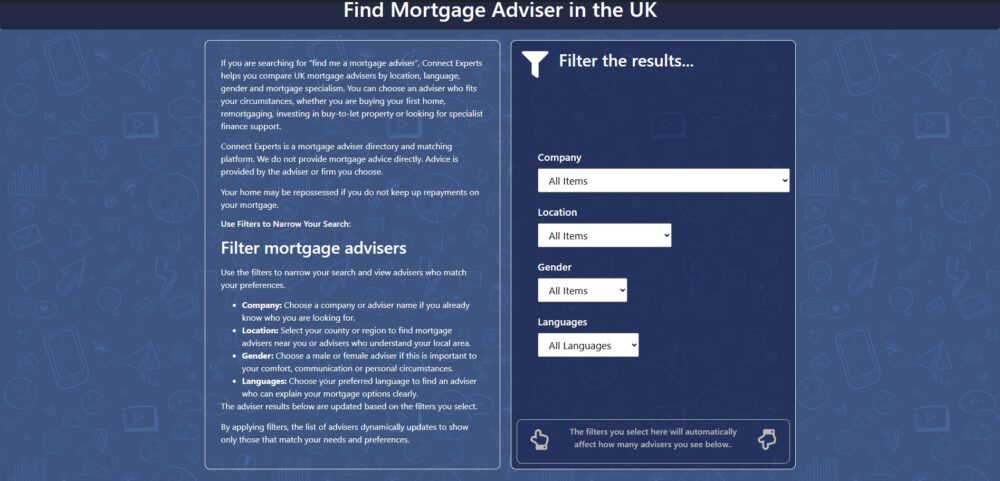
The most useful adviser is not always the nearest one. Relevant experience and clear communication may matter more.