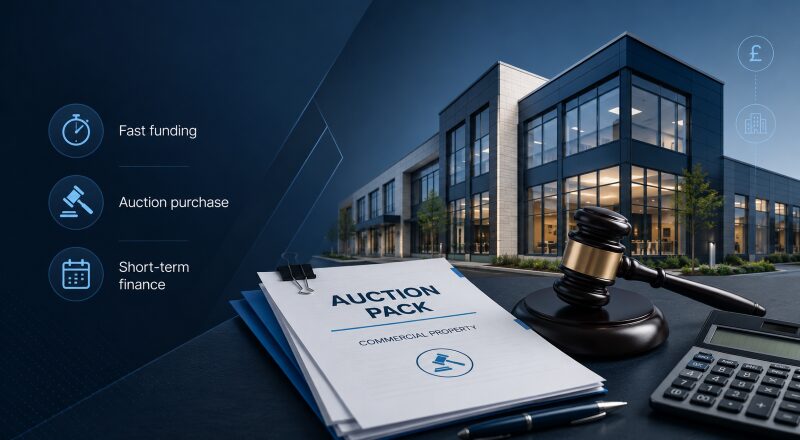
Commercial Auction Bridging Loans: A commercial auction purchase is governed by the clock.
Once the hammer falls, the buyer normally becomes legally committed. The completion deadline appears in the auction contract rather than the buyer’s preferred mortgage timetable.
Commercial auction bridging loans provide short-term funding when a standard commercial mortgage may not be completed within that period.
The loan is not simply a faster commercial mortgage. It is a temporary facility requiring a defined repayment route.
At a Glance
Commercial auction bridging finance may help fund a business or investment property bought through an auction.
Lenders usually examine:
- The auction legal pack
- The property value and condition
- The borrower’s deposit
- The required completion date
- Existing charges against the property
- The intended use of the building
- The proposed repayment strategy
The exit might involve selling the property or refinancing through a longer-term commercial mortgage.
Why auction deadlines change the finance process
Private treaty purchases often allow more time for surveys, lender decisions and legal enquiries.
Auction purchases work differently. Buyers may have only a few weeks to complete after exchanging contracts.
Failing to complete can place the deposit at risk. The seller may also pursue other losses permitted under the auction conditions.
This makes preparation important before bidding.
The buyer should understand the legal pack, finance position and likely property value before making a binding commitment.
What property can commercial auction bridging cover?
Commercial auction bridging may be considered for:
- Shops and retail units
- Offices
- Warehouses
- Workshops
- Industrial units
- Restaurants
- Public houses
- Care-related premises
- Commercial investments
- Mixed-use buildings
- Vacant business premises
Property type matters because lenders do not treat every commercial building equally.
A vacant specialist building may present a different resale risk from a fully let office with an established tenant.
How lenders assess an auction bridge
The property value
The lender usually arranges an independent valuation.
The valuation may consider market value, vacant possession value and suitability for the intended use.
The auction price alone does not determine the amount available.
The deposit and loan-to-value
The borrower normally needs to contribute funds.
Maximum lending is usually expressed as a percentage of the lender’s accepted property value.
Interest and fees may reduce the net amount released where they are added to the facility.
The legal pack
Commercial legal packs may contain:
- Title information
- Special auction conditions
- Existing leases
- Restrictive covenants
- Planning documents
- Searches
- Tenancy details
- Service charge information
An adviser and solicitor should understand the completion deadline from the beginning.
The exit strategy
A bridging loan must be repaid.
Common exits include:
- Refinancing onto a commercial mortgage
- Selling the property
- Selling another asset
- Repayment from confirmed business funds
A possible future sale is not always enough. The lender will usually consider whether the exit is reasonable.
Auction bridge to commercial mortgage
Some buyers use bridging finance to complete, followed by a longer-term commercial mortgage.
This may be considered where:
- The auction deadline is too short
- The property requires minor works
- A tenant must be installed
- Updated accounts are being prepared
- The building must become operational
- Planning or licensing matters remain outstanding
The long-term finance should be examined before the bridge begins.
A proposed refinance can fail if the eventual commercial mortgage criteria are not satisfied.
Read the UK Commercial Mortgage Guide to understand how longer-term commercial borrowing is assessed.
Costs to examine before bidding
Commercial bridging costs may include:
- Interest
- Lender arrangement fees
- Valuation charges
- Legal costs
- Adviser fees
- Telegraphic transfer charges
- Administration fees
- Exit charges, where applicable
Interest may be paid monthly, retained from the advance or added to the balance.
The calculation method affects both the net loan and final repayment figure.
Questions to ask an adviser
Before bidding, ask:
- Can the lender meet the stated deadline?
- Has the legal pack been reviewed?
- What value will the lender use?
- How much cash must I contribute?
- Is the property acceptable security?
- How will interest be charged?
- What could prevent the planned refinance?
- What happens if completion is delayed?
- What happens if the exit takes longer?
A decision made before the auction is usually stronger than a hurried search afterwards.
Frequently asked questions
Can a bridging loan fund a commercial auction purchase?
It may be considered where a commercial property must complete within a short auction deadline. Lending remains subject to valuation and criteria.
Should finance be arranged before bidding?
Buyers should examine funding before making a binding bid. An agreement in principle is not a guarantee of completion.
Can the bridge be repaid through a commercial mortgage?
Potentially. The future property use, borrower, income and valuation must meet the commercial mortgage lender’s requirements.
Are commercial auction bridges FCA regulated?
Some arrangements may not be regulated. However, regulatory status depends on the borrower, security and property use.
What happens if the exit is delayed?
Interest and other costs may continue. The borrower should speak with the lender and adviser before the term expires.
Find an adviser for commercial auction finance
Connect Experts does not provide mortgage advice directly.
The directory helps you compare advisers by location, language, preferences and relevant mortgage experience.
Use the Commercial Mortgage Adviser Search to find an adviser who can review the property, the deadline, and the intended exit.
Commercial auction borrowing depends on preparation. Speed matters, but structure determines whether the loan remains workable.