Complex income mortgages are not a separate mortgage product. It describes an income-related application that requires more detailed assessment.
This may include bonuses, commission, dividends, retained profits, contract income, rent, overtime or earnings from several sources.
The income may be strong and sustainable. However, it may not fit a lender’s standard salary calculation.
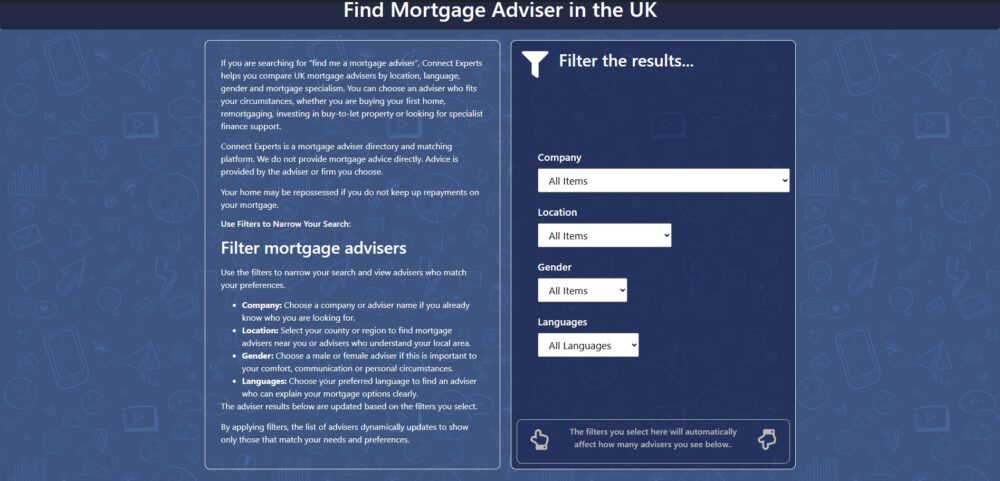
Connect Experts helps you find mortgage advisers who understand how different lenders assess complex income. You can compare advisers by location, expertise, language and personal preference.
Connect Experts is a directory of mortgage advisers. It does not provide mortgage advice directly. Advice is provided by the adviser or firm you choose.
At a Glance
- Complex income may include several, irregular or non-salaried income sources.
- Lenders do not all calculate complex income in the same way.
- Evidence, history and sustainability can be as important as the income amount.
- Bonuses, dividends, overtime and contract earnings may be treated differently.
- A mortgage adviser can explain which lender criteria may fit your circumstances.
- You can use the Connect Experts Mortgage Adviser Directory to compare suitable UK advisers.
What Is a Complex Income Mortgage?
A complex income mortgage is a mortgage application where the applicant’s earnings require more interpretation than a standard monthly salary.
The term usually describes the applicant’s financial position rather than a specific mortgage product.
An applicant may have one large income source or several smaller sources. The important question is whether those earnings are acceptable, evidenced and sustainable under a lender’s criteria.
Complex income can include:
- salary with regular bonuses
- commission or performance-related pay
- overtime and shift allowances
- self-employed profits
- company director salary and dividends
- retained profits within a limited company
- fixed-term or day-rate contract income
- freelance and consultancy earnings
- income from several employments
- rental income
- investment or trust income
- maintenance payments
- pension income
- foreign currency earnings
Not every lender accepts every income type. Those that do may use different percentages, periods and calculations.
Why Can Complex Income Affect a Mortgage Application?
A lender must decide whether mortgage repayments are affordable now and over the mortgage term.
Financial Conduct Authority rules require regulated lenders to consider income and household expenditure. They must also consider the possible effects of future interest rate increases. Read the FCA responsible lending requirements.
A straightforward salary is often easier to verify through payslips, bank statements and a P60.
Complex income can require more questions:
- How long has the income been received?
- Is it guaranteed, regular or discretionary?
- Is the latest figure representative?
- Could the income reduce?
- Is it declared for tax purposes?
- Can it continue after the mortgage completes?
- Does the applicant control how the income is paid?
- Is the income received in sterling or another currency?
The difficulty is therefore often one of evidence and calculation.
A complex income is not automatically an unreliable income. It is an income that may require a more detailed explanation.
Which Borrowers May Have Complex Income?
Company directors
A limited company director may receive a salary, dividends or both.
Some lenders assess salary and dividends. Others may consider the applicant’s share of company profit. A smaller group may review retained profits where their criteria permit.
The adviser may need to understand:
- ownership percentage
- latest company accounts
- trading performance
- dividends already taken
- retained profits
- business liabilities
- recent changes in remuneration
Applicants in this position can also review the Self-Employed Mortgage Brokers directory page.
Contractors and consultants
Contractors may be assessed using completed accounts, tax calculations or contract value.
The approach can depend on:
- the length of the current contract
- previous contracts
- gaps between assignments
- day or hourly rate
- remaining contract term
- employment structure
- industry experience
A high annual contract value does not mean every lender will use the same income calculation.
Employees receiving bonuses or commission
Some lenders use all regular variable pay. Others apply a percentage or calculate an average.
They may examine:
- recent payslips
- the latest P60
- year-to-date earnings
- bonus frequency
- whether payments are contractual
- previous annual totals
- employer confirmation
A one-off bonus may receive different treatment from an established quarterly payment.
Applicants with several jobs
Some people receive income from a main role and one or more secondary jobs.
ONS data showed that 1.301 million people had second jobs between May and July 2025. This represented 3.8% of people in employment.
A lender may consider secondary employment where it appears sustainable. Working hours and the history of that income may also matter.
Landlords receiving rental income
Rental income may contribute to an applicant’s wider financial position. However, lenders can distinguish between:
- personal residential income
- existing buy-to-let rent
- proposed rent from a new property
- company-owned rental income
- short-term or holiday letting income
The calculation may also account for mortgage payments, tax and property costs.
For property investment cases, users can compare Buy-to-Let Mortgage Brokers through the directory.
Applicants paid in foreign currency
Foreign income can introduce exchange-rate and transfer risks.
A lender may apply a reduction to the converted income. It may also restrict acceptable currencies, countries or employment arrangements.
The Foreign Currency Income Mortgage Guide explains common evidence and currency considerations.
Can Different Income Sources Be Combined?
Some lenders may combine acceptable income from several sources.
For example, an applicant might receive:
- a basic salary
- annual commission
- freelance income
- rent from an existing property
The lender may not use every source in full. It may use different calculations for each element.
One lender might average commission over two years. Another might use a percentage of the latest annual figure.
Freelance income could require tax records and a trading history. Rental income might be assessed separately against property costs.
This is why a high total income does not yield the same borrowing outcome across all lenders.
How Do Lenders Assess Complex Income?
Lender policies differ, but assessment often focuses on four principles.
1. Evidence
The lender needs documents that confirm the income exists.
Bank credits alone may not prove the source, tax position or future reliability of that income.
2. History
A longer record may make variable income easier to assess.
However, some lenders can consider applicants with shorter histories where the wider case meets their criteria.
3. Sustainability
Past income must provide reasonable evidence about future affordability.
A lender may consider the applicant’s occupation, contract position, company performance and likely continuity.
4. Affordability
Income is assessed alongside expenditure, credit commitments, mortgage term, dependants and the proposed repayment method.
A lender can accept an income source but still offer less than the applicant expected.
What Documents Might You Need?
Required documents depend on the income structure and lender.
Common evidence includes:
Employed applicants
- recent payslips
- latest P60
- personal bank statements
- employment contract
- bonus or commission records
- employer confirmation where required
Sole traders and partnerships
- SA302 tax calculations
- tax year overviews
- completed accounts
- business bank statements
- accountant details
- evidence of current trading
GOV.UK explains how applicants can obtain an SA302 tax calculation and tax year overview when proof of earnings is required for a mortgage.
Limited company directors
- finalised company accounts
- business bank statements
- personal tax calculations
- tax year overviews
- dividend vouchers
- shareholder information
- accountant’s certificate where accepted
Contractors
- current and previous contracts
- invoices
- bank statements
- employment history
- accounts or tax calculations
- details of contract gaps
Landlords
- tenancy agreements
- mortgage statements
- bank statements showing rent
- tax calculations
- property schedules
- evidence of operating costs
Foreign income applicants
- foreign payslips
- overseas tax documents
- employment contracts
- translated documents where required
- bank statements
- currency and payment evidence
Submitting clear documents early can reduce avoidable questions. It does not guarantee approval.
How Can a Mortgage Adviser Help?
A mortgage adviser can review how the income is earned before recommending a mortgage.
Their work may include:
- identifying all usable income sources
- checking which evidence is available
- explaining lender calculation differences
- assessing whether the income history may meet lender criteria
- reviewing affordability and financial commitments
- comparing suitable mortgage routes
- preparing the case for underwriting
- explaining costs, risks and conditions
The adviser cannot guarantee that a lender will approve the application.
They can, however, reduce the risk of applying to a lender whose published or known criteria do not fit the case.
When Might High-Net-Worth Mortgage Experience Matter?
Some complex income cases also involve substantial assets, larger loans or high-value property.
This can apply to:
- entrepreneurs
- senior executives
- professional firm partners
- investors
- portfolio landlords
- applicants with trusts
- people receiving significant overseas income
- borrowers with substantial assets but lower regular drawings
These cases may require assessment by a specialist lender, a large-loan team, or a private bank.
Where this reflects your position, you can compare high-net-worth mortgage brokers with experience in complex earnings and significant borrowing.
A high-value property alone does not remove the need for affordability and evidence.
How to Find a Complex Income Mortgage Adviser
The right adviser should understand the specific income structure involved.
Before choosing an adviser, consider asking:
- Do you regularly handle this income type?
- Which documents should I prepare?
- How might lenders calculate each income source?
- Do you advise on residential, buy-to-let or both?
- How will you assess affordability before applying?
- Which fees may apply?
- How will lender commission be explained?
- Who will manage the case after submission?
You can use Find Mortgage Advisers UK to search by location, mortgage expertise, language and personal preference.
Read each adviser’s profile before making contact. Check that their experience matches the mortgage and income involved.
Connect Experts does not recommend an adviser solely because they appear in a search result. You decide which listed adviser or firm to contact.
Preparing Before You Speak to an Adviser
A short preparation process can make the first discussion more useful.
Gather details of:
- every income source
- how long each source has been received
- annual and monthly amounts
- existing credit commitments
- deposit funds
- current mortgage balances
- property plans
- recent accounts and tax records
- contracts or bonus evidence
- expected changes to income
Do not alter how you draw income solely to support a mortgage application without taking appropriate tax and professional advice.
A mortgage decision should reflect a sustainable financial position, not only the largest figure available on paper.
Frequently Asked Questions
Is complex income a mortgage product?
No. The term describes an application involving income that requires detailed assessment. The mortgage itself may be a standard residential or buy-to-let product.
Can I get a mortgage with several income sources?
It may be possible. The lender will decide which sources it accepts and how much of each source it will use.
Can a lender use bonus or commission income?
Some lenders can consider regular bonuses or commission. They may average the income or use only a stated percentage.
Can retained company profits support a mortgage application?
Some lenders may consider retained profits for eligible company directors. Ownership, accounts, trading results and lender policy will matter.
How many years of accounts do I need?
Requirements vary. Many lenders request two or more years, while some may consider a shorter trading history.
Can contract income be used?
It may be accepted where the contract, employment record and future sustainability meet the lender’s criteria.
Can overseas income be included?
Some lenders accept foreign income. Currency, country, employer, tax position and exchange-rate treatment may affect the assessment.
Does having complex income mean I need a specialist lender?
Not always. Some high street lenders accept several complex income types. The suitable route depends on the complete application.
Will a larger deposit solve income problems?
A larger deposit can reduce the loan-to-value ratio. It does not replace the lender’s affordability assessment.
Does using a mortgage adviser guarantee approval?
No. Every application remains subject to lender criteria, affordability, valuation, status and underwriting.
Find an Adviser for a Complex Income Mortgage
Income does not need to be simple to be credible. It does need to be understood, evidenced and assessed under suitable lender criteria.
Use the Connect Experts Directory to compare UK mortgage advisers with experience in self-employment, contracts, bonuses, dividends, rental earnings and other complex income structures.
Choose an adviser whose experience matches your circumstances before arranging a detailed mortgage assessment.