A face-to-face meeting with a mortgage broker is an in-person appointment about your property plans and financial circumstances.
The adviser may review your income, deposit, commitments, credit history and preferred mortgage features. You can ask questions, examine figures and understand the likely application process.
Connect Experts helps you find mortgage advisers by location, specialism, language and other preferences. You can then contact a suitable adviser and ask whether they offer local, face-to-face appointments.
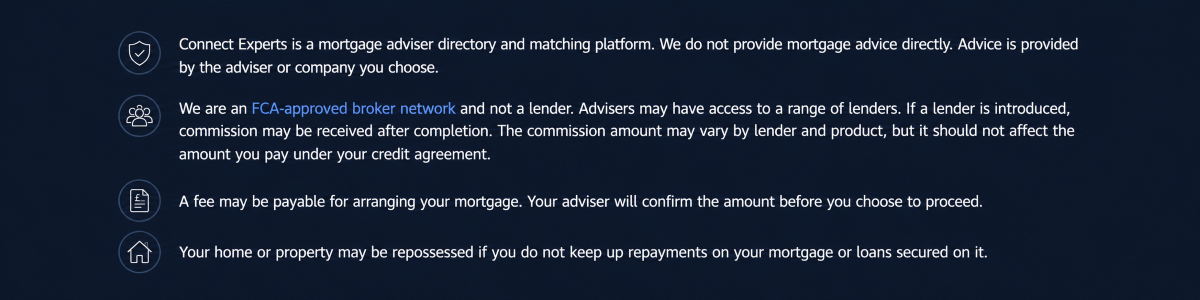
Important: Connect Experts is a mortgage adviser directory and matching platform. It does not provide mortgage advice directly. Advice is provided by the adviser or firm you select.
At a Glance
A face-to-face mortgage meeting can help when you prefer detailed discussion in person.
During the appointment, an adviser will usually:
- Discuss your property plans and borrowing needs
- Review your income, deposit and financial commitments
- Explain lender affordability and eligibility requirements
- Consider relevant mortgage options
- Explain costs, risks and possible next steps
- Request documents needed for further assessment
Prepare your documents and questions before attending. You can use the Connect Experts UK adviser directory to search for an adviser who may offer in-person appointments.
What Is a Face-to-Face Mortgage Meeting?
A face-to-face mortgage meeting is an appointment where you and an adviser meet in person.
The meeting may take place at:
- An adviser’s office
- Your home, where offered
- Another agreed professional location
- A property-related meeting venue
Availability depends on the adviser, your location and the service being discussed.
The meeting is not simply a presentation of mortgage rates. Its purpose is to understand your circumstances before any personal recommendation is made.
A suitable mortgage depends on more than the headline interest rate. Fees, mortgage term, repayment method and early repayment charges can affect the overall cost.
The real value of the meeting lies in turning financial information into a structured decision.
Who May Prefer an In-Person Appointment?
A face-to-face appointment may suit people who prefer discussing important financial decisions in person.
It may be particularly useful when:
- You want to review documents together
- Your income comes from several sources
- You are self-employed or work as a contractor
- Your credit history requires explanation
- You are purchasing your first property
- You own several rental properties
- Your proposed property is unusual
- You want another person to attend the discussion
- You find telephone or video meetings less comfortable
An in-person meeting is not automatically better than remote advice. The right format depends on your communication needs and circumstances.
Read online mortgage brokers versus local advisers before choosing how you want to meet.
What Happens During a Face-to-Face Meeting?
The exact appointment will depend on your needs. However, most initial mortgage meetings follow several practical stages.
1. Your Property Plans Are Discussed
The adviser will first establish what you want to achieve.
This may include:
- Buying your first home
- Moving to another property
- Remortgaging
- Purchasing a rental property
- Raising funds against an existing property
- Reviewing a current mortgage before its deal ends
You may also discuss your preferred timeframe and expected purchase price.
2. Your Financial Circumstances Are Reviewed
The adviser will need an accurate picture of your finances.
Topics may include:
- Employment and income
- Deposit or available equity
- Loans and credit commitments
- Household expenditure
- Dependants
- Credit history
- Existing properties
- Future financial changes
These details help the adviser assess which lenders and mortgage types may be relevant.
Providing complete information matters. A mortgage recommendation can only reflect the circumstances disclosed during the advice process.
3. Affordability and Eligibility Are Considered
Mortgage affordability is not based on salary alone.
Lenders may consider:
- Basic income
- Overtime, bonuses or commission
- Self-employed profits
- Contract income
- Rental income
- Existing credit commitments
- Household costs
- Mortgage term
- Interest-rate stress testing
- Loan-to-value
Different lenders can treat the same information differently. An adviser can explain how these differences may affect your potential application.
4. Mortgage Features Are Explained
Once your circumstances are understood, the adviser may explain relevant mortgage features.
These could include:
- Fixed interest rates
- Variable interest rates
- Tracker mortgages
- Repayment mortgages
- Interest-only arrangements
- Product fees
- Incentives
- Early repayment charges
- Overpayment allowances
- Mortgage portability
The discussion should cover both benefits and limitations. A low rate may not represent the lowest total cost.
5. Costs Are Reviewed
Your meeting should include a clear explanation of known or likely costs.
These may include:
- Adviser fees
- Lender arrangement fees
- Valuation fees
- Legal costs
- Survey costs
- Stamp Duty Land Tax, where applicable
- Early repayment charges on an existing mortgage
Ask whether fees are payable upfront, on application or following completion.
6. The Adviser Explains the Next Steps
The adviser may outline what is needed before an application can progress.
Possible next steps include:
- Supplying further documents
- Obtaining an agreement in principle
- Reviewing your credit report
- Confirming your deposit source
- Waiting for updated accounts or payslips
- Identifying a property
- Comparing suitable mortgage products
- Submitting a full mortgage application
An initial meeting does not guarantee that a lender will approve an application.
What Documents Should You Bring?
Bringing the correct documents can make the meeting more productive.
Depending on your circumstances, the adviser may ask for:
- Photographic identification
- Proof of your current address
- Recent payslips
- Recent bank statements
- Evidence of savings or deposit funds
- Details of loans and credit cards
- Existing mortgage statements
- Proof of benefits or pension income
- Property details
- Details of other properties you own
Self-employed applicants may also need:
- Recent accounts
- Tax calculations
- Tax year overviews
- Business bank statements
- Company information
- Accountant contact details
Document requirements vary between lenders. Your adviser should confirm what is needed for your case.
Those with business or variable earnings may wish to search for self-employed mortgage brokers with relevant experience.
Questions to Ask During the Meeting
A useful mortgage meeting should be a two-way conversation.
Consider asking:
- Are you authorised to provide the advice I need?
- Do you offer face-to-face appointments throughout the process?
- Which parts of the mortgage market can you access?
- What fees will I pay?
- When will each fee become payable?
- How will you assess mortgage suitability?
- Which documents will I need?
- What could delay my application?
- How will you communicate after the meeting?
- Who will manage my application?
- How often will I receive updates?
- What happens if the lender declines my application?
You should understand both the proposed mortgage and the service being provided before proceeding.
The FCA provides a Firm Checker that helps consumers check whether a firm is authorised and has the required permissions.
How Long Does a Face-to-Face Mortgage Meeting Take?
Appointment length varies according to the case and the adviser’s process.
A straightforward initial discussion may be shorter than a meeting involving:
- Self-employed accounts
- Several income sources
- Adverse credit
- Multiple properties
- Buy-to-let portfolios
- Specialist property
- Short-term finance
- Several applicants
Ask about the expected appointment length when arranging the meeting.
Allow enough time for questions. Mortgage decisions should not be rushed simply because an appointment slot is ending.
Is the First Meeting a Mortgage Application?
Not necessarily.
An initial meeting is often used to collect information and understand your objectives. The adviser may need to complete further research before recommending a mortgage.
A full application normally requires:
- Confirmed personal details
- Supporting documents
- A suitable property, where applicable
- An agreed recommendation
- Your authority to proceed
- Completion of the lender’s application requirements
You should not feel pressured to submit an application during the first meeting.
Face-to-Face Advice Versus Online Advice
Both meeting formats can support a regulated mortgage advice process.
Face-to-face meetings may offer:
- Physical document review
- Easier discussion for some clients
- Space for several applicants to attend
- Personal contact with a local adviser
- Immediate clarification of complex information
Online meetings may offer:
- Wider adviser choice
- No travel requirement
- Easier scheduling
- Digital document sharing
- Access from different locations
The format does not determine the quality of the advice. Adviser permissions, relevant experience, research and communication remain more important.
How Connect Experts Helps You Find an Adviser
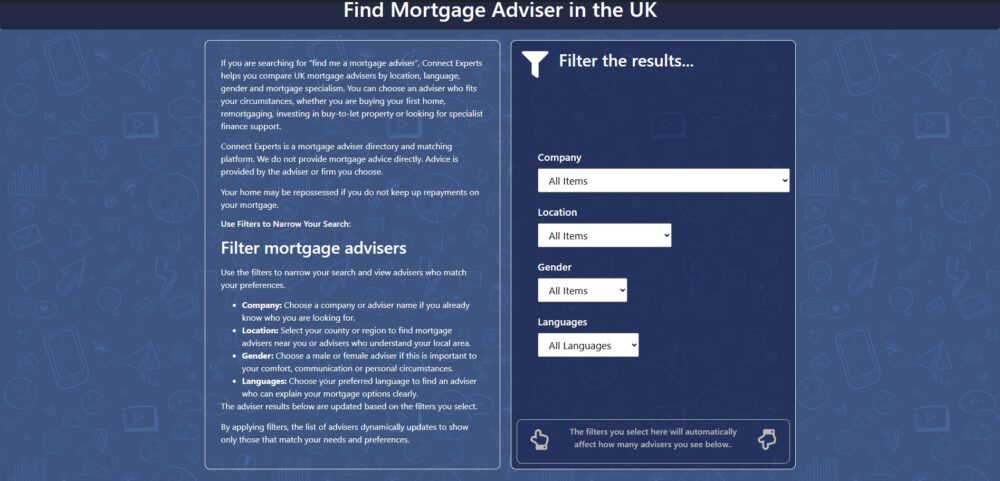
Connect Experts allows users to search for mortgage advisers across the UK.
Directory filters may help you search by:
- Location
- Mortgage specialism
- Language
- Gender
- Company or adviser name
You can review available profiles before deciding who to contact.
When making an enquiry, state that you want a face-to-face meeting. Ask where appointments take place and whether the adviser covers your area.
You can also browse mortgage brokers across the UK before narrowing your search.
Connect Experts does not guarantee that every listed adviser offers in-person appointments. Availability should be confirmed with the selected adviser.
Finding an Adviser for Your Circumstances
The closest adviser is not always the most suitable adviser.
Consider both location and relevant experience.
For example, a first-time buyer may value an adviser who explains each application stage carefully. Connect Experts provides a dedicated search route for first-time buyer mortgage brokers.
Other users may need experience involving buy-to-let, adverse credit, commercial property or complex income.
A directory helps you narrow the field. Your own conversation with the adviser determines whether the service feels suitable.
Before Agreeing to Proceed
Before continuing beyond the initial meeting, confirm:
- Which firm will provide the advice
- The adviser’s regulatory status
- What service will be provided
- Which fees may apply
- How your information will be used
- How recommendations will be explained
- How complaints are handled
- How you can withdraw from the process
Read the adviser’s initial disclosure documents carefully.
The FCA explains that consumers should check whether a firm is authorised and has permission for the required service. Using an authorised firm can provide important regulatory protections.
Frequently Asked Questions
Can I ask a mortgage broker to meet me in person?
Yes. You can ask whether an adviser provides face-to-face appointments. Availability will depend on their location, working arrangements and service model.
Do all mortgage advisers offer face-to-face meetings?
No. Some advisers work entirely by telephone or video. Check the available meeting formats before arranging an appointment.
Do I need a property before meeting a mortgage broker?
No. You can speak with an adviser before finding a property. An early meeting may help you understand affordability and document requirements.
Should I bring bank statements to the first meeting?
It is sensible to have recent bank statements available. The adviser may need them to review income, expenditure and account conduct.
Can my spouse, relative or interpreter attend?
Ask the adviser before the appointment. Another person may be able to attend with your permission, subject to privacy and advice-process requirements.
Will I receive a mortgage recommendation during the first meeting?
Not always. The adviser may need further documents and research before making a personal recommendation.
Does meeting face to face improve mortgage approval chances?
The meeting format does not determine lender approval. Approval depends on lender criteria, affordability, property details and the information supplied.
How do I find a mortgage broker near me?
Use the Connect Experts directory to search by location. Contact suitable advisers and confirm whether they provide in-person appointments locally.
Find a Mortgage Adviser Offering Face-to-Face Meetings
A mortgage is a long-term financial commitment. The meeting format should help you understand the decision rather than simply complete a process.
Use Connect Experts to search by location and specialism. Review adviser profiles and ask whether face-to-face appointments are available.
Start your search for a mortgage adviser