FCA-Regulated Mortgage Brokers: An FCA-regulated mortgage broker provides regulated mortgage advice through a firm authorised by the Financial Conduct Authority.
Authorisation is not simply a badge beside a business name. It establishes who is responsible for the advice, which activities the firm may undertake and which regulatory rules may apply.
Connect Experts helps you search for mortgage advisers by location, language, gender and mortgage specialism. Connect Experts is a mortgage adviser directory and matching platform. It does not provide mortgage advice directly.
Advice is provided by the adviser or firm you choose.
At a Glance
Before choosing a mortgage broker:
- Check the firm on the Financial Services Register.
- Confirm that its contact details match those on the register.
- Check that the firm has the required mortgage permissions.
- Establish how the individual adviser operates under that firm.
- Ask about fees, commission, lender access and service scope.
- Choose an adviser with relevant experience for your mortgage needs.
You can then use the Connect Experts mortgage broker directory to compare advisers using practical search filters.
Find an FCA-Authorised Mortgage Adviser
A mortgage adviser should be assessed on more than proximity or price.
Before making contact, consider:
- The adviser’s regulatory position
- Relevant mortgage experience
- Areas of specialist knowledge
- Languages spoken
- Geographic coverage
- Meeting options
- Broker fees
- Lender access
- Communication arrangements
Use Find Mortgage Advisers in the UK to search for an adviser who fits your requirements.
Your search can begin with personal preferences. However, the final decision should rest on verifiable professional information.
What Is an FCA-Regulated Mortgage Broker?
The Financial Conduct Authority regulates financial services firms in the UK.
A mortgage broker may provide regulated advice as:
- An adviser employed by an authorised firm
- An adviser working for an appointed representative
- An authorised individual operating under a principal firm
- A representative of a directly authorised mortgage business
The precise arrangement matters because the authorised firm or principal normally carries regulatory responsibility for the activity.
The term “FCA-regulated mortgage broker” is widely used by consumers. More precisely, the broker should provide advice through a firm with the relevant FCA authorisation and permissions.
What Does FCA Authorisation Mean for Mortgage Customers?
FCA authorisation creates a formal regulatory framework.
Depending on the activity, an authorised mortgage firm may be required to:
- Gather information about the customer’s circumstances
- Assess needs and objectives
- Consider mortgage affordability
- explain material risks and limitations
- Recommend a suitable mortgage where advice is provided
- Disclose relevant fees and commission arrangements
- Issue prescribed mortgage documents
- Keep appropriate records
- Handle complaints under established procedures
- Support customers experiencing financial difficulty
- Meet applicable Consumer Duty requirements
The framework aims to create accountable advice rather than remove every financial risk.
A regulated broker cannot guarantee mortgage approval, a particular rate or a specific financial outcome.
FCA Authorisation Is Not an Endorsement
The FCA does not personally recommend a mortgage broker because that broker appears on its register.
A registered firm may have permission to conduct certain financial activities. That does not mean the FCA has:
- Recommended the firm to you
- Approved every service it offers
- Guaranteed the quality of every interaction
- Confirmed that every adviser suits your needs
- Guaranteed that your mortgage application will succeed
Regulation provides a framework. Choosing an adviser still requires judgement.
The useful question is not merely, “Is this firm listed?” It is:
Is the firm authorised for the relevant activity, and is this adviser suitable for my circumstances?
How to Check Whether a Mortgage Broker Is Authorised
Use the official Financial Services Register before sharing sensitive information or paying a fee.
1. Search for the firm
Search using:
- The firm’s legal name
- Its trading name
- Its FCA reference number
- The adviser’s name, where applicable
A website brand may differ from the authorised company’s legal name. Ask the broker to explain the relationship if it is unclear.
2. Match the contact information
Compare the firm’s:
- Telephone number
- Email domain
- Website address
- Registered address
Use the contact details shown on the official register when possible.
Fraudsters may copy the name or reference number of an authorised business. Matching the communication details helps reduce the risk of dealing with a clone firm.
3. Review the firm’s status
Check whether the record shows the firm as authorised or otherwise permitted to conduct the relevant activity.
Do not rely only on a logo, website footer or social-media profile.
4. Check the firm’s permissions
A firm’s presence on the register does not automatically mean it can provide every financial service.
Review whether its permissions cover the activity you require. This may include advising on or arranging regulated mortgage contracts.
5. Establish the adviser’s relationship with the firm
Ask:
- Which authorised firm is responsible for your advice?
- Are you employed by that firm?
- Are you operating through an appointed representative?
- What is the principal firm’s FCA reference number?
- Which permissions cover the proposed advice?
The adviser should be able to explain this without ambiguity.
Firm Authorisation and Individual Adviser Status
Customers often search for an individual broker’s name and expect to find a simple personal authorisation entry.
However, mortgage regulation often operates through firms and principal arrangements.
An adviser may work:
- For a directly authorised firm
- Within an appointed representative business
- Under a network or principal firm
- As an employee of an authorised company
Therefore, check both the adviser’s identity and the firm responsible for the advice.
An adviser profile should make that relationship understandable. If it does not, request written clarification before proceeding.
Are All Mortgages Regulated by the FCA?
No. Regulatory treatment can depend on the borrower, property, purpose and type of transaction.
Advice about a residential mortgage secured on a home occupied by the borrower will commonly fall within the regulated mortgage framework.
However, different rules may apply to:
- Certain buy-to-let mortgages
- Business buy-to-let transactions
- Commercial mortgages
- Development finance
- Business loans
- Some forms of bridging finance
- Lending to limited companies
Some consumer buy-to-let activity may come within a separate regulatory framework. Other business lending may be unregulated.
Ask the adviser to confirm in writing:
- Whether the proposed activity is regulated
- Which firm is responsible
- What protection and complaint routes apply
This distinction is especially important when searching for a commercial mortgage broker or specialist property-finance adviser.
What Is the FCA Consumer Duty?
The Consumer Duty sets standards for firms serving retail customers.
Where it applies, firms should act to deliver good customer outcomes across four areas:
- Products and services
- Price and value
- Consumer understanding
- Consumer support
For a mortgage customer, this should support clearer explanations, appropriate service design and effective help throughout the advice process.
However, good outcomes do not mean a broker must produce the cheapest mortgage in every case.
Mortgage suitability may also depend on:
- Eligibility
- Affordability
- Product fees
- Early repayment charges
- Incentives
- Mortgage term
- Rate structure
- Property acceptability
- Future plans
- Application reliability
The lowest initial rate is not automatically the most suitable mortgage.
What Should a Regulated Mortgage Adviser Ask?
A regulated adviser may need information about:
- Income and employment
- Regular expenditure
- Existing debts
- Deposit or available equity
- Credit history
- Dependants
- Property type
- Purchase or refinancing purpose
- Preferred mortgage term
- Attitude towards payment changes
- Expected future circumstances
These questions are not administrative obstacles. They help the adviser understand whether a proposed mortgage could be suitable and affordable.
Accurate disclosure matters. Incomplete information may affect the recommendation or mortgage application.
What Documents Should You Expect?
The documents will depend on the service and transaction.
You may receive:
- An initial disclosure or service document
- Information about broker fees
- Details of commission arrangements
- A mortgage illustration
- A suitability or recommendation explanation
- Lender application documents
- Privacy information
- Complaint-handling information
Read each document before agreeing to proceed.
Ask for clarification where a fee, restriction, risk or recommendation is unclear.
How Mortgage Broker Fees and Commission Work
A mortgage broker may receive:
- A fee paid by the customer
- Commission paid by the lender
- A combination of both
The broker should explain the charging structure before you commit.
Ask:
- Is the fee fixed or percentage-based?
- When does it become payable?
- Is it refundable?
- Does another fee apply at mortgage offer or completion?
- Will the lender pay commission?
- Can I receive details of that commission?
- Is the fee different for a specialist case?
Price is only one measure of value. The service scope, adviser experience and complexity of the case also matter.
Does an FCA-Regulated Broker Cover the Whole Market?
Not necessarily.
FCA authorisation and lender access are separate questions.
A broker may advise using:
- A broad range of lenders
- A defined lender panel
- A restricted selection
- Products from one lender or group
Ask how much of the market the adviser considers and whether any important lender categories are excluded.
Read the guide to whole-of-market mortgage brokers for a fuller explanation of lender access and service limitations.
Which Mortgage Specialism Do You Need?
Regulation alone does not demonstrate experience in every mortgage area.
Choose an adviser whose knowledge fits the case.
Buying your first home
A first-time buyer mortgage broker may help explain deposits, affordability, mortgage terms and the application process.
Earning through self-employment
A self-employed mortgage broker may understand accounts, tax calculations, retained profit and varied income evidence.
Financing rental property
A buy-to-let mortgage broker may help assess rental calculations, ownership structure and lender criteria.
Dealing with credit problems
An adverse credit mortgage broker may have experience with defaults, missed payments, arrangements or county court judgments.
Raising short-term property finance
A bridging finance broker may help explain the loan term, interest method, fees and proposed exit route.
The relevant specialism should be supported by experience and appropriate regulatory permissions.
How Connect Experts Helps You Search
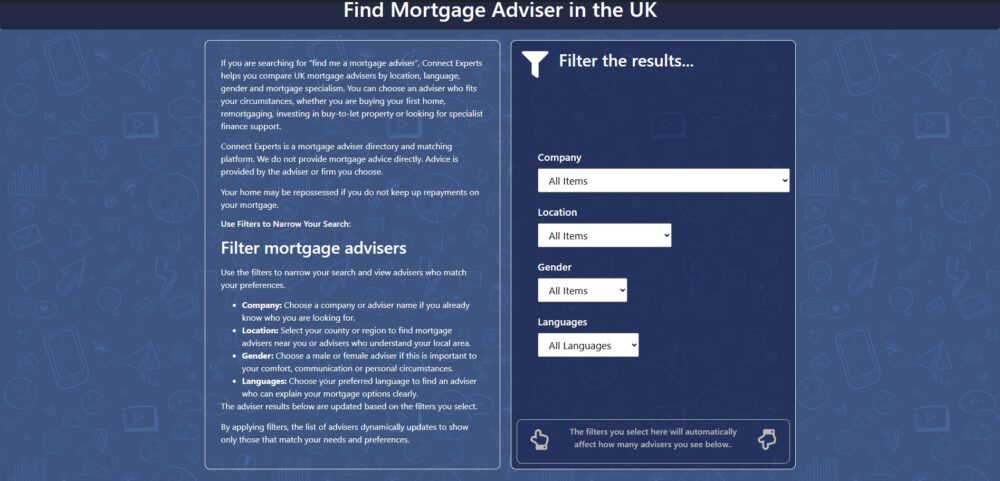
Connect Experts provides a searchable directory of mortgage advisers.
You can compare profiles using details such as:
- Location
- Mortgage expertise
- Language
- Gender
- Firm
- Service area
The directory helps you identify potential advisers. It does not replace regulatory checks or the adviser’s personal assessment of your circumstances.
Before proceeding:
- Review the adviser’s profile.
- Confirm the responsible firm.
- Check the firm’s FCA record.
- Discuss your mortgage requirements.
- Request fee and service information.
- Decide whether the adviser is appropriate for you.
You can also explore UK mortgage brokers by location and expertise before choosing whom to contact.
Questions to Ask a Mortgage Broker
Use these questions during your first conversation:
- Which authorised firm is responsible for my advice?
- What is the firm’s FCA reference number?
- Is this mortgage activity regulated?
- Do you have experience with cases like mine?
- Which lenders can you consider?
- Are any lender groups excluded?
- What fee will I pay?
- When will that fee become payable?
- Will you receive lender commission?
- Who will manage my case?
- How will you communicate with me?
- What happens if my circumstances change?
- How can I make a complaint?
Clear answers make comparison easier.
Warning Signs to Consider
Take care when someone:
- Refuses to provide a firm name or FCA reference number
- Uses contact details that differ from the official register
- Guarantees mortgage approval
- Pressures you to pay immediately
- Requests money through an unrelated personal account
- Promises to hide information from a lender
- Suggests altering income or expenditure figures
- Avoids explaining fees
- Cannot explain whether the activity is regulated
- Contacts you unexpectedly using copied firm details
Stop the conversation if the information cannot be verified.
Complaints and Consumer Protection
An authorised firm should explain its complaint process.
If a complaint is not resolved, an eligible customer may be able to refer it to the Financial Ombudsman Service.
Financial Services Compensation Scheme protection may also apply in certain circumstances if an authorised firm fails. Eligibility depends on the activity, firm and nature of the claim.
These protections are not automatic for every mortgage-related service. Confirm which regulatory framework applies before proceeding.
Frequently Asked Questions
How do I know whether a mortgage broker is FCA-regulated?
Search the Financial Services Register using the firm’s legal name or FCA reference number. Check its status, permissions and official contact details.
Is every adviser listed individually on the FCA Register?
Not always in the way a customer may expect. An adviser may operate as an employee or through an appointed representative under an authorised principal firm. Confirm which firm accepts regulatory responsibility.
Does FCA authorisation guarantee good mortgage advice?
No. Authorisation creates regulatory duties and oversight, but it does not guarantee a particular mortgage result. You should still check experience, permissions, fees and service terms.
Are all buy-to-let mortgages FCA-regulated?
No. Regulatory treatment varies. Some consumer buy-to-let activity may be subject to regulation, while business buy-to-let transactions may fall outside the standard regulated mortgage regime.
Are commercial mortgage brokers FCA-regulated?
A commercial finance firm may be FCA-authorised for certain activities. However, many commercial mortgage transactions are not regulated mortgage contracts. Ask which parts of the proposed service are regulated.
Can I check a mortgage broker using only an FCA number?
The reference number is a useful starting point. You should also match the legal name, website, telephone number, email details, address, status and permissions.
Does Connect Experts give mortgage advice?
No. Connect Experts is a mortgage adviser directory and matching platform. Mortgage advice is provided by the adviser or firm selected by the customer.
Can I choose an adviser by language or location?
Yes. Connect Experts allows users to search using filters including location, language, gender and mortgage expertise.
Find an FCA-Authorised Mortgage Adviser
Regulation turns mortgage advice into an accountable professional process. It does not remove the need to ask questions.
The soundest decision combines two forms of evidence:
- Official regulatory information
- An adviser whose experience matches your needs
Search the Connect Experts adviser directory and review each profile before making contact.
Always verify the responsible firm and relevant permissions using the Financial Services Register.