How to Compare Self-Employed Mortgage Advisers: Do not compare advisers only by distance or headline fee.
Consider:
- Experience with your income structure
- Lender access
- How income will be assessed
- Required documents
- Service and communication
- Fees
- Regulatory status
- Support after submission
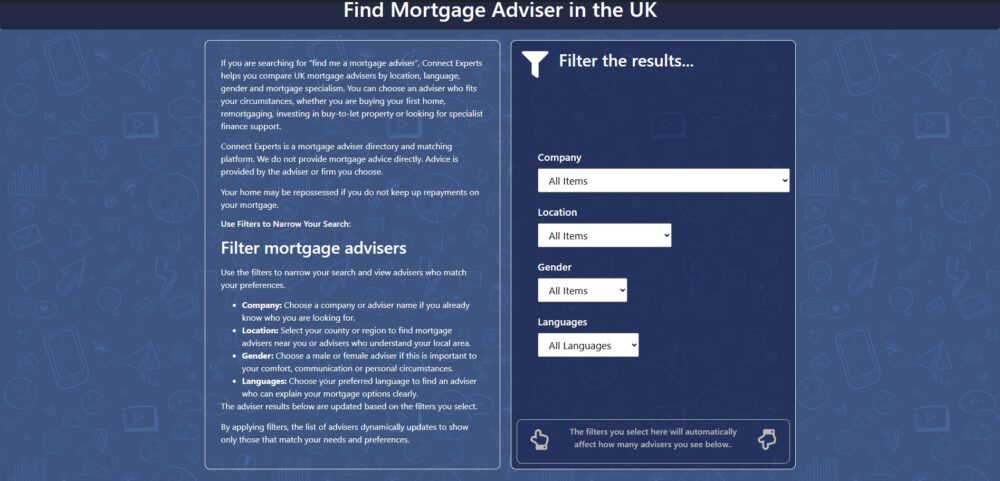
Connect Experts lets you compare adviser profiles by practical criteria. The directory does not provide the mortgage recommendation itself.
Start with the income structure
“Self-employed” covers many arrangements.
An adviser may regularly work with sole traders but have less experience with:
- Retained limited company profit
- Contractors assessed through a day rate
- Freelancers with several clients
- Business partnerships
- Employed and self-employed income
- Recent incorporation
- Applicants with foreign income
- Directors with minority shareholdings
The first comparison should therefore focus on relevant experience rather than a broad self-employment label.
Ask how the adviser approaches income
The adviser should be able to explain the possible assessment methods without guaranteeing a result.
Ask:
- Which income figures may be considered?
- Will the lender use an average?
- Could the latest year be used?
- How might a decline be treated?
- Can any lender consider retained profit?
- Could contractor income be assessed from a day rate?
- What happens after a change in business structure?
A useful answer should distinguish between general possibilities and confirmed lender criteria.
Compare market access
Mortgage advisers can have different lender access.
An adviser might consider:
- A broad range of lenders
- A selected panel
- Products offered through a particular firm
- Specialist lenders unavailable through every route
Ask the adviser to explain the service accurately.
A broad lender range does not mean every UK mortgage is available. Certain products may be offered only through particular distribution channels or directly by a lender.
Read more about the meaning of whole-of-market mortgage brokers.
Compare the adviser’s document process
An adviser experienced with self-employed cases should establish the evidence before recommending an application route.
Ask whether the adviser will review:
- Accounts
- Tax calculations
- Tax year overviews
- Business bank statements
- Personal bank statements
- Contracts
- Shareholding
- Deposit evidence
- Credit commitments
- Current trading information
Document review does not transfer responsibility for accurate disclosure. Applicants remain responsible for supplying complete and truthful information.
Compare fees carefully
A low headline fee may not reflect the full scope of the service.
Ask:
- Is there an initial consultation fee?
- Is a fee charged at application?
- Is another fee due on completion?
- Is the fee fixed or linked to the mortgage amount?
- Is the fee refundable?
- Are future reviews included?
- Could other property or lender fees apply?
- Does the adviser receive lender commission?
The adviser should explain charges before the applicant proceeds.
Price matters, but it should be compared alongside service scope and case complexity.
Compare communication
Self-employed applications can generate additional evidence requests.
Establish:
- Who will be the main contact?
- Will the adviser or an administrator provide updates?
- How quickly are messages usually answered?
- Can documents be uploaded securely?
- Will the adviser contact the accountant?
- How will further underwriting questions be handled?
- Will support continue until completion?
A clear communication process can be particularly valuable where several documents or business entities are involved.
Compare local and online advice
A local adviser may offer:
- Face-to-face meetings
- Familiarity with local property types
- Knowledge of nearby professionals
- Convenient document discussions
An online adviser may offer:
- Wider geographic choice
- Flexible meeting times
- Specialist experience not available nearby
- Digital document collection
Neither method is automatically better.
The correct comparison concerns competence, communication and suitability for the applicant’s needs.
Connect Experts allows users to search for an adviser by location and other preferences through its mortgage adviser directory.
Check regulatory status
Before using a financial firm, verify that it is authorised or registered and has the relevant permissions.
The Financial Conduct Authority provides a public Financial Services Register.
Check:
- The firm name
- Trading names
- Reference number
- Current status
- Address and contact details
- Relevant permissions
- Appointed representative details, where applicable
Use contact information from an official source where fraud or impersonation is a concern.
Understand what the directory does
Connect Experts helps users find and compare mortgage advisers.
It does not:
- Provide the personal mortgage advice
- Guarantee mortgage acceptance
- Set lender criteria
- Make the lender’s underwriting decision
- Replace legal, tax or accounting advice
The adviser or firm selected by the user provides any regulated mortgage recommendation.
This distinction should remain clear throughout the search journey.
Warning signs during adviser selection
Exercise caution where someone:
- Guarantees approval before reviewing evidence
- Suggests hiding a debt or account
- Encourages inaccurate income figures
- Refuses to explain fees
- Uses contact details that do not match official records
- Describes turnover as automatically available income
- Pressures you to apply immediately
- Will not explain the lender range
- Requests payment through an unusual method
- Avoids providing regulatory details
A specialist case still requires accurate information and responsible advice.
Ten questions for an initial conversation
- How often do you support applicants with my business structure?
- Which evidence should I provide first?
- How could lenders assess my income?
- Can you consider a broad lender range?
- Are any relevant lenders outside your service?
- What fees could I pay?
- Who will manage the case?
- How will we exchange documents?
- What could delay the application?
- How can I verify your firm’s regulatory status?
Record the answers and compare them against your priorities.
When specialist experience may matter most
Relevant case experience may be particularly useful when:
- Trading history is short.
- Profit has changed significantly.
- A company retains substantial profit.
- The applicant recently incorporated.
- Income comes from several businesses.
- Contract work includes gaps.
- One applicant is employed and the other self-employed.
- The property is unusual.
- Credit history contains past problems.
- A previous application was declined.
This does not mean the case will be accepted. It means the adviser should understand which facts require attention.
The philosophical point
Choosing an adviser is not the same as selecting a product from a shelf.
The value lies partly in the questions asked before an application is made. A careful comparison looks at how the adviser interprets evidence, explains limitations and manages the process.
Start your search for a mortgage adviser.