Mortgage adviser profiles should tell you more than someone’s name. It should help you decide whether that adviser understands your circumstances.
Yet a long list of qualifications or mortgage products cannot answer every question.
Useful information is often found in the details: experience, location, firm, languages, and available services.
At a Glance
A mortgage adviser profile can help you assess:
- The adviser’s mortgage and finance specialisms.
- Their location and available appointment methods.
- Languages offered for mortgage discussions.
- Their company and professional qualifications.
- Whether their experience fits your borrowing needs.
You should also confirm the firm’s regulatory position, lender access and any fees before proceeding.
Start With Your Mortgage Requirement
Two people may both need a mortgage, but their borrowing circumstances could be entirely different.
A first-time buyer with regular employment income may need help understanding deposits and affordability.
A company director might need an adviser familiar with salary, dividends and business accounts.
A landlord purchasing an HMO could face specialist lender and property requirements.
These situations call for different experience.
Therefore, when reading mortgage adviser profiles, begin with the work each adviser actually undertakes.
Look for experience relevant to your circumstances rather than simply counting the services displayed.
An Adviser’s Location Is Only One Part of the Decision
Local knowledge can be useful.
An adviser familiar with your area may understand common property types and local housing characteristics.
However, distance does not establish whether an adviser regularly handles your type of borrowing.
A mortgage adviser based outside your county may offer telephone or video appointments.
That could widen your options, especially when your income or property needs are more specialised.
Check whether the adviser offers face-to-face meetings, online appointments or telephone consultations.
Then consider which arrangement works best for you.
Language Can Make Mortgage Advice Easier to Understand
Mortgage discussions often involve unfamiliar financial terms.
You may need to explain your income, existing commitments, deposit arrangements or plans for the property.
Being comfortable with the language used during these conversations can make a meaningful difference.
For example, Kelvin Cheng, a mortgage adviser in Newbury, lists English, Cantonese and Mandarin among his languages.
His profile also describes residential mortgages, property investment, specialist finance and protection.
Meanwhile, Mohammed Malik, a mortgage adviser in Hornchurch, lists English, Urdu, Hindi and Punjabi.
These examples show why individual profiles can be more informative than a simple list of names.
However, language availability does not establish product suitability. Always check the adviser’s relevant experience and services.
You can also search mortgage advisers by language before comparing individual profiles.
Understand Who Is Responsible for the Advice
An adviser profile should identify the company associated with the adviser.
That matters because individuals and firms can have different regulatory relationships.
Some mortgage advisers work for directly authorised firms. Others work through Appointed Representative firms.
An Appointed Representative carries out agreed activities under the responsibility of an authorised principal firm.
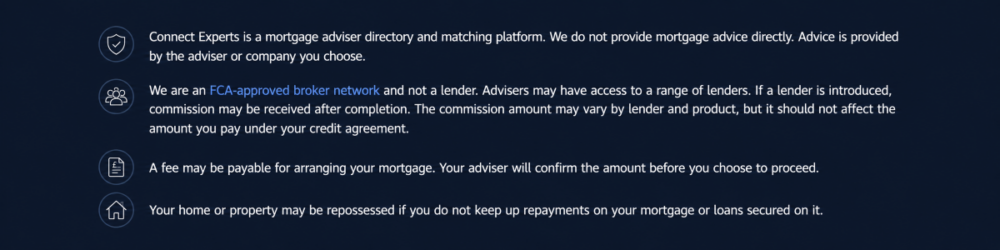
Connect Experts is a trading style of Connect IFA Ltd, which is authorised and regulated by the FCA under FRN 441505.
The directory helps you find advisers. Mortgage advice is provided by the adviser or firm you choose.
Before proceeding, check the relevant firm through the FCA Financial Services Register.
Also confirm whether the firm can provide the particular service you need.
This is especially important when considering specialist lending or commercial finance.
What an Adviser Profile Might Not Tell You
A well-written profile helps you decide whom to contact. It should not replace a conversation about your requirements.
Before choosing an adviser, establish several practical details.
Lender access: Which lenders can the adviser consider? Are there restrictions or exclusions?
Fees: Is there an advice or arrangement fee? When would it become payable?
Remuneration: Will the adviser or firm receive commission from the lender?
Experience: Does the adviser regularly work with your particular income or property circumstances?
Communication: Who will manage the application, and how will progress be explained?
MoneyHelper’s guide to choosing a mortgage adviser explains why lender access, fees and advice scope deserve attention.
A wider lender panel may be useful, but no adviser can guarantee mortgage approval.
Don’t Confuse a Profile With a Recommendation
A profile may describe qualifications, services and experience. It does not establish which mortgage is suitable for you.
That decision requires the adviser to assess your circumstances.
A lender may consider affordability, credit history, property condition, income evidence and existing financial commitments.
Therefore, choosing an adviser should be the beginning of a more detailed conversation.
You do not have to contact the first person who appears in a search result.
You can compare profiles and decide which adviser appears most relevant.
Find an Adviser Who Fits Your Circumstances
The right introduction starts with a better question.
Instead of asking only, “Who is the nearest mortgage broker?”, ask, “Who has relevant experience with my situation?”
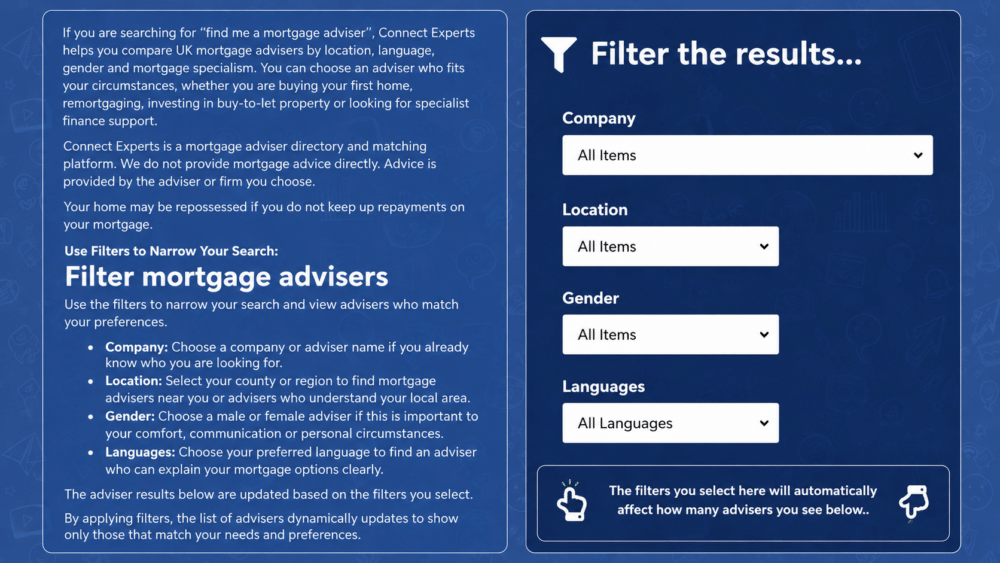
You can compare mortgage adviser profiles across the UK using the Connect Experts directory.
Search by location, language and mortgage type. Then review individual advisers before making contact.
A good adviser profile gives you a reason to start the conversation. The conversation helps you decide whether to proceed.