
Mortgage Broker in Bristol: City Centre Mortgage Guide
A mortgage decision begins with numbers, but it rarely ends there.
The property, its legal structure and the applicant’s circumstances all affect how a lender views an application. This is especially relevant in Bristol BS1, where modern apartments, converted buildings, period properties and mixed-use developments can sit within a relatively small area.
A mortgage adviser serving Bristol BS1 can help you understand affordability, lender criteria, deposit requirements and property-related checks before you apply.
Connect Experts is a mortgage adviser directory and matching platform. We do not provide mortgage advice directly. Advice is provided by the adviser or firm you select.
Mortgage advice in Bristol BS1
- BS1 covers Bristol’s central business, retail and Harbourside districts.
- Many properties are flats, apartments or converted buildings.
- Lenders may examine lease length, service charges and building construction.
- Your borrowing will depend on income, commitments, deposit and credit history.
- Self-employed, contractor or variable income may require further evidence.
- Buy-to-let affordability is usually assessed using expected rental income.
- Commercial and mixed-use premises may require specialist finance.
- Connect Experts helps users compare advisers by expertise and communication preferences.
What can a mortgage adviser in Bristol BS1 help with?
A mortgage adviser can review your circumstances and explain which mortgage routes may be relevant.
This may include:
- First-time buyer mortgages
- Home mover mortgages
- Remortgages
- Product transfers
- Buy-to-let mortgages
- Limited company buy-to-let
- HMO mortgages
- Self-employed mortgages
- Contractor mortgages
- Adverse credit applications
- Commercial mortgages
- Semi-commercial property finance
- Bridging finance
- Second charge mortgages
Not every adviser holds permission or experience in every advice area. Check the adviser’s profile before making contact.
Users comparing the wider city can also visit our mortgage adviser in Bristol page.
Why can Bristol BS1 properties require closer mortgage checks?
BS1 includes a high concentration of flats, city-centre developments, historic buildings and converted properties.
These homes are not automatically difficult to mortgage. However, lenders may need more information before deciding whether the property meets their criteria.
Leasehold flats
A lender may consider:
- Remaining lease term
- Ground rent provisions
- Service charges
- Planned major works
- Management arrangements
- Restrictions within the lease
- Whether the flat can be sublet
- The building’s insurance arrangements
A short lease can reduce the number of available lenders. Extending a lease may involve legal and valuation work.
Modern apartment developments
Newer apartments may have:
- Communal facilities
- Concierge services
- Underground parking
- Commercial units below
- Higher service charges
- Building warranties
- Developer incentives
- Restrictions on short-term letting
The lender may review the entire development rather than only the individual flat.
Converted and period buildings
Bristol city centre contains buildings that have changed use over time.
A converted property may require checks concerning:
- Construction type
- Planning permission
- Building regulations
- Access arrangements
- Flying freeholds
- Shared entrances
- Commercial neighbours
- Valuation comparables
Unusual construction does not always prevent lending. It can, however, affect lender choice and valuation.
Flats above commercial premises
Some BS1 properties sit above restaurants, bars, offices or retail units.
Lenders may consider:
- The business below
- Noise or operating hours
- Separate access
- Fire and insurance arrangements
- Resale demand
- The proportion of commercial space
- Whether the property is treated as mixed-use
A specialist adviser may be useful where the property falls outside standard residential criteria.
Mortgage affordability in Bristol BS1
Mortgage affordability is not based on salary alone.
Lenders may review:
- Basic income
- Overtime
- Bonuses
- Commission
- Pension contributions
- Loans and credit cards
- Childcare costs
- Student loan deductions
- Maintenance commitments
- Dependants
- Travel costs
- The requested mortgage term
- Expected monthly payments
Two applicants earning the same amount may receive different borrowing outcomes because their commitments and income structures differ.
Before arranging viewings, you can use the Connect Mortgages residential affordability calculator to obtain an initial estimate. A calculator is not a mortgage offer and does not replace advice.
Deposits and loan-to-value
Loan-to-value compares the mortgage with the property’s value.
For example, a £270,000 mortgage on a £300,000 property represents 90% loan-to-value.
A larger deposit may:
- Reduce the loan-to-value
- Increase the number of available products
- Improve access to lower pricing bands
- Provide protection against valuation differences
- Help with unusual property types
However, applicants should retain enough money for fees and unexpected costs. Using every available pound as a deposit can leave little margin after completion.
First-time buyers purchasing in BS1
First-time buyers may be attracted to BS1 because of its central location, employment links and apartment market.
Before making an offer, consider:
- Your deposit
- Likely monthly repayments
- Service charges
- Ground rent where applicable
- Council tax
- Buildings and contents insurance
- Legal costs
- Survey costs
- Moving costs
- Future maintenance
- Stamp Duty Land Tax where payable
The purchase price is only one part of affordability. A lower-priced flat with substantial service charges may have a higher ongoing cost than expected.
First-time buyers can compare advisers through our first-time buyer mortgage brokers directory category.
Editorial correction: The linked page currently appears to use a first-time landlord URL. A dedicated first-time buyer adviser page should be linked here once available.
Mortgages for professionals and complex income
BS1 attracts applicants working across finance, technology, healthcare, education, hospitality, media and professional services.
Income may include:
- Basic salary
- Performance bonuses
- Commission
- Shift allowances
- Overtime
- Contract income
- Dividends
- Retained company profits
- Income from more than one role
Lenders do not all calculate these forms of income in the same way.
Some average variable pay over a defined period. Others use the latest year, the lowest year or only a proportion of the additional income.
Self-employed applicants can search for self-employed mortgage brokers experienced in assessing accounts, tax calculations, and company income.
Buy-to-let property in Bristol BS1
City-centre rental property may appeal to landlords seeking tenants who value access to employment, universities, transport and amenities.
However, rental demand alone does not establish mortgage suitability.
Buy-to-let lenders may assess:
- Expected monthly rent
- Interest coverage ratio
- Stress-test rate
- Deposit size
- Applicant tax status
- Existing property portfolio
- Landlord experience
- Property construction
- Lease restrictions
- Minimum property size
- Whether short-term letting is permitted
A standard residential mortgage should not be used for a property that will be let without the required lender consent.
Landlords can explore our buy-to-let mortgage brokers category.
Tax treatment depends on individual circumstances. Mortgage advisers do not necessarily provide tax advice.
Commercial and mixed-use property
BS1 contains offices, shops, hospitality premises and buildings combining residential and commercial use.
Finance may be required for:
- Owner-occupied business premises
- Commercial investment property
- Shops with flats above
- Offices
- Restaurants
- Warehouses
- Mixed-use developments
- Property refurbishment
- Short-term acquisition funding
Commercial lenders may examine:
- Business accounts
- Trading history
- Rental income
- Lease terms
- Tenant quality
- Property condition
- Location
- Deposit or equity
- Repayment strategy
- Applicant experience
Commercial mortgages and some buy-to-let arrangements are not regulated by the FCA. The adviser should explain the regulatory position before you proceed.
Search our commercial mortgage brokers category for advisers with relevant permissions.
Remortgaging a Bristol BS1 property
A remortgage may be considered when:
- A fixed rate is ending
- Monthly payments are being reviewed
- The property value has changed
- Additional borrowing is required
- The borrower wants a different mortgage term
- An interest-only arrangement needs review
- Personal circumstances have changed
Before moving to another lender, compare the full cost.
This includes:
- Early repayment charges
- Product fees
- Valuation fees
- Legal costs
- Broker fees
- The new interest rate
- The remaining mortgage term
- Any incentives offered
Staying with the existing lender may sometimes be appropriate. In other cases, a remortgage could provide a more suitable arrangement.
You can search for a remortgage mortgage broker based on your circumstances.
What documents might a mortgage adviser request?
Preparing documents early can reduce avoidable delays.
Depending on your circumstances, you may need:
- Proof of identity
- Proof of address
- Recent payslips
- Bank statements
- Evidence of deposit
- Gifted deposit confirmation
- P60 documents
- Employment contract
- Accounts
- Tax calculations
- Tax year overviews
- Existing mortgage statement
- Details of loans and credit cards
- Rental statements
- Tenancy agreements
- Company documents
- Property particulars
Documents should be accurate, current and consistent with the information provided.
Unexplained transactions, undisclosed credit or differences between documents can lead to further questions.
The mortgage process
1. Initial discussion
The adviser gathers information about your plans, income, deposit, commitments and chosen property.
2. Affordability review
The adviser considers how different lenders may calculate your borrowing.
3. Agreement in principle
An agreement in principle can indicate whether a lender may consider the requested amount. It is not a mortgage offer.
4. Property search and offer
You identify a property and make an offer through the selling agent.
5. Mortgage recommendation
Where regulated advice is provided, the adviser recommends a suitable mortgage based on your needs and circumstances.
6. Full application
The lender receives the application, supporting documents and property details.
7. Valuation and underwriting
The lender assesses the applicant and the property.
8. Mortgage offer
If approved, the lender issues a formal mortgage offer subject to its conditions.
9. Legal work and completion
Your solicitor completes the legal checks, handles the transfer of money and confirms completion.
A clear process cannot remove every uncertainty. It can make each uncertainty easier to identify and address.
How to choose a mortgage adviser serving BS1
Look beyond distance alone.
Consider:
- Relevant mortgage permissions
- Experience with your applicant type
- Experience with your property type
- Access to lenders
- Communication method
- Availability
- Fees
- Regulatory status
- Reviews and profile information
- Whether advice is in person, by telephone or online
The FCA provides a firm checker that consumers can use to confirm whether a financial firm is authorised and has the required permissions.
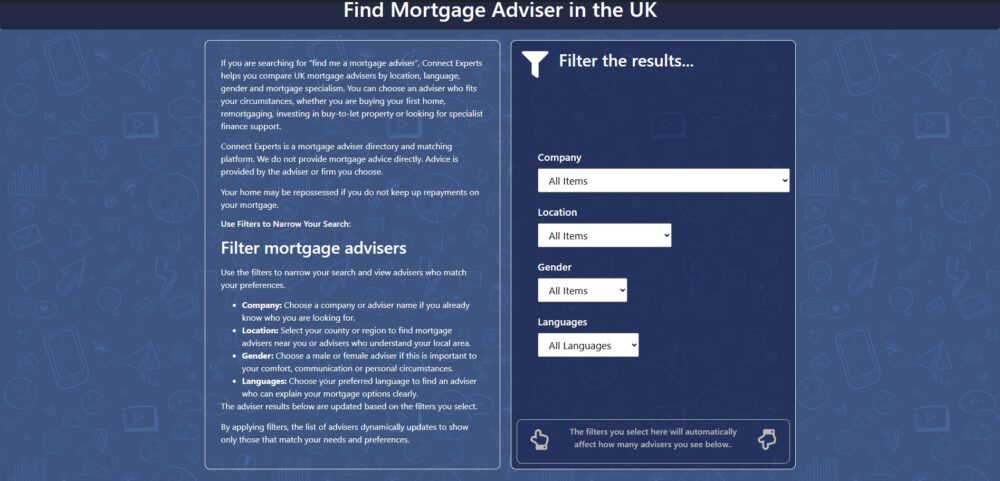
Connect Experts lets users compare advisers by location, language, gender and mortgage expertise. The platform itself does not provide advice.
Find a mortgage adviser in Bristol BS1
The right mortgage is not simply the product with the most attractive headline rate.
A suitable decision must also account for:
- The complete cost
- Mortgage term
- Repayment method
- Product restrictions
- Property acceptability
- Future plans
- Personal circumstances
- Risks if circumstances change
Use Connect Experts to compare mortgage advisers who may serve the Bristol BS1 area.
Review each profile carefully and confirm that the adviser has experience relevant to your needs.
Search for mortgage advisers by location
Frequently asked questions
How do I find a mortgage adviser in Bristol BS1?
Use a mortgage adviser directory to compare advisers by location, mortgage type, language and other practical preferences. Check each adviser’s expertise and regulatory details before making contact.
Does a mortgage adviser need to be based in BS1?
No. Many advisers provide advice by telephone or video. The important factors are their permissions, availability and experience with your circumstances and property type.
Are city-centre flats harder to mortgage?
Not necessarily. However, lenders may examine the lease, service charges, construction, floor level, building height, commercial use and property size.
Can I get a mortgage for a flat above a shop?
Possibly. Lender criteria vary according to the type of business, access arrangements, construction, location and resale prospects.
What is an agreement in principle?
It is an initial indication that a lender may consider a particular borrowing amount. It is not a mortgage offer or a guarantee of approval.
Can a mortgage adviser help if I am self-employed?
Yes, where the adviser has relevant experience. Lenders may assess accounts, tax documents, salary, dividends, retained profits and trading history differently.
Can I obtain a buy-to-let mortgage in BS1?
Potentially. The lender will normally review the deposit, expected rent, rental stress test, property type and applicant circumstances.
What costs should I consider when buying a BS1 flat?
Consider the deposit, legal fees, survey, valuation, mortgage fees, service charges, insurance, moving costs and Stamp Duty Land Tax where applicable.
Is every mortgage adviser FCA-authorised?
Consumers should not assume that every person using the term adviser holds the required status. Check the firm and adviser information before proceeding. Some commercial and buy-to-let activities fall outside FCA mortgage regulation.
Does Connect Experts provide mortgage advice?
No. Connect Experts is a directory and matching platform. Mortgage advice is provided by the adviser or firm chosen by the user.