A Mortgage Broker in Burnley can help turn a property price into a more important question: do the mortgage, the borrower and the property all fit the same lender’s criteria?
Buying a home is rarely decided by price alone. Income, deposit, credit history, construction, property condition, and future plans can all change which mortgage options are suitable.
Burnley has one of the more accessible average property values in Lancashire, but its market is changing. The UK House Price Index recorded an average Burnley property price of around £135,012 in July 2026, compared with £124,272 a year earlier, an annual increase of 8.6%.
That does not mean every Burnley home has risen by the same amount. Individual streets, property types, condition and recent comparable sales still matter to lender valuations.
At a Glance
Burnley combines comparatively accessible property values with traditional housing, first-time buyer opportunities and a sizeable private rented sector. However, affordability, property condition, lender valuation, employment income and deposit size can all affect a mortgage application. A Mortgage Broker in Burnley can assess these factors and help identify lenders whose criteria suit the borrower and the property.
What Makes Burnley’s Mortgage Market Different?
Burnley’s housing market reflects its industrial history and more recent development.
Victorian and Edwardian terraces remain common across parts of the town, alongside semi-detached homes, post-war housing and newer developments around the wider borough.
That mix matters to mortgage lenders.
An apparently straightforward purchase can become more technical if a valuer identifies significant repairs, non-standard alterations or another issue affecting marketability.
Burnley Borough Council’s adopted development strategy identifies Burnley as the borough’s principal town and provides for major, large-scale and smaller housing sites to increase the choice of homes and tenures available locally.
Population growth also adds useful context. Burnley’s population rose from around 87,100 in 2011 to approximately 94,700 in 2021, an increase of about 8.8%. That exceeded growth across both England and the North West during the same period.
These changes create different mortgage requirements for first-time buyers, existing homeowners and landlords.
What Could Affect a Mortgage in Burnley?
A lender normally assesses two separate things.
First, can the applicant afford the mortgage?
Second, is the property acceptable security for the loan?
In Burnley, relevant considerations may include:
- Deposit and loan-to-value: A larger deposit normally reduces the percentage of the property’s value that needs to be borrowed.
- Income and employment: PAYE income can often be assessed differently from self-employed profits, dividends, contract income or multiple jobs.
- Credit history: Missed payments, defaults or county court judgments may reduce the number of lenders available.
- Property condition: Older housing may prompt closer valuation scrutiny where significant repair work is evident.
- Construction: Lenders can apply different rules to non-standard construction or extensively altered homes.
- Valuation: The agreed purchase price is not automatically the value a lender will use.
- Lease terms: Flats and leasehold homes may require checks on remaining lease length, service charges and ground-rent provisions.
- Rental calculations: Buy-to-let lenders may assess expected rent alongside loan size and the applicant’s wider circumstances.
A mortgage adviser can help identify these issues before an application is submitted, rather than after a lender has completed its underwriting.
Burnley Can Offer a Different Starting Point for First-Time Buyers
Average values in Burnley remain substantially below many parts of England.
That can make the town relevant to buyers whose principal challenge is building a deposit rather than funding a very large mortgage.
Lower purchase prices do not remove mortgage criteria, however.
A first-time buyer still needs to consider:
- the minimum deposit required by the chosen lender;
- affordability after committed expenditure;
- credit commitments;
- employment history;
- the source of the deposit;
- property condition;
- legal and valuation costs;
- the effect of interest rates on monthly repayments.
Someone beginning their search can explore the wider range of residential mortgage options before choosing an adviser.
A useful comparison isn’t just between mortgage rates. Different lenders can reach different affordability figures using the same income because their stress tests, expenditure assumptions and income rules can vary.
Traditional Burnley Homes Can Require More Than a Desktop Valuation
Many Burnley streets contain older terraced housing built during the town’s industrial expansion.
Age alone does not prevent a property from being mortgaged.
However, older homes can make the valuation stage particularly important.
A valuer may consider issues such as:
- evidence of structural movement;
- roof condition;
- significant damp;
- major alterations;
- construction materials;
- resale demand;
- nearby commercial use;
- whether the property is immediately habitable.
A lender may accept the property without difficulty, ask for more information, retain part of the mortgage until the work is completed, or decline the security entirely.
This is why the cheapest-looking property is not always the simplest mortgage.
Price tells you what the seller wants.
The valuation helps tell the lender what it is prepared to lend against.
Self-Employed Applicants and Burnley’s Local Economy
Income does not always arrive as a single predictable monthly salary.
Sole traders, company directors, contractors and people with more than one income source can all be assessed differently.
Some lenders may average recent earnings. Others may place greater emphasis on the latest year’s figures. Company directors may also face different approaches to salary, dividends, and retained profit.
Applicants with less conventional income can search for self-employed mortgage advisers who work with this type of underwriting.
The purpose is not to make complex income appear simple.
It is to present it accurately enough for the right lender to understand it.
Buy-to-Let Mortgages in Burnley
Burnley’s comparatively modest purchase prices can attract landlord interest, but a low purchase price alone does not determine whether an investment works.
Buy-to-let lenders commonly examine expected rent and apply an interest coverage calculation. Deposit requirements are also normally higher than for standard residential mortgages.
Other factors can include:
- whether the applicant is a first-time landlord;
- existing rental properties;
- personal or limited-company ownership;
- property condition;
- tenancy arrangements;
- expected rental income;
- landlord experience;
- overall portfolio borrowing.
Landlords considering a purchase or refinancing existing borrowing can use the buy-to-let mortgage adviser search to identify advisers with relevant experience.
A rental calculation that works for one lender may fail another lender’s stress test. That makes lender criteria particularly important where the available rent is close to the minimum required.
Remortgaging a Burnley Home
Property values can affect more than purchases.
Existing Burnley homeowners approaching the end of a fixed or discounted mortgage period may want to compare their current lender’s product-transfer options with a full remortgage.
A higher current valuation may reduce the loan-to-value ratio, especially if the mortgage balance has also fallen.
For example, moving from above 75% loan-to-value to below that threshold could potentially change the mortgage products available. The actual effect depends on the lender, valuation and products available at the time.
Remortgaging also gives homeowners an opportunity to reconsider:
- mortgage term;
- repayment type;
- monthly affordability;
- existing early repayment charges;
- further borrowing requirements;
- changes in income;
- changes in household circumstances.
The correct decision is therefore not always to change lender.
Sometimes remaining with the existing lender may be suitable. In other circumstances, reviewing the wider market may reveal alternatives.
Finding the Right Mortgage Adviser in Burnley
The nearest adviser is not automatically the most suitable adviser.
Relevant experience can matter just as much as geography.
A Burnley borrower may need someone experienced with a straightforward residential purchase. Another may need help with self-employed income, buy-to-let lending, adverse credit or an unusual property.
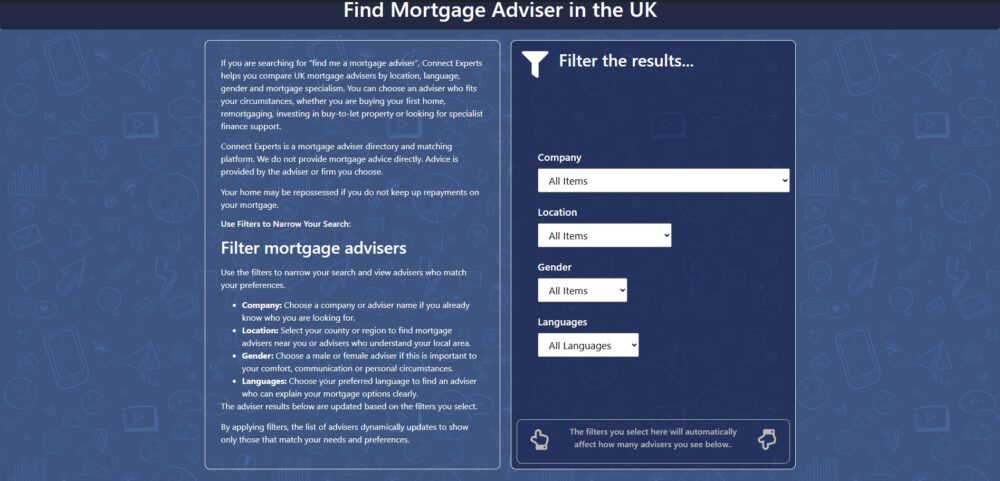
The Connect Experts mortgage adviser directory lets users search and compare advisers using criteria such as location, mortgage requirement, language, and personal preferences. Connect Experts is a directory, not a lender, and the adviser or firm the user selects provides the mortgage advice.
Before proceeding, it can also be sensible to check an adviser’s or firm’s regulatory details using the FCA Financial Services Register.
Good adviser matching is less about finding the biggest list.
It is about reducing the list to people whose experience fits the problem you actually need to solve.
Protection and Longer-Term Financial Planning
Getting the mortgage is only one part of homeownership.
It can also be useful to consider what would happen to the mortgage and household finances if illness, injury, or death affected an income the household depends on.
A specialist protection broker can discuss areas such as life insurance, critical illness cover, and income protection where appropriate to the client’s needs.
Consider protection separately from mortgage approval.
The question is not only whether today’s repayment is affordable.
It is whether the household could remain financially resilient if tomorrow looks different.
Later-Life Mortgage Options in Lancashire
Not every homeowner’s next mortgage decision involves moving.
Burnley residents approaching or already in retirement may instead be considering how existing mortgage borrowing, retirement income and housing wealth fit together.
The 2021 Census recorded 21.7% of Burnley’s residents aged 16 and over as retired, making later-life borrowing a reasonable secondary consideration.
Homeowners considering lifetime mortgages or other later-life options can find information through Equity Release Advisers in Lancashire.
Equity release is not simply another type of remortgage. It is a long-term financial commitment and can reduce an estate’s value or affect entitlement to means-tested benefits. Alternatives should therefore be considered as part of regulated advice.
Find a Mortgage Adviser in Burnley
A Burnley mortgage application can look simple on paper but still depends on several moving parts: income, deposit, credit record, valuation, property condition, and lender criteria.
The useful question is not simply, “Which lender has the lowest rate?”
It is, “Which lenders are prepared to consider this borrower, this property and this objective together?”
Connect Experts can help you compare advisers and choose someone whose stated experience matches the mortgage conversation you need to have.