
Mortgage Broker in Cambridge: Cambridge property can ask an unusual question of a buyer.
How much you earn matters, but so can how you earn it, what you are buying and how much of your wealth sits outside a monthly salary.
That distinction matters in a city where first-time buyer flats, Victorian terraces, modern developments, and homes approaching seven figures can exist within a relatively compact property market.
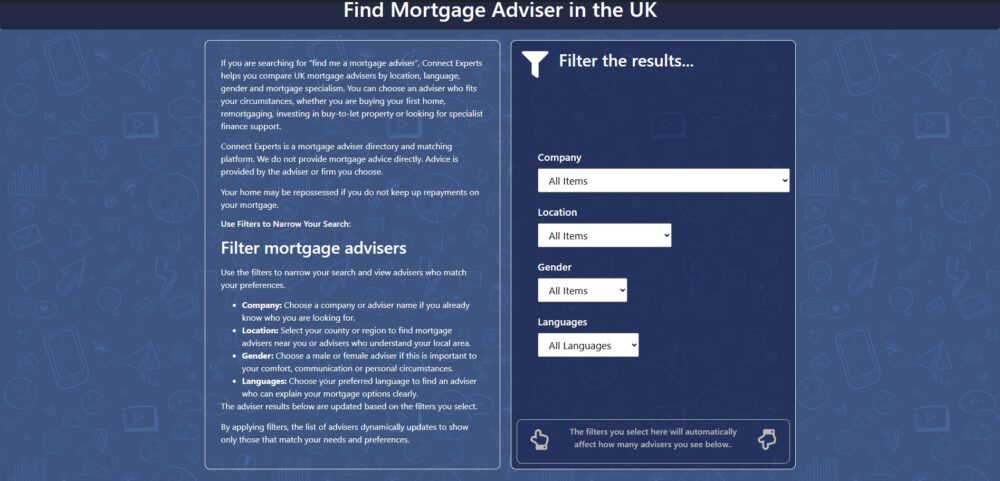
If you are looking for a mortgage broker in Cambridge, Connect Experts can help you compare FCA-authorised mortgage advisers according to location, mortgage expertise, language and other preferences.
Search the Connect Experts mortgage adviser directory
Mortgage Advice in Cambridge
- The average Cambridge property price was £471,000 in June 2026.
- First-time buyers paid an average £394,000.
- Detached properties averaged £976,000.
- Flats and maisonettes averaged £297,000.
- Cambridge’s higher property values can make deposit size and affordability particularly important.
- Business owners, academics, professionals and applicants with bonuses or complex income may face different lender criteria.
- Cambridge also has an active private rental market, making buy-to-let assessment relevant to some investors.
- Connect Experts lets you compare mortgage advisers rather than directing you to one particular broker.
What Does the Cambridge Housing Market Mean for Mortgage Buyers?
A property price is not just a number on an estate agent’s particulars. It determines the deposit required, potential mortgage size, loan-to-value ratio and affordability assessment that follow.
According to the Office for National Statistics, the average Cambridge house price was £471,000 in June 2026, compared with £477,000 a year earlier.
Average Cambridge prices by property type were:
- Detached: £976,000
- Semi-detached: £596,000
- Terraced: £488,000
- Flats and maisonettes: £297,000
First-time buyers paid an average of £394,000.
View the latest ONS Cambridge house-price data
These figures illustrate why mortgage requirements can vary significantly across Cambridge.
Someone buying a city apartment may have very different lender considerations from a family buying a detached property in one of Cambridge’s higher-value residential areas.
Why Cambridge Affordability Can Require Careful Planning
Mortgage affordability is not calculated from the property’s value alone.
A lender may review:
- Basic salary
- Bonuses or commission
- Overtime
- Self-employed income
- Company profits and dividends
- Existing mortgages
- Loans and credit commitments
- Childcare or other regular expenditure
- Deposit size
- Loan-to-value
- Mortgage term
- Proposed retirement age
- Credit history
Two applicants earning the same amount can therefore receive very different borrowing assessments.
This is one reason speaking with a mortgage broker in Cambridge can be useful before making an offer.
An adviser can examine how different lenders may interpret your circumstances rather than assuming every lender will reach the same affordability figure.
Cambridge Mortgages for Professionals and Complex Income
Cambridge’s economy contains a significant concentration of academic, scientific, medical, technology and research-related employment.
Income in these sectors does not always arrive as a simple fixed salary.
Applicants may receive:
- Performance bonuses
- Research-related income
- Fixed-term contract income
- Consultancy income
- Company dividends
- Restricted stock or share awards
- Overseas income
- Multiple sources of earnings
Business owners and contractors may also have income that varies between accounting periods.
Where income is less conventional, a lender’s assessment method can become as important as the headline mortgage rate.
Applicants who run their own businesses can also search for advisers experienced with self-employed mortgage applications.
Higher-Value Mortgages in Cambridge
Cambridge is not exclusively a high-net-worth market.
However, with detached homes averaging close to £1 million in the latest ONS figures, larger mortgage requirements can arise naturally in some parts of the city.
Higher-value cases may involve:
- Large mortgage balances
- Significant deposits
- Complex investment income
- Bonuses or retained company profits
- Interest-only borrowing
- Multiple properties
- Overseas assets
- Private-bank or specialist-lender criteria
Applicants whose financial circumstances extend beyond conventional salary-based affordability may therefore benefit from comparing high net worth mortgage brokers.
A more expensive property does not automatically make someone a high-net-worth mortgage customer. The appropriate lending route depends on the applicant’s complete financial circumstances.
Buying Flats and Leasehold Property in Cambridge
Cambridge has a substantial apartment and flat market, including older conversions and modern developments.
Lenders can assess flats differently from conventional freehold houses.
Considerations may include:
- Remaining lease length
- Ground rent provisions
- Service charges
- Building height
- Construction type
- Cladding or fire-safety documentation where relevant
- Owner-occupier versus investor concentration
- New-build status
- Commercial premises within the same building
A mortgage agreement in principle cannot confirm that a particular property will be acceptable to a lender.
The applicant must satisfy affordability criteria, but the property must also satisfy the lender’s security requirements.
Buying a Period Property in Cambridge
Cambridge also contains Victorian, Edwardian and older housing stock.
Character can add considerable appeal, yet an older building may create lending questions that do not arise with a standard modern home.
A lender or valuer could consider:
- Structural condition
- Roofing
- Damp
- Non-standard alterations
- Listed status
- Construction method
- Previous extensions
- Property access
- Valuation comparables
A mortgage adviser does not replace a solicitor or surveyor. Their role is different: to assess whether the mortgage structure and lender criteria suit the proposed purchase.
New-Build Mortgages in Cambridge
Modern housing development across Cambridge and its surrounding growth areas creates another lending category.
Some lenders apply specific loan-to-value limits to new-build properties.
Applicants should establish:
- Whether the property is a house or flat
- Required deposit
- Expected completion date
- Mortgage-offer validity
- Developer incentives
- Service or estate charges
- Leasehold or freehold tenure
A long construction period can also matter because a mortgage offer may expire before completion.
This makes timing particularly important when buying off-plan.
First-Time Buyers in Cambridge
The average first-time buyer property price in Cambridge was £394,000 in June 2026, according to the ONS.
That figure demonstrates why the deposit can be one of the biggest practical hurdles facing Cambridge first-time buyers.
For example, buyers should consider:
- Available cash deposit
- Legal costs
- Survey fees
- Mortgage-related fees
- Moving costs
- Stamp duty position
- Emergency savings after completion
The largest mortgage available is not necessarily the most comfortable mortgage to maintain.
A sensible first-time buyer strategy considers both lender affordability and the household’s longer-term monthly budget.
You can also compare mortgage advisers who work with first-time buyers.
Buy-to-Let Mortgages in Cambridge
Cambridge’s private rental sector makes buy-to-let relevant to some property buyers.
ONS data shows that the city’s average private rent reached £1,806 per month in July 2026, up 1.9% over twelve months.
That figure does not mean every Cambridge property will provide an attractive investment return.
Buy-to-let lenders commonly consider:
- Expected monthly rent
- Interest coverage ratio
- Loan-to-value
- Applicant tax position
- Personal or limited-company ownership
- Property type
- Number of existing properties
- Landlord experience
- HMO status where relevant
Rental yield should also be considered alongside maintenance, taxation, finance costs, void periods, insurance and management costs.
Landlords considering Cambridge property can compare specialist buy-to-let mortgage advisers.
Independent Schools and Education Finance in Cambridge
Education can influence where a family chooses to buy.
Cambridge and the wider county contain a notable selection of independent schools. The Independent Schools Council lists establishments covering day, boarding, preparatory and senior education.
View independent schools in Cambridge through the ISC
For some households, the financial question is therefore broader than simply obtaining a mortgage.
Mortgage commitments, school fees and household cash flow may need to be considered together.
Families researching how property wealth or borrowing may interact with school costs can read about Education Finance for independent school fees.
Borrowing against a property increases secured debt and should be considered carefully.
Moving to Cambridge from Elsewhere in Cambridgeshire
Cambridge represents only one part of the county’s housing market.
Property values, housing types and commuting patterns can differ considerably between Cambridge, Ely, Huntingdon, St Ives, St Neots and surrounding villages.
People widening their property search beyond the city can compare mortgage advisers across Cambridgeshire.
This creates a clearer choice between advisers focused on Cambridge itself and advisers operating more broadly across the county.
Finding Mortgage Advice in Your Preferred Language
Mortgage terminology can become particularly difficult when English is not someone’s preferred language.
This can matter in a globally connected city such as Cambridge, where residents and employees arrive from many countries.
Connect Experts lets users search by language, mortgage expertise, and location.
You can use the mortgage adviser language search to explore advisers who may offer advice in languages other than English.
Language preference should sit alongside qualifications, permissions and appropriate mortgage expertise when selecting an adviser.
Later-Life Property Decisions in Cambridgeshire
Some Cambridge homeowners may reach a stage where their property’s value has grown considerably while their borrowing requirements have changed.
Their options could include:
- Moving to a smaller property
- Taking a conventional mortgage later in life
- Using retirement income for borrowing
- Reviewing an existing mortgage
- Considering later-life lending
- Investigating equity release where appropriate
Equity release is a specialist area and is not suitable for everyone.
Homeowners exploring that separate market can read about Equity Release Advisers in Cambridgeshire.
What Should You Ask a Mortgage Broker in Cambridge?
A useful mortgage discussion should involve more than asking for the lowest available rate.
Consider asking:
- Which lenders are likely to assess my income favourably?
- How much deposit would I need for this type of property?
- Are there lender restrictions affecting this property?
- What mortgage term should I consider?
- Are arrangement or product fees payable?
- Would a lower rate with a higher fee actually cost more?
- How long will the mortgage offer remain valid?
- What documentation should I prepare?
- What happens if the valuation differs from my purchase price?
- How will my circumstances affect lender selection?
The purpose of mortgage advice is not to make every application appear simple.
Good advice should make the important complications visible before they become expensive problems.
How Connect Experts Helps You Find a Cambridge Mortgage Adviser
Connect Experts is a mortgage adviser directory and matching platform.
Rather than presenting one named broker as the answer for every Cambridge buyer, the directory lets you compare advisers according to the criteria that matter to you.
Depending on availability, you can search using factors including:
- Location
- Mortgage expertise
- Preferred language
- Adviser gender
- Company
- Type of mortgage requirement
You can then review adviser profiles before choosing who you wish to contact.
Connect Experts itself does not provide mortgage advice. Mortgage advice is provided by the adviser or firm you select.
Mortgage Broker in Cambridge | Start Your Search
A Cambridge property can be expensive, unusual, straightforward or somewhere between all three.
The important question is not simply whether a lender offers mortgages in Cambridge.
It is whether its criteria fit your income, deposit, property, and plans.
If you are buying, moving home, refinancing or investing, use Connect Experts to compare FCA-authorised advisers who can assess your circumstances.
Find a mortgage adviser for your Cambridge property plans today.
Search Connect Experts and choose a mortgage adviser
Some forms of buy-to-let and commercial mortgage lending are not regulated by the Financial Conduct Authority.