Mortgage Broker in Edgbaston: A property can appear straightforward yet present a more complex mortgage case.
Edgbaston includes period homes, modern apartments, converted buildings, investment properties and commercial premises. Each property may be assessed differently by lenders.
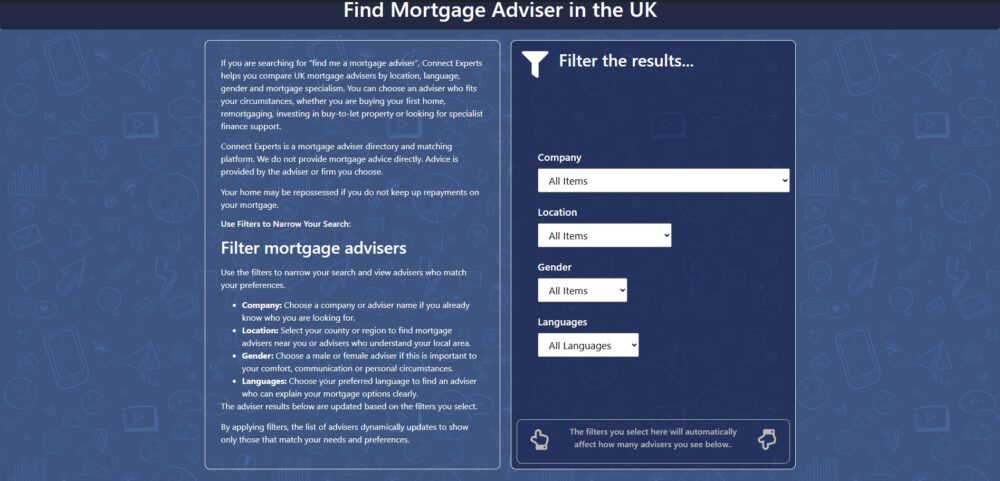
Connect Experts helps you find a mortgage broker in Edgbaston based on your location and mortgage requirements.
You can compare advisers by mortgage expertise, language, gender and preferred communication method.
Connect Experts is a mortgage adviser directory and matching platform. It does not provide mortgage advice directly.
Advice is provided by the adviser or firm you choose.
At a Glance
A mortgage broker in Edgbaston can review your finances, property and borrowing plans before you approach a lender.
The adviser may assess:
- Your income and regular commitments.
- Your deposit or available equity.
- Your credit history.
- The property type and condition.
- Lease terms for flats and converted properties.
- Expected rent for buy-to-let applications.
- Your planned repayment or exit route.
- Documents required by potential lenders.
Connect Experts helps you search for advisers covering Edgbaston. You can then review their profiles before choosing whom to contact.
Finding a Mortgage Broker in Edgbaston
Choosing an adviser should begin with your circumstances, rather than the nearest available mortgage product.
A suitable adviser should understand the type of borrowing you require. They should also explain how lenders may assess your application.
This could include:
- Buying your first home.
- Moving to another property.
- Remortgaging an existing home.
- Buying or refinancing a rental property.
- Purchasing property through a limited company.
- Financing business premises.
- Arranging short-term property funding.
- Borrowing with irregular or complex income.
You can widen your search through the Mortgage Adviser in Birmingham directory page.
This may be useful when you want to compare advisers across Birmingham and the wider West Midlands.
Why Edgbaston Property Can Require Careful Mortgage Planning
Mortgage lending is not based on the postcode alone.
Lenders consider the borrower, the property and the proposed use. They also consider whether the property provides acceptable security.
Edgbaston contains varied housing and building types. These can include large period homes, converted flats, purpose-built apartments and mixed-use property.
Different property characteristics can affect:
- The lender’s valuation.
- The available loan-to-value.
- The deposit required.
- Survey recommendations.
- Leasehold requirements.
- Building construction checks.
- Rental calculations.
- The lender’s appetite for the case.
A property may suit a buyer but still fall outside one lender’s criteria.
This is why mortgage research should begin before a full application is submitted.
What Will a Mortgage Adviser Review?
A mortgage adviser will normally collect information about your finances and intended property purchase.
The review may cover the following areas.
Income
Lenders may assess basic salary, overtime, bonuses, commission and other regular income.
Self-employed applicants may need accounts, tax calculations and business bank statements.
Company directors can be assessed using salary, dividends, retained profit or another permitted calculation.
The method depends on the lender’s rules and the applicant’s circumstances.
Financial commitments
Existing credit can affect mortgage affordability.
This can include:
- Personal loans.
- Credit card balances.
- Car finance.
- Maintenance payments.
- Childcare costs.
- Student loan deductions.
- Other mortgages.
- Regular financial commitments.
A lender may consider both the current payment and the outstanding balance.
Deposit or equity
The size and source of the deposit matter.
A lender may ask whether funds come from:
- Personal savings.
- Existing property equity.
- A gifted deposit.
- An inheritance.
- The sale of an asset.
- Business funds.
- Another permitted source.
Evidence may be required before the mortgage offer is issued.
Credit history
Credit scoring is only one part of a mortgage assessment.
Lenders may also review:
- Missed payments.
- Defaults.
- County Court judgments.
- Debt arrangements.
- Recent credit applications.
- Electoral roll information.
- The age and value of any credit issue.
Different lenders can interpret the same credit history differently.
Property details
The property must usually meet the lender’s security requirements.
The lender may consider:
- Construction type.
- Current condition.
- Remaining lease term.
- Service charges.
- Ground rent.
- Occupancy restrictions.
- Planning use.
- Commercial elements.
- Whether major work is required.
- Whether the property is immediately habitable.
An adviser can identify potential concerns before the lender completes its valuation.
Residential Mortgages in Edgbaston
Residential mortgages apply when you intend to live in the property as your main home.
The lender will normally consider your income, commitments, deposit, credit record and the property.
A broker may help you understand:
- How much you could potentially borrow.
- Which income sources lenders may accept.
- The deposit required.
- Fixed, tracker and variable mortgage structures.
- Mortgage term options.
- Early repayment charges.
- Product fees and valuation costs.
- The evidence required before application.
The lowest advertised rate is not always the lowest overall cost.
Fees, incentives, mortgage term and repayment charges can change the total amount paid.
A recommendation should therefore consider both cost and suitability.
Buying a Flat or Converted Property
Flats and converted buildings may require additional checks.
Lenders can review:
- The remaining lease term.
- Ground rent clauses.
- Service charge levels.
- Building management arrangements.
- The number of units within the building.
- Commercial premises below or nearby.
- External wall or fire-safety information.
- Access and shared-area arrangements.
Not every lender applies the same rules.
The legal and valuation stages may therefore influence the available mortgage options.
Buy-to-Let Mortgages in Edgbaston
A buy-to-let mortgage is usually assessed differently from a residential mortgage.
Lenders often consider the expected rental income alongside the applicant’s financial position.
They may review:
- The anticipated monthly rent.
- The mortgage interest coverage calculation.
- Deposit size.
- Property type.
- Landlord experience.
- Personal or limited company ownership.
- Existing rental properties.
- The proposed tenancy.
- Whether the property is an HMO.
- The applicant’s personal income.
Edgbaston can attract different tenant groups. However, lenders still assess the specific property and proposed tenancy.
A strong local rental market does not automatically make every property mortgageable.
Use Connect Experts to compare buy-to-let mortgage brokers with relevant experience.
Tax treatment depends on personal circumstances and can change. Seek qualified tax advice before selecting an ownership structure.
Commercial Mortgages in Edgbaston
Commercial mortgages can support purchases or refinancing involving business and investment premises.
This could include:
- Offices.
- Retail units.
- Professional premises.
- Mixed-use buildings.
- Investment property.
- Owner-occupied business premises.
Commercial lenders may assess the property, business and repayment structure.
They can consider:
- Business trading history.
- Accounts and management figures.
- Lease terms.
- Tenant quality.
- Rental income.
- Property use.
- Deposit or available equity.
- Business experience.
- The proposed repayment term.
Commercial mortgage criteria vary considerably.
A specialist adviser may help identify lenders that consider the relevant property and business profile.
Compare suitable commercial mortgage brokers through the directory.
Some commercial mortgages and business buy-to-let arrangements are not regulated by the Financial Conduct Authority.
Your adviser should explain the regulatory position before you proceed.
Bridging Finance for Edgbaston Property
Bridging finance provides short-term funding secured against property.
It may be considered where a standard mortgage cannot meet the required timescale or property condition.
Common uses include:
- Auction purchases.
- Chain breaks.
- Property refurbishment.
- Buying before another property sells.
- Short-term business property funding.
- Refinance while longer-term finance is arranged.
A bridging lender will usually require a clear exit strategy.
The exit may involve:
- Selling the property.
- Refinancing onto a mortgage.
- Receiving proceeds from another transaction.
- Repaying from another verified source.
The exit should be realistic and supported by evidence.
Interest, valuation charges, legal fees and arrangement fees can make bridging finance more expensive than standard borrowing.
Search for bridging loan mortgage brokers who can explain the risks and costs.
Documents to Prepare Before Speaking With an Adviser
Early preparation can reduce delays.
The exact evidence depends on your circumstances. However, useful documents may include:
- Proof of identity.
- Proof of address.
- Recent bank statements.
- Payslips.
- P60 documents.
- Tax calculations and tax year overviews.
- Business accounts.
- Evidence of deposit.
- Existing mortgage statements.
- Details of loans and credit commitments.
- Rental agreements and mortgage statements for existing properties.
- Property details or sales particulars.
Documents should be accurate, complete and consistent.
Unexplained transactions or conflicting information can create further lender questions.
Questions to Ask a Mortgage Broker
Before choosing an adviser, ask practical questions.
These could include:
- Does the adviser handle my type of mortgage?
- Which mortgage markets can the adviser access?
- How will the adviser communicate with me?
- What information will be required?
- What fees could apply?
- When would any fee become payable?
- Does the firm receive lender commission?
- Who will manage the application after submission?
- How will the adviser explain their recommendation?
- Is the adviser or firm authorised for the required activity?
Clear answers can help you understand the service before proceeding.
Check the Adviser’s Regulatory Status
Residential mortgage advice is generally a regulated financial activity.
Before receiving regulated advice, confirm the adviser or firm has the required permission.
You can check this using the Financial Services Register.
The register can show:
- The firm’s regulatory status.
- Its reference number.
- Permitted activities.
- Trading names.
- Contact information.
- Any regulatory notices.
The firm shown on the register may differ from the adviser’s public trading name.
Ask the adviser to explain which authorised firm is responsible for the advice.
Local Knowledge and Mortgage Suitability
Local knowledge can help an adviser understand common property types and practical transaction issues.
However, location alone does not determine suitability.
A mortgage recommendation must still consider:
- Your needs.
- Your financial circumstances.
- The property.
- The borrowing purpose.
- Product costs.
- Lender criteria.
- The risks of the recommended mortgage.
A familiar postcode cannot replace a full affordability and suitability assessment.
Good advice brings the local property decision and the lending decision together.
How Connect Experts Helps
Connect Experts allows you to search for mortgage advisers covering Edgbaston.
You can compare advisers using information such as:
- Location.
- Mortgage expertise.
- Language.
- Gender.
- Company.
- Advice method.
- Individual adviser profile.
Connect Experts does not recommend a mortgage product.
It helps you identify advisers who may be able to discuss your circumstances.
You remain free to review profiles and decide whom to contact.
Find a Mortgage Broker in Edgbaston
A mortgage decision combines personal affordability with the realities of the property.
The correct starting point is not simply finding a rate. It is understanding what a lender will assess and why.
Use Connect Experts to find a mortgage broker covering Edgbaston. Review adviser profiles and choose someone with experience relevant to your circumstances.
Find a Mortgage Broker in Edgbaston
Frequently Asked Questions
How do I find a mortgage broker in Edgbaston?
Use Connect Experts to search for advisers covering Edgbaston. Compare their expertise, language, communication options and profile information before making contact.
Does a mortgage broker need to be based in Edgbaston?
No. An adviser can often provide advice by telephone or video. A local adviser may be useful when local knowledge matters.
Can an Edgbaston mortgage broker help with buy-to-let property?
Some advisers specialise in buy-to-let mortgages. Check the adviser’s profile and confirm they handle your property and ownership structure.
Can a broker help with self-employed income?
A suitable adviser can review accounts, tax documents and income structure. Lender calculations vary for sole traders, partnerships and company directors.
Does using a mortgage broker guarantee acceptance?
No. Mortgage approval remains subject to affordability, credit assessment, valuation, lender criteria and satisfactory supporting evidence.
How much deposit will I need?
The required deposit depends on the mortgage type, property, borrower and lender. Buy-to-let and specialist mortgages may require larger deposits.
Can I get a mortgage for a flat in Edgbaston?
Potentially. The lender may assess the lease, service charges, ground rent, building construction and any commercial premises within the building.
Can a broker arrange commercial property finance?
Some advisers specialise in commercial mortgages. Confirm that the adviser has experience with your property type and proposed business use.
Are bridging loans regulated?
Some bridging loans are regulated and others are not. The regulatory position depends on the property, borrower and intended use.
Does Connect Experts provide mortgage advice?
No. Connect Experts is a directory and matching platform. Mortgage advice is provided by the adviser or firm selected by the user.
Your home or property may be repossessed if you do not keep up repayments on your mortgage or loans secured against it.
A fee may be payable for mortgage advice or arrangement. Your adviser will explain any fee before you choose to proceed.