A Mortgage Broker in Glasgow can help turn a property decision into a lending decision by assessing how your income, deposit, property and future plans fit lender criteria.
Glasgow is not one single housing market. Traditional sandstone tenements, modern apartments, suburban family homes and newer developments can create very different mortgage questions. The right mortgage is therefore rarely determined by postcode alone.
For buyers and homeowners, the important question is not simply what a property costs. It is whether the property, valuation and applicant fit the lender’s requirements.
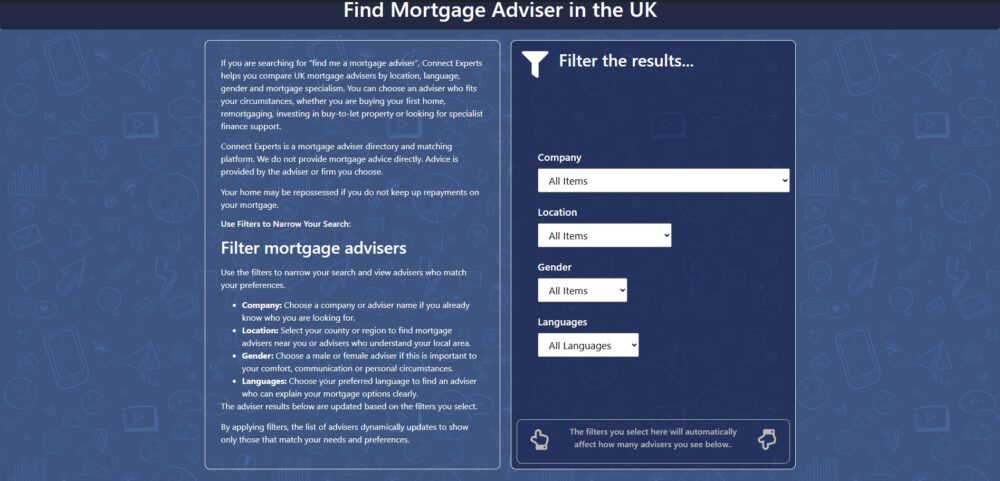
Connect Experts helps you find a mortgage adviser by location, language, and expertise before deciding who you want to contact.
Glasgow’s Housing Market Has Changed Considerably
Registers of Scotland recorded a median Glasgow residential property price of £185,000 during 2025–26. This represented annual growth of 4%.
More significantly, Glasgow’s median residential price increased by 57% over the ten years to 2025–26. That was the strongest ten-year percentage rise among Scotland’s eight cities.
Glasgow City also recorded 11,305 residential sales during 2025–26. Together with Edinburgh, it accounted for a substantial share of Scottish residential transactions.
You can review the underlying figures in the Registers of Scotland Property Market Report 2025–26.
Those figures do not mean every Glasgow neighbourhood behaves alike. West End tenements, city-centre apartments and suburban houses can differ considerably in value, condition and lender treatment.
That makes property-specific mortgage research important.
What Could Affect a Mortgage in Glasgow?
A lender normally assesses the borrower and the property separately before deciding whether both are acceptable.
For somebody seeking a Mortgage Broker in Glasgow, important considerations may include:
- Deposit and loan-to-value: A larger deposit can reduce the percentage of the property’s value being borrowed.
- Affordability: Salary, overtime, bonuses, debts, childcare, credit commitments and household spending can influence borrowing capacity.
- Employment structure: Self-employed income, contracting or company-director earnings may be assessed differently between lenders.
- Property type: Flats, tenements, new builds and properties above commercial premises can attract different lending criteria.
- Condition: Significant repair requirements can affect a lender’s valuation or willingness to lend.
- Credit history: Missed payments, defaults or other credit problems may reduce the range of available lenders.
- Purpose: Residential, buy-to-let and HMO lending have different affordability and underwriting rules.
- Valuation: What a buyer agrees to pay and what a lender accepts as mortgage security are not necessarily the same figure.
Applicants with business income can also compare self-employed mortgage brokers where accounts, salary, dividends, retained profit or contracting income need specialist assessment.
The Scottish Home Report matters
Most homes marketed for sale in Scotland require a Home Report.
It contains a Single Survey, Energy Report and Property Questionnaire. The Single Survey gives buyers information about the property’s condition and includes a valuation.
The Scottish Government’s Home Report guidance explains the framework in more detail.
A mortgage lender may still apply its own valuation requirements. Therefore, the Home Report valuation should not automatically be treated as a guarantee of the mortgage value a lender will accept.
Glasgow’s Tenements and Flats Need Property-Specific Thinking
Glasgow’s built environment gives this page a genuinely local mortgage angle.
Sandstone tenements are an established part of areas including the West End, Southside and parts of the East End. Modern apartments are also common around central Glasgow and regeneration areas.
For mortgage purposes, the word flat alone tells a lender very little.
Underwriting may consider:
- construction type
- building condition
- floor level
- access arrangements
- shared repair responsibilities
- commercial premises within the building
- valuation comments
- major planned works
- whether the property is suitable security for the lender
Older properties can have enormous character, but character does not remove the need for careful underwriting.
A mortgage adviser can review the Home Report and property details before an applicant commits to a lender whose criteria may not suit that particular building.
First-Time Buyers in Glasgow
Glasgow can present a wide range of entry points for first-time buyers, particularly because its 2025–26 city median price of £185,000 remained below Scotland’s £198,000 median.
However, a lower purchase price does not automatically make a mortgage affordable.
Across Scotland, the mean loan-to-value for first-time buyer mortgages was 82.8% in Q1 2026. The number of mortgages advanced to Scottish first-time buyers also increased by 6% across 2025–26.
Someone buying their first Glasgow property should therefore consider:
- available deposit
- mortgage affordability
- purchase costs
- Home Report valuation
- credit profile
- mortgage term
- monthly payment resilience
- property condition
- lender criteria
Buyers who are unfamiliar with the process can search for first-time buyer mortgage advisers and compare advisers whose experience fits their circumstances.
Glasgow’s Student Market Creates Specialist Landlord Questions
Glasgow has an unusually significant further and higher education population.
Glasgow City Council’s housing strategy estimated around 130,000 further and higher education students studying in Glasgow, with approximately half living inside the council boundary. The strategy also identifies purpose-built student accommodation, private renting and HMOs as parts of the city’s student housing picture.
That creates a genuine specialist mortgage angle for landlords.
A conventional buy-to-let property and an HMO are not interchangeable from a lending perspective.
Landlords may need to consider:
- expected rental income
- lender rental stress tests
- deposit requirements
- landlord experience
- number of occupants
- property configuration
- licensing requirements
- planning status
- valuation method
- personal or limited-company ownership
Glasgow City Council handles HMO licensing within the city, and Scottish legislation applies specific requirements where qualifying properties are occupied by unrelated residents.
Investors can compare buy-to-let mortgage brokers or, where the property meets the relevant criteria, search specifically for HMO mortgage brokers.
Consider mortgage suitability and HMO licensing separately. Securing finance does not itself confirm that a property can lawfully operate as an HMO.
Finding the Right Mortgage Adviser in Glasgow
The nearest mortgage adviser is not automatically the most suitable adviser.
A better match considers the circumstances that could affect the mortgage application.
When looking for a Mortgage Broker in Glasgow, consider whether the adviser regularly deals with:
- your type of property
- your employment or income structure
- first-time purchases
- remortgaging
- landlord finance
- HMO lending
- previous credit problems
- complex deposits
- Scottish property transactions
Connect Experts lets users compare advisers through its mortgage broker directory rather than relying only on geographical proximity.
You can review areas of expertise, location, appointment preferences and other profile information before choosing who to contact.
Connect Experts is a directory and matching platform. Mortgage advice is provided by the adviser or firm you select.
Glasgow’s Diversity Can Make Language Choice Important
Glasgow also has a credible multilingual search opportunity.
Scotland’s Census 2022 reported that 17.3% of Glasgow’s population identified as belonging to an ethnic minority, one of the highest proportions among Scottish cities. The recorded groups included Pakistani, African, Chinese, Irish and other communities.
Mortgage terminology can materially affect a financial decision. Affordability, loan-to-value, fixed periods, early repayment charges and lender conditions should be properly understood.
Clients who prefer discussing financial matters in another language can use Connect Experts to find a broker by language.
Language preference does not change lending criteria. It can, however, make detailed mortgage discussions clearer.
Protection and Longer-Term Financial Planning
Finding the mortgage is only one part of owning a home.
A mortgage creates a financial commitment that may continue for decades. It can therefore be sensible to consider what would happen to repayments if illness, injury, death or a loss of income affected the household.
A specialist protection mortgage broker can discuss areas such as life insurance, critical illness cover and income protection where appropriate.
Cover should reflect individual circumstances, existing benefits, budget and financial responsibilities rather than being treated as an automatic addition to a mortgage.
For older homeowners considering later-life borrowing rather than a standard residential mortgage, you may need separate specialist advice. Equity Release Advisers in Lanarkshire can provide a more relevant starting point for that distinct type of borrowing.
Equity release reduces the value of your estate and may affect your entitlement to means-tested benefits. It is not suitable for everyone.
Why Local Knowledge Still Needs Lender Knowledge
Knowing Glasgow can be useful. Knowing lender criteria is essential.
A local adviser may understand the practical differences between tenements, modern apartments, suburban houses, student property and newer developments. However, local knowledge alone does not determine which lender will accept an application.
The decision normally depends on a combination of:
Borrower + income + deposit + credit history + property + valuation + lender criteria.
A property can suit one lender but fall outside another lender’s policy.
Likewise, two people buying similar Glasgow properties may receive different mortgage options because their incomes, deposits, or financial commitments differ.
That is why speaking with a suitably experienced Mortgage Broker in Glasgow can be more useful than searching for a mortgage rate in isolation.
Find a Mortgage Adviser in Glasgow
A home can be local, but the mortgage decision is personal.
Whether you are considering a tenement flat, buying your first home, moving across Glasgow, refinancing an existing mortgage or purchasing rental property, the right adviser should understand both the lending question and your circumstances.
Connect Experts lets you compare mortgage advisers by location, expertise, language and personal preferences before deciding who you want to speak with.