
Mortgage Broker in Luton LU1 – Discover Living in Luton Guide. Luton is a large town in Bedfordshire with strong links to London, Bedford, St Albans, Milton Keynes, and the wider South East.
It is known for London Luton Airport, the University of Bedfordshire, Luton Town Football Club, local parks, diverse communities, and practical commuter links. The town has a long industrial history, including hat making, car manufacturing, aviation, engineering, and local trade.
Today, Luton offers town-centre living, family suburbs, commuter homes, investment property options, and access to major road and rail routes. Luton is also a unitary authority, which means Luton Borough Council provides local services for the town.
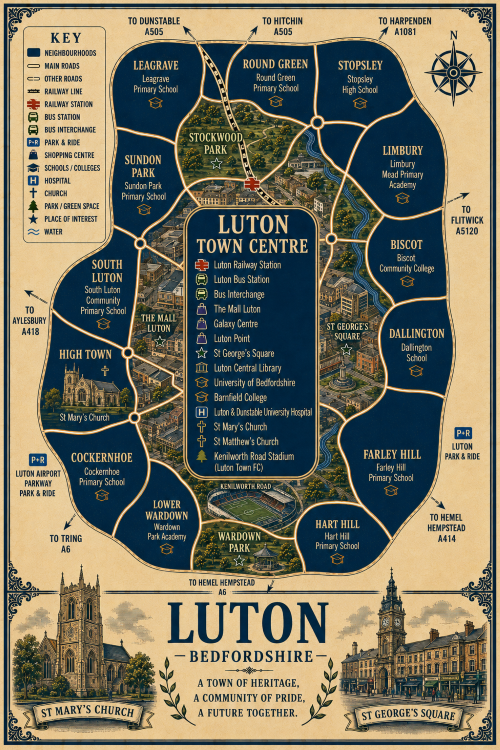
Popular areas include Luton town centre, High Town, Stopsley, Leagrave, Limbury, Wigmore, Round Green, Bury Park, Farley, Bushmead, Lewsey, Bramingham, and Dallow. Nearby places such as Dunstable, Houghton Regis, Harpenden, Caddington, Slip End, Toddington, and St Albans may also appeal to buyers comparing the wider area.
Property in Luton
Luton has a varied property market for buyers, landlords, home movers, and investors.
The town includes terraced homes, semi-detached houses, detached homes, flats, maisonettes, converted buildings, new-build homes, and commercial premises.
 Buyers may find:
- Victorian terraced homes
- 1930s semi-detached houses
- Post-war family homes
- Modern apartments
- Town-centre flats
- Homes near Luton station
- Homes near Leagrave station
- Homes near Luton Airport Parkway
- Buy-to-let investment homes
- Student rental properties
- Professional rental properties
- Family houses near schools
- Properties near parks
- Homes close to the M1
- Homes near London Luton Airport
- Commercial premises
- Semi-commercial buildings
- Mixed-use properties
- HMO-style rental properties
- Leasehold flats
- New-build developments
- Properties needing refurbishment
Property types can vary widely by location.
Town-centre flats may suit buyers who want shops, rail links, and university facilities nearby. Leagrave may appeal to commuters who want rail access and established residential streets. Stopsley, Wigmore, Bushmead, and Bramingham may suit buyers looking for suburban homes and local amenities.
Bury Park, Dallow, High Town, and Round Green may appeal to buyers wanting access to community shops and central services. Landlords may consider tenant demand from students, airport workers, professionals, families, and local employees.
Lenders will still review every case against their own criteria. They will assess income, deposit, credit history, commitments, property type, property condition, and affordability.
Flats, leasehold homes, HMOs, new builds, commercial units, and semi-commercial buildings may need extra checks. Properties close to transport routes or employment areas can be attractive, but suitability depends on the buyer’s aims.
Meet Jai Olatunde: Mortgage Broker Supporting Luton
Jai Olatunde is a mortgage broker supporting clients who are buying, remortgaging, investing, or reviewing property options in Luton. Jai can help clients understand lender requirements for residential mortgages, buy-to-let mortgages, remortgages, and specialist lending cases.
This may include support for first-time buyers, home movers, landlords, self-employed applicants, and clients with complex income. Mortgage advice should always reflect the applicant’s circumstances.
This includes income, deposit, credit profile, property type, borrowing needs, and future plans. Jai can help explain how lenders assess affordability and what documents may be needed.
This can make the mortgage process clearer from the early planning stage through to completion.
Find Jai on:
Living in Luton: What to Expect
Luton offers a practical lifestyle with transport links, schools, shops, parks, community facilities, and access to nearby countryside. The town is larger and busier than many Bedfordshire locations. It may appeal to people who want access to London without choosing a London borough.
Luton also has a strong local identity shaped by migration, industry, football, aviation, and independent businesses. Everyday life is supported by supermarkets, pharmacies, banks, gyms, healthcare services, cafés, restaurants, and local shops.
The Mall Luton is a central shopping destination in the town centre.
George Street, Park Street, Bury Park, High Town, Dunstable Road, and Marsh Road are important local shopping and service areas. The University of Bedfordshire has a Luton campus in the town centre.
London Luton Airport is also a major local employer and travel hub.
These features can support housing demand among students, workers, commuters, and families.
Luton can suit:
- First-time buyers
- Home movers
- Families
- Commuters
- Students
- Landlords
- Professionals
- Retirees
- Business owners
- Self-employed applicants
- Buyers seeking Bedfordshire property options
- Investors comparing rental demand
- Buyers wanting access to London by rail
- Buyers wanting airport access
- Buyers wanting town-centre convenience
- Buyers wanting suburban family homes
Areas to Consider in Luton
Luton has many different neighbourhoods, and each area can offer a different style of living. The town centre may suit buyers who want direct access to shops, the university, buses, and Luton railway station. High Town offers period properties, local businesses, and access to the station. Stopsley and Wigmore can appeal to buyers wanting suburban homes and access towards the airport.
Leagrave offers residential streets, local shops, and rail links from Leagrave station.
Bury Park is known for its independent shops, food businesses, community services, and its proximity to central Luton. Bushmead and Bramingham may appeal to families looking for quieter residential settings.
Lewsey, Limbury, Dallow, Farley, Round Green, and Biscot each offer different housing styles and local amenities.
Buyers should compare travel times, parking, schools, property condition, and local facilities before choosing an area.
Popular areas to compare include:
- Luton town centre
- High Town
- Stopsley
- Wigmore
- Leagrave
- Limbury
- Bury Park
- Dallow
- Biscot
- Farley
- Round Green
- Bushmead
- Bramingham
- Lewsey
- Caddington
- Dunstable
- Houghton Regis
- Harpenden
- St Albans
Education and Schools in Luton
Luton is served by primary schools, secondary schools, sixth forms, colleges, and higher education.
Families moving to Luton should check catchment areas, admissions rules, school performance, and daily travel routes.
Luton Borough Council provides school admissions information for parents and carers.
This includes applications, transfers, catchment areas, waiting lists, deadlines, and supporting documents.
School planning can be important when choosing a home.
Families may want to assess:
- Distance to schools
- Admissions criteria
- Catchment areas
- Walking routes
- Bus routes
- Nursery provision
- After-school care
- Sixth-form options
- College access
- School travel arrangements
- Parking near schools
- Peak-time journey times
- Future education needs
The University of Bedfordshire also has a strong presence in Luton.
Its town-centre campus supports higher education, student housing demand, and the local economy.
Landlords considering student property should check lender criteria before buying.
Some lenders have specific rules for student lets, HMOs, leasehold flats, and multi-tenant property.
Amenities and Everyday Convenience
Luton has a wide range of everyday amenities across the town centre and residential areas. Residents can access supermarkets, pharmacies, GP surgeries, dental practices, cafés, restaurants, banks, gyms, and local shops.
The Mall Luton provides town-centre retail, while George Street remains an important central shopping area.
Bury Park has a strong independent retail and food scene.
Marsh Road, Stopsley, Wigmore, Leagrave, and Round Green also provide useful neighbourhood amenities.
Key retail and lifestyle areas include:
- The Mall Luton
- George Street
- Bury Park
- Park Street
- High Town
- Dunstable Road
- Marsh Road
- Stopsley village area
- Wigmore local shops
- Leagrave local shops
- Luton Indoor Market
- Retail parks around Luton
- Town-centre restaurants and cafés
- Independent shops in Bury Park
- Local shops in High Town
- Food businesses on Dunstable Road
Daily convenience will depend on the chosen area.
A town-centre flat may offer different benefits from a family home in Stopsley or Bushmead. Buyers should compare walking distances, parking, road access, bus routes, and local services.
Parks and Green Space in Luton
Luton has several parks and open spaces that support walking, leisure, sport, and family life. Wardown Park is one of the town’s best-known green spaces. Luton Borough Council describes Wardown Park as a Grade II listed historic green space near the town centre.
It includes heritage features, a boating lake, sports facilities, a café, play areas, and Wardown House Museum.
Stockwood Park is another important local green space.
Stockwood Discovery Centre offers gardens, galleries, local collections, and family-friendly attractions.
Other local green spaces include People’s Park, Brantwood Park, Lewsey Park, Stopsley Common, and Wigmore Park.
Local green spaces include:
- Wardown Park
- Stockwood Park
- People’s Park
- Brantwood Park
- Lewsey Park
- Stopsley Common
- Wigmore Park
- Manor Road Park
- Memorial Park
- The Moor
- Cowslip Meadow
- Galley and Warden Hills nearby
- Local recreation grounds
- Play areas across residential neighbourhoods
Access to parks can influence property choice.
Families may want homes near play areas and open space.
Dog owners may prefer homes near larger parks or walking routes.
Commuters may value green space close to town-centre homes.
Buyers should also consider road noise, parking, and peak-time traffic around popular park areas.
Social Life and Local Lifestyle in Luton
Luton has a varied social life shaped by culture, food, sport, music, education, and local community groups. The town is known for its diverse population and wide range of independent food businesses. Residents can find restaurants, cafés, takeaways, dessert shops, supermarkets, and specialist food stores across the town.
Bury Park is especially known for South Asian food, independent shops, and community businesses. The town centre provides cinemas, restaurants, pubs, gyms, and cultural facilities.
Luton Town Football Club gives the town a strong sporting identity.
Kenilworth Road has long been part of Luton’s local character. The Hat Factory Arts Centre and local cultural venues add creative and entertainment options.
Stockwood Discovery Centre and Wardown House Museum also support family days out and local heritage.
Luton may appeal to people who want:
- Town-centre convenience
- Strong transport links
- Airport access
- Local restaurants and cafés
- Independent food businesses
- Parks and open space
- Football and sports culture
- University facilities
- Family-friendly suburbs
- Road links across Bedfordshire
- Rail links to London
- Access to the M1
- A mix of old and new housing
- Diverse local communities
Transport Links in Luton
Transport is one of Luton’s main strengths.
Luton has rail services from Luton station, Luton Airport Parkway, and Leagrave station. Thameslink services connect Luton with London, St Albans, Bedford, Gatwick Airport, Brighton, and other destinations.
East Midlands Railway also serves Luton on routes between London and the East Midlands.
Luton Airport Parkway provides access to London Luton Airport.
The Luton DART links Luton Airport Parkway with the airport terminal area.
Road links are also important.
The M1 runs close to Luton and provides access towards London, Milton Keynes, Northampton, and the Midlands.
The A6 connects Luton with Bedford, St Albans, and nearby communities.
The A505 provides routes towards Dunstable, Hitchin, and the wider area.
London Luton Airport gives the town direct access to domestic and international travel.
This can appeal to airport workers, frequent travellers, and businesses linked to aviation.
Transport links may be useful for travel to:
- London St Pancras International
- London Blackfriars
- London Bridge
- St Albans
- Bedford
- Gatwick Airport
- Brighton
- Leicester
- Nottingham
- Sheffield
- Dunstable
- Milton Keynes
- Hitchin
- London Luton Airport
- Wider Bedfordshire routes
Buyers who rely on transport should check current timetables before choosing a property.
They should also compare station distance, parking, bus routes, journey times, and peak-hour traffic.
Those researching relocation may also wish to read “Why Move to Bedfordshire” to understand the county’s wider housing and lifestyle appeal.
Why Luton Appeals to Buyers
Luton attracts buyers because it offers strong transport links, varied housing, airport access, and a practical location. The town may appeal to people priced out of nearby London, St Albans, Harpenden, or Hertfordshire locations.
It can also suit buyers who want Bedfordshire homes with commuting options.
Luton offers:
- Town-centre flats
- Period terraces
- Family houses
- Suburban homes
- Modern apartments
- Homes near stations
- Homes near the airport
- Properties near the M1
- Student rental opportunities
- Professional rental demand
- Commercial property options
- Semi-commercial property options
- Homes near schools
- Homes near parks
- Buy-to-let investment options
- Properties near the University of Bedfordshire
- Homes close to local shopping areas
- Properties with London commuter appeal
The area may suit:
- First-time buyers
- Home movers
- Families
- Commuters
- Landlords
- Students
- Airport workers
- University staff
- Self-employed applicants
- Business owners
- Property investors
- Buyers seeking Bedfordshire links
- Clients comparing London commuter towns
- Buyers wanting access to the M1
- Buyers wanting access to London Luton Airport
A home in Leagrave may suit different needs from a flat near Luton station.
A house in Stopsley may offer a different lifestyle from a property in Bury Park.
A home in Bushmead may appeal to families seeking quieter residential streets.
Buyers should think carefully about daily routines, local facilities, budget, and mortgage affordability.
Mortgage Considerations in Luton
Mortgage suitability depends on personal circumstances and lender criteria. Lenders will review income, deposit, employment type, debts, credit history, property condition, and affordability.
Self-employed applicants may need bank account statements, tax calculations, business bank statements, or references from an accountant. First-time buyers may need guidance on deposit size, credit checks, mortgage terms, and monthly repayments.
Landlords may need buy-to-let affordability checks, rental assessments, and property-specific underwriting. Some Luton properties may need closer lender review.
This can apply to leasehold flats, new builds, converted buildings, HMOs, mixed-use premises, and properties needing renovation.
Commercial and semi-commercial buildings can also need a specialist lender assessment.
Buyers should budget beyond the deposit.
Costs may include:
- Solicitor fees
- Survey fees
- Valuation fees
- Broker fees
- Insurance costs
- Removal costs
- Stamp duty
- Search fees
- Product fees
- Arrangement fees
- Buildings insurance
- Contents insurance
- Protection cover
- Possible leasehold costs
- Service charges
- Ground rent, where applicable
Stamp duty depends on the purchase price and the buyer’s status.
Professional advice can help buyers understand their options before making an offer.
Buy-to-Let in Luton
Luton can interest landlords because of its transport links, airport economy, university presence, and local employment base. Rental demand may come from students, professionals, families, airport workers, and commuters.
Different areas may attract different tenant profiles. Town-centre flats may appeal to students and professionals.
Family homes may suit tenants needing schools, gardens, and local amenities.
Properties near stations may appeal to commuters.
Homes near the airport may appeal to workers who value shorter journeys.
Landlords may consider:
- Student rental demand
- Professional tenant demand
- Family rental demand
- Airport worker demand
- Commuter demand
- Proximity to Luton station
- Proximity to Leagrave station
- Proximity to Luton Airport Parkway
- Access to the M1
- Local school demand
- Property condition
- Refurbishment costs
- Licensing requirements
- HMO rules
- Leasehold restrictions
- Expected rent
- Void periods
- Maintenance costs
- Insurance costs
Landlords should review lender criteria before buying.
Buy-to-let lenders will consider rent, deposit, property type, borrower profile, and tax position.
HMOs may need additional checks and licensing.
Leasehold flats, ex-local authority homes, and mixed-use buildings can also need a specialist lender review.
Landlords should also consider maintenance costs, insurance, void periods, letting rules, and local licensing requirements.
Living in Luton
Luton offers transport links, employment, education, shopping, parks, cultural diversity, and a wide range of housing. It is a practical Bedfordshire town with direct links to London and the wider region. The town may suit buyers who value connectivity, affordability, local amenities, and a variety of property options. From town-centre flats to suburban family homes, Luton offers choice across a range of budgets and lifestyles.
The airport, university, rail network, and M1 all support the town’s appeal.
Neighbourhoods such as Stopsley, Leagrave, High Town, Bury Park, Wigmore, Bushmead, and Bramingham offer a range of living options. For buyers, landlords, and home movers, Luton offers valuable property opportunities.
Mortgage suitability will still depend on lender criteria and personal circumstances. For tailored mortgage advice in Luton, Jai Olatunde can help review your options.
Jai can explain lender requirements, compare suitable mortgage routes, and support your application from planning through to completion.
This can help you make informed decisions when buying, remortgaging, or investing in Luton.
Thank you for reading our “Mortgage Broker in Luton LU1 | Discover Living in Luton” publication. Stay “Connect“-ed for more updates soon!