A Mortgage Broker in St Mary’s Loch can help turn the attraction of a remarkable setting into a mortgage decision built on facts. A home is more than its view, and borrowing is more than an interest rate. Around St Mary’s Loch, the property itself, its access, services, construction and surrounding land can matter almost as much as the applicant’s income.
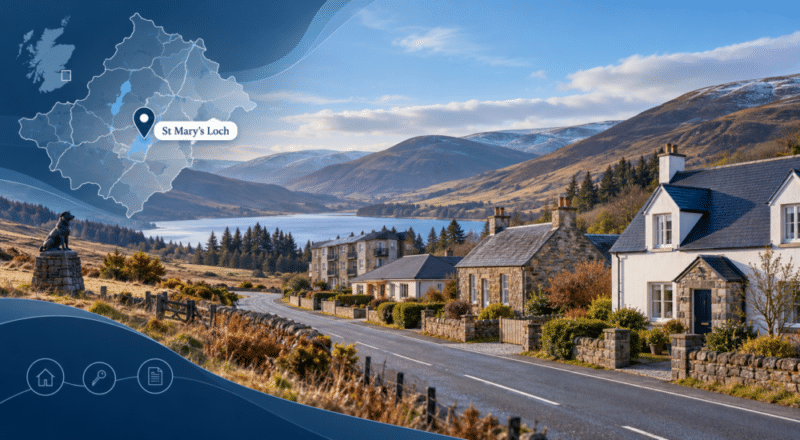
St Mary’s Loch sits within the Upper Yarrow landscape in the Scottish Borders. Scottish Borders Council describes it as the only large natural loch in the Borders, within a landscape characterised by pastoral land, woodland and scattered settlement.
For buyers, that rural character creates an important principle: the right mortgage is not simply one a borrower can afford. The lender must also be comfortable with the property offered as security.
At a glance: Mortgage Broker in St Mary’s Loch
- St Mary’s Loch is a distinctly rural market within the TD7 postcode area.
- Homes may include traditional cottages, farmhouses, converted buildings and properties with substantial land.
- Private roads, tracks, drainage, water supplies and non-standard heating can require closer lender assessment.
- The average house price in the Scottish Borders was approximately £195,000 in August 2026.
- First-time buyers across Scottish Borders paid approximately £150,000 on average in August 2026.
- Detached properties averaged about £374,000, showing how property type can significantly affect local prices.
- Scotland has its own Home Report and Land and Buildings Transaction Tax system.
- Mortgage rate, lender criteria and property suitability should be considered together.
- Protection planning can help safeguard the mortgage when circumstances change.
The August 2026 figures are provisional Scottish Borders averages rather than valuations for St Mary’s Loch itself. Local transaction numbers can be smaller, so individual properties should always be assessed on their own characteristics.
Rural homes require more than an affordability calculation
A lender assesses two things at the same time: the borrower and the security.
Your income, expenditure, deposit, credit history and existing commitments determine whether the borrowing appears affordable. The property must also meet the lender’s security requirements.
That distinction becomes particularly important around St Mary’s Loch.
A rural property could have:
- a private water supply;
- septic-tank or private drainage arrangements;
- oil, LPG, biomass or electric heating;
- shared or privately maintained access;
- an unadopted road or forestry track;
- agricultural land;
- several acres attached to the title;
- stables, barns or other outbuildings;
- an annexe;
- older stone construction;
- extensive renovation requirements;
- rights of access or servitudes; or
- part of the property used for business purposes.
None of these features automatically prevents a mortgage. However, different lenders can take different approaches.
Working with a Mortgage Broker in St Mary’s Loch can therefore be particularly useful when a straightforward residential property search doesn’t reflect the home you actually want to buy.
Look beyond the asking price
The headline price is only one part of buying a Scottish property.
Before committing, consider the deposit, legal costs, survey implications, monthly mortgage payment, possible renovation expenses and any tax due.
Scotland uses Land and Buildings Transaction Tax rather than Stamp Duty Land Tax. Additional property purchases can also involve the Additional Dwelling Supplement. Use Revenue Scotland to check the current rules and calculate potential liability before completion.
Mortgage rates also change frequently. Buyers who want a current starting point can compare UK mortgage rates and associated costs before discussing eligibility and suitability with an adviser.
A low rate does not necessarily mean a low overall cost. Product fees, incentives, valuation charges, early repayment charges, and how long you expect to keep the mortgage can change the comparison.
The Home Report is important, but it is not the lender’s final word
Most homes marketed for sale in Scotland require a Home Report. It includes a Single Survey, Energy Report and Property Questionnaire.
That information gives a buyer a useful starting point, but a mortgage lender still decides whether the property provides acceptable security.
For an older or unusual rural home, an adviser may need to consider:
- the Home Report valuation;
- lender valuation requirements;
- construction type;
- roof and structural condition;
- evidence of significant repairs;
- the extent of any land;
- private access arrangements;
- water and drainage;
- outbuildings;
- occupancy restrictions; and
- how each part of the property will be used.
Choosing a Mortgage Broker in St Mary’s Loch who understands how property characteristics interact with lender criteria can help identify potential issues before an application reaches underwriting.
Energy efficiency can matter more in an exposed rural property
The character of an older countryside home may be part of its appeal, but running costs still belong in the affordability conversation.
An Energy Performance Certificate explains a building’s energy efficiency and potential improvements. The Scottish Government confirms that an EPC forms part of the Home Report when a home is sold.
For a rural property, buyers may want to understand:
- the current heating system;
- insulation;
- glazing;
- likely heating costs;
- whether mains gas is available;
- possible energy-efficiency improvements; and
- the cost of replacing an older heating system.
These considerations don’t replace mortgage affordability calculations, but they can help you assess whether the property will remain financially comfortable after completion.
Buying land, outbuildings or a property with several uses
More space can create more questions.
If a house includes significant acreage, woodland, agricultural buildings, or commercial activity, a conventional residential lender may want to understand exactly what you’re buying.
Be clear about your plans from the beginning.
For example, tell your adviser if you intend to:
- keep horses or livestock;
- operate a business from the property;
- rent an annexe;
- convert an outbuilding;
- undertake major development;
- derive income from the land; or
- substantially alter the property after purchase.
If a project involves extensive construction or conversion rather than a conventional habitable home, development finance advice may be more appropriate than forcing the project into an unsuitable residential mortgage.
For a property acquired primarily for business occupation, an owner-occupied commercial mortgage adviser can help determine whether commercial rather than residential finance should be considered.
Buying a property you intend to let
Not every property around the loch will be purchased as a main residence.
If the property will be rented to tenants, the lender needs to know from the beginning. Rental property is assessed differently from a normal residential home, with factors including expected rent, loan-to-value, property type and the applicant’s circumstances.
Someone entering the rental market for the first time can search for a first-time landlord mortgage adviser.
An experienced landlord with several mortgaged properties may instead need portfolio landlord mortgage advice.
Where the property will be acquired through a company, limited company buy-to-let advice may be relevant.
The ownership structure should normally be considered before an offer or mortgage application rather than changed simply to obtain a particular mortgage product. Legal and tax advice may also be required.
The Financial Conduct Authority does not regulate some forms of buy-to-let mortgage.
When timing becomes part of the mortgage problem
Rural properties may need work before they meet conventional mortgage criteria.
If a property needs substantial refurbishment, has limited mortgageability in its current condition, or must be purchased before longer-term finance is available, a short-term solution may be considered.
A short-term bridging loan adviser can explain how bridging finance works, its costs and the importance of having a credible repayment or refinance strategy.
For an investment property, there is also specialist buy-to-let bridging loan advice.
Bridging finance is usually more expensive than a conventional mortgage and shouldn’t be treated as a simple, faster substitute for long-term borrowing.
First-time buyers should understand the Scottish process
Buying your first home beside a loch may feel very different from buying a conventional starter property, but the fundamentals remain important.
Start by establishing:
- how much deposit you have;
- what mortgage payment is affordable;
- how lenders will assess your income;
- your likely purchase costs;
- whether the property suits mainstream mortgage criteria; and
- how much financial flexibility remains after completion.
The Scottish Borders average first-time buyer price was approximately £150,000 in August 2026, although individual homes around St Mary’s Loch can differ considerably from that wider local authority figure.
Don’t let a regional average dictate your budget. Your own income, deposit, expenditure and chosen property determine what is realistic.
Remortgaging a home near St Mary’s Loch
Existing owners should ideally review their position before the current mortgage deal ends.
The best next step isn’t automatically to stay with the existing lender or switch to a new one.
Compare:
- the new interest rate;
- product fees;
- early repayment charges;
- valuation requirements;
- outstanding mortgage balance;
- loan-to-value;
- proposed term;
- affordability; and
- whether changes to the property affect lender choice.
If your current deal is nearing its end, a mortgage rate ending adviser can help you compare the available options.
This can be especially important if you have since added land, converted buildings, changed how part of the property is used, or undertaken substantial renovations.
Protect the home as well as financing it
A mortgage decision considers how to buy the property. Protection planning asks what happens if life changes after the keys are collected.
A Mortgage Broker in St Mary’s Loch may also introduce or work alongside an adviser who can review protection needs based on the mortgage balance, income, dependants, existing cover and household expenditure.
Protection mortgage advice can include consideration of:
- life insurance;
- critical illness cover;
- income protection; and
- mortgage payment protection.
The appropriate type and level of cover depends on individual circumstances. Policy exclusions, deferred periods, premiums and claim definitions should be understood before proceeding.
Protection is not about expecting something to go wrong. It is about whether the financial plan would keep working if something did.
The nearest adviser is not necessarily the right adviser
Geography can matter when an adviser understands the local property market. Expertise matters even more when the property doesn’t fit a standard lending profile.
Before selecting an adviser, consider:
- Rural property experience: Have they dealt with homes with land, outbuildings or private services?
- Mortgage expertise: Do they regularly advise on your type of borrowing?
- Lender access: What range of lenders can they consider?
- Property assessment: Will they examine potential lender concerns before submission?
- Communication: Can meetings be handled effectively by phone, video or another suitable method?
- Fees: What will you pay and at what stage?
- Regulation: Does the adviser or firm have the permissions required for the work being undertaken?
The aim is not simply to find someone nearby. It is to find someone whose expertise fits the borrower and the property.
Prepare the property information early
For an unusual or rural home, accurate information can prevent avoidable delays.
Try to obtain relevant details about:
- construction;
- acreage;
- title plan;
- road access;
- private water;
- drainage;
- heating;
- outbuildings;
- planning permissions;
- building warrants;
- commercial activity;
- tenancy arrangements; and
- proposed alterations.
Registers of Scotland’s ScotLIS service can also be used to research property information, including title and boundary information and recorded sale prices.
The principle is simple: describe the property you are actually buying, not the simpler property you hope the lender imagines.
Mortgage advice built around the property and the person
A beautiful location does not make mortgage criteria disappear. In many cases, it makes understanding them more important.
St Mary’s Loch combines a distinctive landscape with a housing market where individual properties can differ substantially. A traditional house reached by a private track has different lending questions from a conventional home in a larger settlement. A farmhouse with land has different considerations from a cottage used purely as a residence.
A good mortgage recommendation therefore brings together:
- affordability;
- deposit;
- credit profile;
- property construction;
- land and outbuildings;
- access and services;
- intended use;
- mortgage rate;
- fees;
- future plans; and
- financial resilience.
That is where advice earns its value. The objective is not simply to find a mortgage that exists. It is to identify a mortgage that makes sense for the circumstances.
Speak to a Mortgage Broker in St Mary’s Loch
The right decision begins before the application.
Whether you are buying your first rural home, moving to Selkirkshire, refinancing an existing property, or purchasing something with land, speak to a Mortgage Broker in St Mary’s Loch who can assess your borrowing needs and the property.
Prepare the facts early, understand the costs, and let the mortgage support the life you intend to build, rather than letting it define it.