
Mortgage Life Insurance UK: Mortgage life insurance is designed around a clear financial risk.
A mortgage may continue for decades. However, the income supporting it can change without warning.
Mortgage life insurance can pay a lump sum if an insured person dies during the policy term. The money can then help repay the outstanding mortgage.
It is not normally a legal requirement for UK homeowners. However, it may reduce the financial pressure placed on a surviving partner or family.
Connect Experts helps you find qualified mortgage and protection advisers across the UK. Connect Experts does not provide insurance advice directly.
Advice is provided by the adviser or authorised firm you choose.
At a Glance
- Mortgage life insurance can help repay a mortgage following the insured person’s death.
- Decreasing term cover is commonly used with repayment mortgages.
- Level term cover maintains the same insured amount throughout the policy term.
- Life insurance does not normally cover illness, redundancy or temporary loss of earnings.
- Critical illness cover and income protection address different financial risks.
- Premiums can depend on age, health, occupation, smoking status, cover and policy length.
- Policy information must be accurate and complete.
- Existing cover should be reviewed after major mortgage or family changes.
- Connect Experts lets you search for advisers by location, language, gender and expertise.
What Is Mortgage Life Insurance?
Mortgage life insurance is a form of term life insurance.
It pays a lump sum if the insured person dies during the agreed policy term. The policy ends without a payout if the insured person survives beyond that term.
The payout can be used to:
- Repay some or all of the mortgage.
- Reduce future monthly housing costs.
- Help a surviving borrower remain in the property.
- Protect family savings from immediate mortgage demands.
- Reduce the need for a forced property sale.
The insurer does not usually make monthly mortgage payments. Instead, it pays the agreed benefit after accepting a valid claim.
How the money is paid can depend on the policy structure and any trust arrangement.
Is Mortgage Life Insurance Compulsory in the UK?
Mortgage life insurance is not normally compulsory.
A lender may discuss protection with a borrower, but the borrower can usually choose whether to arrange cover.
This differs from buildings insurance. A mortgage lender will usually require suitable buildings insurance from exchange or completion.
Although life insurance is optional, the financial risk remains.
The important question is not simply whether insurance is required. It is whether the household could maintain or repay the mortgage without the insured person.
How Does Decreasing Term Mortgage Life Insurance Work?
Decreasing term life insurance provides an insured amount that reduces during the policy term.
It is commonly used alongside a capital repayment mortgage.
With a repayment mortgage, the outstanding capital should reduce as monthly payments are made. Decreasing cover aims to follow a similar downward pattern.
For example, a homeowner may arrange:
- An initial mortgage of £250,000.
- A mortgage term of 25 years.
- Decreasing life cover starting at £250,000.
- A matching 25-year insurance term.
The insurance benefit reduces according to the policy schedule.
However, it may not match the mortgage balance exactly. Differences can arise from interest rates, missed payments, payment holidays or mortgage changes.
Borrowers should check the policy’s assumed interest rate. If the mortgage rate rises above that assumption, the insurance benefit could fall faster than the mortgage balance.
What Is Level Term Life Insurance?
Level term insurance keeps the same insured amount throughout the policy term.
A £250,000 level term policy would retain that cover amount, provided premiums remain paid and the policy remains valid.
This may be considered when:
- The mortgage is interest-only.
- Additional family protection is required.
- The borrower wants a fixed benefit.
- Household costs must be considered alongside the mortgage.
- The borrower expects the mortgage structure to change.
Level term cover often costs more than comparable decreasing cover. The insurer remains exposed to the full insured amount throughout the term.
Any surplus remaining after the mortgage is repaid could support other financial needs.
Decreasing Term Versus Level Term Cover
| Policy feature | Decreasing term cover | Level term cover |
|---|---|---|
| Insured amount | Reduces over time | Remains fixed |
| Common use | Repayment mortgage | Interest-only mortgage or wider family cover |
| Typical premium | Often lower | Often higher |
| Mortgage match | Approximate | Does not reduce with the mortgage |
| Potential surplus | Usually limited | May leave money after mortgage repayment |
| Inflation protection | Normally none | Normally none unless increasing cover is selected |
The lower premium is not always the better outcome.
A policy should reflect the debt, household structure, budget and intended financial result.
What Is Increasing Term Life Insurance?
Increasing term cover raises the insured amount during the policy term.
The increase may follow inflation or a fixed annual percentage.
This can help preserve the real value of the benefit. However, premiums may also increase.
Increasing cover is less closely connected to a reducing mortgage debt. It may be considered when wider family protection is the main objective.
Should the Policy Match the Mortgage Term?
The policy term should normally reflect the period during which the financial risk exists.
For mortgage protection, that may mean matching the remaining mortgage term.
However, the right term may be different when:
- The borrower expects to repay the mortgage early.
- The mortgage includes an interest-only period.
- The borrower plans to move home.
- The household has dependent children.
- Existing employer benefits provide temporary protection.
- Retirement plans affect the repayment strategy.
A short policy may end while the mortgage remains outstanding.
A longer policy may provide cover after the original mortgage has been repaid. That may be useful, but it can increase the cost.
Single-Life and Joint-Life Mortgage Cover
A single-life policy covers one person.
A couple may arrange one policy each. This can allow each policy to pay independently following a valid claim.
A joint-life policy covers two people but normally pays only once.
Most joint-life mortgage policies operate on a first-death basis. After a valid claim, the policy ends.
Two single-life policies may provide more potential cover. However, they can cost more than one joint policy.
The decision should consider affordability, family responsibilities and the financial effect of either person dying.
What Affects the Cost of Mortgage Life Insurance?
Insurers assess the probability of a claim and the possible size of that claim.
Premiums can be affected by:
- Age
- Medical history
- Current health
- Smoking or nicotine use
- Occupation
- Dangerous work activities
- Hazardous hobbies
- Policy term
- Cover amount
- Policy type
- Country of residence
- Travel history
- Family medical history
Higher cover and longer terms generally increase the insurer’s exposure.
Health conditions do not always prevent cover. An insurer may offer standard terms, increase the premium, apply an exclusion or decline the application.
Different insurers may assess the same information differently.
What Is Insurance Underwriting?
Underwriting is the insurer’s assessment of the application risk.
The insurer may request:
- A health questionnaire
- Details of existing medical conditions
- Current medication information
- A general practitioner’s report
- A nurse screening
- Blood or other medical tests
- Details of occupation and income
- Information about travel or hobbies
Applicants should answer questions fully and accurately.
Incorrect or incomplete information can affect the claim. It may also allow the insurer to change or cancel the policy.
The insurer should explain what information is required and how it will be used.
What Does Mortgage Life Insurance Not Cover?
Standard life insurance normally covers death during the policy term.
It does not normally provide benefits for:
- Redundancy
- Temporary unemployment
- Short-term sickness
- Reduced working hours
- Mortgage payment increases
- Relationship breakdown
- General financial difficulty
Some policies include terminal illness benefit. This may allow an early payout following a qualifying terminal diagnosis.
Definitions and time limits vary between insurers.
Policies may also contain exclusions. These should be reviewed before the application is completed.
Life Insurance and Critical Illness Cover
Life insurance and critical illness cover protect against different events.
Life insurance pays following the insured person’s death during the policy term.
Critical illness cover can pay following diagnosis of an illness covered by the policy. The diagnosis must meet the insurer’s definition.
Conditions, severity requirements and exclusions vary.
A critical illness payment could help:
- Repay or reduce the mortgage.
- Fund household costs during treatment.
- Pay for property changes.
- Replace part of lost earnings.
- Support recovery or care costs.
Someone requiring this type of help can search for critical illness cover advisers.
Life Insurance and Income Protection
Income protection is designed to replace part of a person’s earnings following qualifying illness or injury.
Unlike life insurance, it usually pays a regular benefit rather than one lump sum.
Important policy features can include:
- The insured income
- Benefit percentage
- Deferred period
- Claim duration
- Occupation definition
- Guaranteed or reviewable premiums
- Indexation
- Exclusions
Income protection may support mortgage payments while the insured person remains alive but cannot work.
Life insurance addresses death. Income protection addresses an interruption to earnings.
Some households may need both forms of protection.
Should Mortgage Life Insurance Be Written in Trust?
A life insurance policy can sometimes be written in trust.
A trust may allow the policy benefit to pass to named beneficiaries without forming part of the policyholder’s estate.
This can sometimes speed up payment because probate may not be required for the policy proceeds.
Trusts can carry legal and tax consequences. They may also be difficult to change after being created.
The policyholder should understand:
- Who the trustees are.
- Who may receive the benefit.
- Whether beneficiaries can be changed.
- How claims will be handled.
- Whether legal or tax advice is required.
An insurance adviser can explain available trust documentation. Legal or tax questions may require a separate specialist.
When Should Existing Cover Be Reviewed?
Protection should not be treated as a one-time decision.
A policy may need reviewing after:
- Buying a new home
- Remortgaging
- Increasing the mortgage
- Extending the mortgage term
- Switching to interest-only
- Marriage or civil partnership
- Divorce or separation
- Birth or adoption
- A major salary change
- Becoming self-employed
- Loss of workplace benefits
- A change in health
- Repaying a significant debt
Do not cancel existing cover before replacement cover has started.
A new application may be more expensive or subject to different terms. Health changes can also affect the outcome.
Questions to Ask Before Choosing a Policy
Before applying, consider asking:
- Does the insured amount reflect the mortgage balance?
- Does the policy term match the financial risk?
- Is decreasing or level cover more suitable?
- Is the mortgage repayment or interest-only?
- Does the policy cover one or two people?
- Are premiums guaranteed or reviewable?
- Is terminal illness benefit included?
- What exclusions apply?
- Could the policy be written in trust?
- What happens if the mortgage changes?
- How will the insurer assess a claim?
- What existing workplace or personal cover is available?
The cheapest premium may not provide the required result.
Insurance has value only when its structure reflects the risk it is intended to cover.
How to Find a Mortgage Life Insurance Adviser
A protection adviser can assess the mortgage alongside the household’s wider financial commitments.
The review may include:
- Mortgage balance and term
- Repayment method
- Household income
- Dependants
- Existing insurance
- Workplace benefits
- Savings
- Other debts
- Monthly budget
- Health and occupation
- Expected future changes
Connect Experts is a UK adviser directory and matching platform.
You can use the directory to find protection mortgage brokers or compare listed life insurance advisers.
You can also view matched protection advisers for the selected service.
Connect Experts does not provide personal protection advice. Advice is provided by the adviser or authorised firm you choose.
What to Check Before Contacting an Adviser
Check whether the adviser or firm:
- Has the relevant regulatory permissions.
- Provides life insurance and protection advice.
- Can consider more than one insurer.
- Explains fees and commission clearly.
- Discusses exclusions and claim definitions.
- Reviews existing protection before replacing it.
- Can support your preferred communication method.
- Understands your mortgage type and family needs.
You can check firms and permissions through the Financial Conduct Authority.
Independent information about policy structures is also available through MoneyHelper’s life insurance guidance.
Frequently Asked Questions
Does mortgage life insurance pay the lender directly?
Not always.
The payment may be made to the policyholder’s estate, trustees, beneficiaries or an assigned lender. This depends on the policy structure.
Can I get mortgage life insurance after completing my mortgage?
Yes.
Cover can usually be arranged before or after completion. However, age and health changes may affect the premium or available terms.
Can I change my policy after remortgaging?
Some policies allow changes. Others require a new application.
Review the cover amount, term, mortgage type and new medical underwriting before replacing an existing policy.
Does mortgage life insurance cover an interest-only mortgage?
Decreasing cover may not be suitable because an interest-only balance does not normally reduce during the term.
Level term cover may provide a closer match to the outstanding debt.
Can both borrowers have separate policies?
Yes.
Two single-life policies can provide separate benefits. A joint-life policy normally pays once and then ends.
Will a life insurance claim always be paid?
No insurer can guarantee every claim.
A claim may be declined when the event is excluded, the policy has ended or important application information was inaccurate.
Does life insurance cover critical illness?
Standard life insurance only pays following death.
Critical illness cover is a separate benefit, although it can sometimes be added to a life insurance policy.
Is mortgage life insurance suitable for someone without dependants?
It depends on the intended outcome.
A person may still want to protect a joint borrower, guarantor, family member or estate. Others may decide the cover is unnecessary.
Can self-employed borrowers arrange mortgage life insurance?
Yes.
Employment status does not normally prevent life insurance. Income protection may require more detailed evidence of earnings.
Is Connect Experts an insurer?
No.
Find an Adviser Through Connect Experts
A mortgage creates an obligation that may continue regardless of personal events.
Protection planning considers who would carry that obligation if life changed unexpectedly.
Connect Experts lets you search by location, language, gender and specialist area. This helps you identify an adviser whose services match your protection needs.
Find a mortgage adviser and review their profile before making contact.
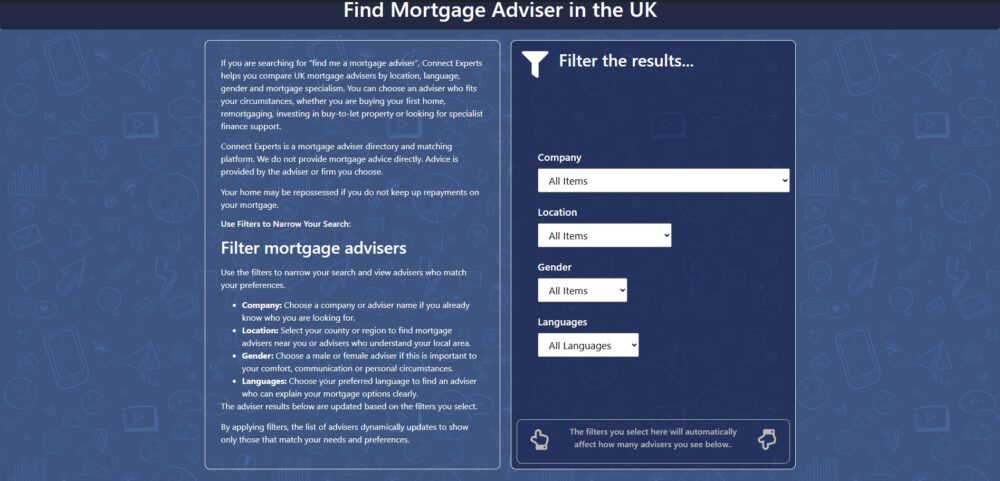
There is no obligation to proceed after using the directory.