Moving Home Affordability: A homeowner may have paid their mortgage reliably for years.
That record is important. However, it does not fix the amount they can borrow for their next home.
Moving house creates a new mortgage decision.
The lender must consider the applicant’s current finances, the requested loan amount, and the proposed property.
At a Glance
- Moving home normally triggers a fresh affordability assessment.
- Current income matters more than income used for the original mortgage.
- Credit commitments and household spending can reduce borrowing.
- Lenders use different methods for variable and self-employed income.
- A longer term may reduce payments but increase total interest.
- Preparation before property viewings can reduce avoidable delays.
Why Is Affordability Checked Again?
Mortgage affordability changes over time.
Income may rise or fall. Household commitments may increase. Interest rates and lender policies may also change.
A lender must assess whether the new mortgage appears affordable.
This applies even when:
- The existing mortgage has never been missed.
- The current product is portable.
- The requested loan is similar.
- The borrower remains with the same lender.
- The new monthly payment appears manageable.
Past payment conduct supports the application. It does not replace present affordability checks.
What Income May Be Considered?
Employed applicants may usually provide:
- Basic salary.
- Regular overtime.
- Commission.
- Bonus income.
- Shift allowances.
- Additional employment income.
Lenders may not use every income source in full.
They may average variable earnings or require an established history.
Treatment differs between lenders.
One lender may use a high proportion of regular overtime. Another may use less or exclude it.
The application should reflect income that can be evidenced.
Self-Employed and Company Director Income
Self-employed applicants may be assessed using:
- Net profit.
- Share of partnership profit.
- Salary and dividends.
- Salary and retained profit.
- Latest year’s earnings.
- An average across several years.
The method depends on the lender and business structure.
A business can be profitable while the director takes a modest salary. That does not mean every lender will use retained profit.
Some lenders also consider recent business performance and sustainability.
Users with mixed or business income can search for a self-employed residential mortgage adviser through Connect Experts.
How Debts Affect Borrowing
Lenders consider existing commitments because they reduce available monthly income.
These may include:
- Personal loans.
- Vehicle finance.
- Credit cards.
- Student loan deductions.
- Maintenance payments.
- Childcare costs.
- School fees.
- Buy-now-pay-later balances.
- Other mortgages.
- Guaranteed financial commitments.
Clearing a debt before completion may help in some cases.
However, the lender may still require evidence that the balance has been repaid.
Taking new credit during the application can change the result.
Credit Limits and Credit Balances
Some lenders focus mainly on current monthly payments.
Others also consider total balances or available credit limits.
A large unused credit limit does not create a monthly payment. However, lender treatment can vary.
Applicants should not close long-held accounts automatically without understanding the possible effect on their credit profile.
The aim is accurate preparation, not cosmetic changes shortly before applying.
Household Spending and Dependants
Affordability does not depend only on debt.
Lenders may consider:
- Number of adults.
- Number and age of dependants.
- Childcare costs.
- Travel expenses.
- Pension contributions.
- Regular insurance.
- Ground rent.
- Service charges.
- Maintenance commitments.
- Essential household spending.
The new property can also affect expenditure.
A larger home may require higher energy, council tax, maintenance and insurance costs.
How the Mortgage Term Changes Affordability
A longer mortgage term can reduce the monthly contractual payment.
However, it usually increases the total interest paid.
The term may also be limited by:
- Applicant age.
- Expected retirement age.
- Pension income.
- Employment type.
- Lender policy.
- Interest-only repayment plans.
A term should not be extended simply to reach a target loan amount.
It should remain consistent with the borrower’s long-term repayment capacity.
What Is Mortgage Stress Testing?
Lenders do not assess only the starting payment.
They may consider whether payments remain manageable under higher future costs.
The exact method depends on the product, the fixed-rate period, and the lender’s policy.
Stress testing can affect two applicants with similar incomes differently.
Existing debts, mortgage term and household commitments can change the outcome.
Online calculators provide estimates. They do not reproduce every lender’s assessment.
How Maternity Leave Can Affect an Application
Applicants on maternity or parental leave may still obtain a mortgage.
The lender may request:
- Current leave income.
- Intended return date.
- Expected working hours.
- Employer confirmation.
- Future childcare costs.
- Savings covering any temporary shortfall.
The application should present the real post-return position.
Future income should not be overstated, and future childcare costs should not be ignored.
Moving Home After a Change of Job
A new job does not always prevent mortgage approval.
Lenders may consider:
- Whether employment has started.
- Whether a contract is signed.
- Probation terms.
- Employment history.
- Industry continuity.
- Income structure.
- Gaps between roles.
Some accept a signed employment contract before the start date. Others require a first payslip.
The choice of lender can therefore affect timing.
Affordability With Adverse Credit
Credit problems can affect lender choice, deposit requirements and available rates.
Relevant events may include:
- Missed payments.
- Defaults.
- County Court judgments.
- Debt management plans.
- Individual voluntary arrangements.
- Bankruptcy.
- Mortgage arrears.
- Repossession history.
The date, value, reason and current status may all matter.
Connect Experts allows users to search for adverse-credit mortgage brokers when a specialist assessment may be required.
Approval cannot be guaranteed.
Documents to Prepare
Before applying, prepare:
- Proof of identity.
- Proof of address.
- Recent payslips.
- Latest P60.
- Bank statements.
- Tax calculations where relevant.
- Business accounts.
- Existing mortgage statement.
- Evidence of deposit.
- Details of loans and credit cards.
- Evidence of bonuses or overtime.
- Childcare and maintenance costs.
Documents should match the information supplied on the application.
Unexplained differences can delay underwriting.
Why an Agreement in Principle Is Not Final Approval
An agreement in principle provides an initial indication.
It may use limited information and an automated credit check.
It does not confirm that:
- All income will be accepted.
- The property is suitable.
- Documents meet requirements.
- The valuation supports the purchase price.
- The final application will be approved.
A material change before completion can also require reassessment.
Frequently Asked Questions
Does my existing payment history guarantee affordability?
No. It can support the application, but the lender must assess current circumstances.
Can overtime be included?
Possibly. The amount accepted depends on regularity, evidence and lender policy.
Does childcare reduce mortgage borrowing?
It can. Regular childcare costs may form part of the affordability assessment.
Can I extend the mortgage term?
Possibly. Age, retirement income and lender rules may limit the available term.
Should I repay debts before applying?
That may help, but it depends on the debt, available savings and lender treatment.
The Practical Principle
Affordability is not a judgement about whether someone has managed money well.
It is a calculation based on evidence, assumptions and future financial pressure.
Understanding those inputs helps borrowers prepare before the property search becomes urgent.
Finding an Adviser for Affordability Planning
Different lenders can reach different affordability results from the same household information.
An adviser can explain which evidence may be required and how different lenders assess income.
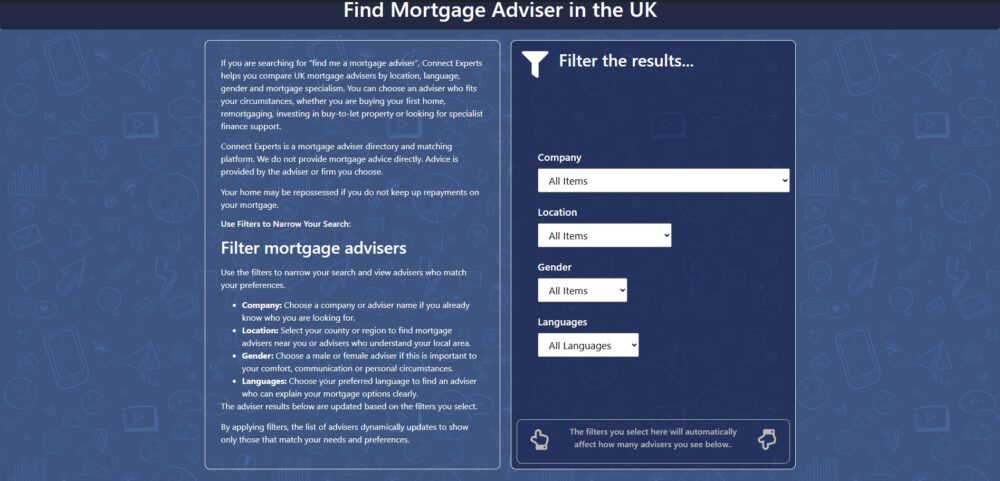
Connect Experts helps users find mortgage advisers by expertise, location, language and other preferences.