
Need Tax-Free Cash From Your Home?
A home may hold financial value built over many years. However, accessing that value changes both present choices and future wealth.
Eligible homeowners may release cash through equity release, a later-life mortgage or another secured borrowing option. The released capital is normally not treated as taxable income.
However, “tax-free” does not mean cost-free or consequence-free. Borrowing may affect your estate, benefits, future housing choices and total interest costs.
Connect Experts helps you find qualified mortgage advisers through its UK directory. It does not provide equity release advice directly.
At a Glance
- Money released from your home is normally received free of income tax.
- A lifetime mortgage is the most common equity release product.
- Home reversion involves selling part or all of your property.
- Interest may compound when lifetime mortgage payments are not made.
- Releasing money can reduce the value left in your estate.
- Holding released cash may affect means-tested benefits.
- Downsizing, remortgaging and retirement mortgages should also be considered.
- Specialist regulated advice is required before proceeding with equity release.
- Connect Experts lets you compare advisers by expertise, location, language and other preferences.
What Does “Tax-Free Cash From Your Home” Mean?
The value of your home minus any secured borrowing is known as your property equity.
For example, a property worth £400,000 with a £50,000 mortgage has £350,000 of gross equity. This does not mean the entire £350,000 can be borrowed.
The available amount may depend on:
- Your age
- The youngest applicant’s age
- The property value
- The property’s condition and construction
- Existing mortgages or secured loans
- The chosen product
- Current lender criteria
- Health or lifestyle information, where applicable
Money borrowed against a property is generally capital rather than earnings. Therefore, the amount received is not normally subject to income tax.
However, tax may apply to income or investment returns later produced by that money. Personal circumstances can also affect the outcome.
How Can You Access Cash From Your Home?
There is no single route for every homeowner. The main options have different repayment structures and long-term effects.
Lifetime Mortgage
A lifetime mortgage is a loan secured against your home. You remain the legal owner of the property.
The money may be provided through:
- One lump sum
- Smaller withdrawals through a drawdown facility
- A combination of both
Monthly payments are not always required. Where interest is not paid, it is usually added to the outstanding loan.
The mortgage is normally repaid when the last borrower dies or moves permanently into long-term care. The home is usually sold at that stage.
Some plans permit voluntary repayments. These can reduce the future effect of compound interest, subject to the lender’s conditions.
Home Reversion Plan
A home reversion plan involves selling part or all of your home to a provider.
You receive a lump sum, regular payments or both. You normally retain the right to remain in the property under the plan’s terms.
You no longer own the proportion sold. When the property is eventually sold, the provider receives its agreed share.
The amount paid for the share may be below its open-market value. This reflects the provider’s potentially long wait before receiving sale proceeds.
Retirement Interest-Only Mortgage
A retirement interest-only mortgage requires regular interest payments.
The original capital is generally repaid when the property is sold, the borrower dies or enters permanent care.
This option may suit homeowners with reliable retirement income. Affordability checks and lender conditions apply.
Standard Remortgage
Some older homeowners may qualify for a standard residential remortgage.
This could provide capital while retaining a conventional repayment structure. However, income, age and affordability requirements still apply.
Second Charge Mortgage
A second charge mortgage is a separate loan secured against your home.
It leaves the existing first mortgage in place. Monthly repayments are normally required, and affordability must be demonstrated.
The combined cost of both loans should be examined carefully.
Downsizing
Selling a larger home and purchasing a less expensive property may release capital without creating long-term secured debt.
However, moving costs, legal fees, Stamp Duty and emotional considerations may reduce its appeal.
Is Equity Release Cash Always Tax-Free?
The released amount is normally tax-free because it is borrowed capital rather than income.
However, the wider position requires care.
For example:
- Interest earned after placing the money in savings may be taxable.
- Investment returns may create tax liabilities.
- Gifts may affect estate planning.
- Retaining cash can change means-tested benefit entitlement.
- Using funds to buy another asset may create separate tax considerations.
The phrase “tax-free cash” describes the initial receipt. It does not provide a permanent tax exemption for everything later done with the money.
Homeowners should consider financial, benefits and legal guidance where these matters are relevant.
How Compound Interest Can Change the Cost
Compound interest is one of the most important lifetime mortgage considerations.
Suppose a homeowner releases £50,000 at a fixed annual interest rate of 6%. No repayments are made.
An approximate illustration would be:
| Time elapsed | Approximate balance |
|---|---|
| Starting balance | £50,000 |
| After 5 years | £66,900 |
| After 10 years | £89,500 |
| After 15 years | £119,800 |
| After 20 years | £160,400 |
This is a simplified illustration rather than a product quotation. Actual calculations, fees and repayment conditions will vary.
The example shows why the amount borrowed is only part of the decision. Time can become as important as the original interest rate.
Lump Sum or Drawdown?
A lump-sum plan provides the full amount at completion. Interest normally begins on the entire balance immediately.
A drawdown plan provides an initial amount and creates a facility for later withdrawals.
Interest is generally charged only on money already withdrawn. This may reduce total interest where the full amount is not needed immediately.
However:
- Future withdrawals are not always guaranteed.
- The rate for later withdrawals may differ.
- Minimum withdrawal limits may apply.
- The remaining facility can depend on lender terms.
- Holding less cash may protect some means-tested benefits.
An adviser can compare the cost of taking money now against releasing it gradually.
What Can Tax-Free Property Cash Be Used For?
There is normally considerable flexibility over how released funds are used.
Common purposes include:
- Repaying an existing mortgage
- Adapting the home for reduced mobility
- Completing essential repairs
- Supplementing retirement income
- Supporting children or grandchildren
- Paying selected debts
- Meeting care-related costs
- Purchasing a more suitable property
- Creating an emergency reserve
The intended use should be measured against the long-term cost.
Borrowing for a lasting need may have a different rationale from borrowing for short-term discretionary spending.
How Can Equity Release Affect Your Estate?
Equity release reduces the part of your property value that remains unencumbered.
The eventual effect depends on:
- The amount released
- The interest rate
- Whether repayments are made
- How long the plan remains active
- Future property values
- Plan fees
- Any inheritance protection selected
Some products allow a percentage of the property value to be protected for beneficiaries.
However, protecting part of the value may reduce the amount available to borrow.
Speaking with family can be helpful. Yet the homeowner’s needs, independence and financial security must remain central.
Could Benefits Be Affected?
Receiving a lump sum may affect means-tested benefits if the retained capital exceeds relevant thresholds.
Possible areas include:
- Pension Credit
- Council Tax Reduction
- Help with health costs
- Certain care-related support
- Other capital-assessed assistance
The impact depends on the benefit, amount released and how the money is used.
A benefits assessment should take place before funds are released. It should not be left until after completion.
MoneyHelper’s equity release guidance provides independent information about the products and their possible effects.
What Safeguards Should You Examine?
Product safeguards can reduce certain risks. They do not remove every cost or limitation.
Points to examine include:
- Fixed or capped interest
- A no negative equity guarantee
- The right to remain in the property
- Portability to another acceptable property
- Voluntary repayment allowances
- Downsizing protection
- Inheritance protection
- Early repayment charges
- Joint borrower protection
- Drawdown conditions
A no negative equity guarantee means the estate should not owe more than the property’s sale value, subject to the product terms.
It does not preserve a particular inheritance amount. It limits liability when the property is sold.
Alternatives That Should Be Considered
Equity release advice should not begin with a product. It should begin with the homeowner’s objective.
Possible alternatives include:
- Using existing savings
- Reducing planned expenditure
- Claiming overlooked state benefits
- Downsizing
- Taking in a lodger
- Remortgaging
- A retirement interest-only mortgage
- A standard mortgage extending into retirement
- A second charge mortgage
- Support from family
- Selling another asset
Each alternative has financial and practical consequences.
For example, downsizing avoids compound mortgage interest but requires moving. A retirement mortgage preserves more equity but requires affordable payments.
A suitable recommendation depends on which compromise creates the most acceptable long-term position.
What Will a Specialist Adviser Review?
Equity release is a regulated specialist advice area.
An adviser will normally examine:
- Your reasons for requiring the money
- Your age and health
- Property ownership and value
- Existing secured borrowing
- Income and expenditure
- Savings and investments
- State benefit entitlement
- Care needs
- Family circumstances
- Inheritance intentions
- Expected future spending
- Moving-home plans
- Suitable alternatives
- Product fees and repayment charges
The adviser should also provide a personalised illustration. This shows projected balances, fees and important product conditions.
How to Find an Equity Release Adviser
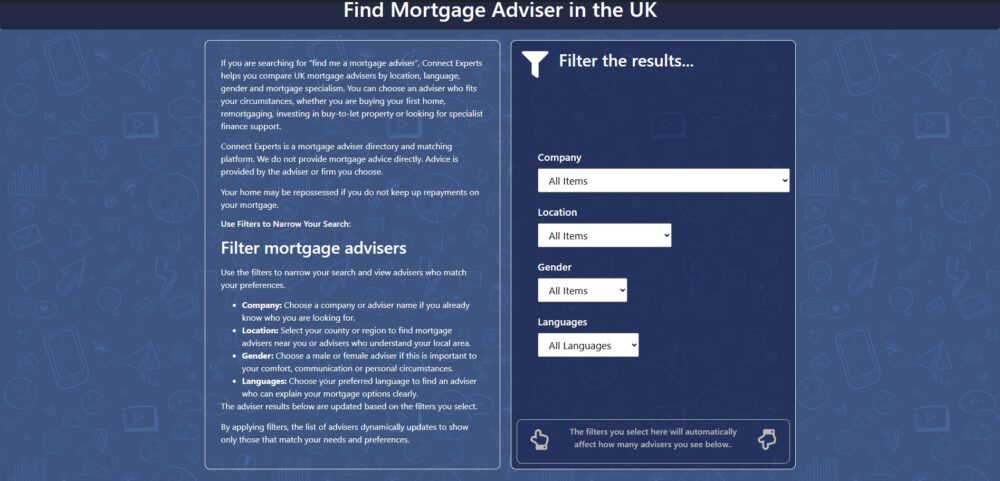
You can use Connect Experts to find equity release mortgage advisers with relevant later-life lending experience.
Adviser profiles can help you compare:
- Specialist areas
- Location
- Languages spoken
- Appointment preferences
- Adviser background
- Firm details
Before proceeding, confirm that the adviser holds the required equity release qualification. You should also check the adviser’s firm.
The Financial Services Register can confirm whether a firm is authorised and what regulated permissions it holds.
Connect Experts is a directory and matching platform. It does not recommend a particular plan or provide regulated advice directly.
Questions to Ask Before Releasing Cash
Ask the adviser:
- Why is this option suitable for my needs?
- Which alternatives have been assessed?
- How much could the balance become over time?
- Can I make voluntary repayments?
- What early repayment charges apply?
- Can I move the mortgage to another home?
- Could my benefits be affected?
- How might my estate change?
- What fees and commission apply?
- What happens if one joint borrower enters care?
- Are future drawdown withdrawals guaranteed?
- What protection applies if house prices fall?
Clear answers should be recorded before any application proceeds.
Why Adviser Choice Matters
Later-life borrowing involves more than obtaining a rate.
The recommendation may influence:
- Where you live
- How much money remains available later
- Whether monthly payments are required
- What beneficiaries may inherit
- How future care needs are funded
- Whether moving home remains practical
You may therefore need an adviser who understands both equity release and wider later-life mortgage choices.
Connect Experts also provides access to older borrower mortgage advisers who may consider conventional or retirement borrowing alternatives.
Frequently Asked Questions
Is money released from my home taxable?
The released capital is normally free of income tax. Tax may later apply to savings interest, investments or other returns.
Do I need to be 55?
Lifetime mortgage applicants are commonly required to be at least 55. Minimum ages and other conditions vary between providers.
Can I release all the equity in my home?
No. Providers limit borrowing according to age, property value, product design and other lending criteria.
Will I still own my home?
You retain ownership with a lifetime mortgage. With home reversion, you sell part or all of the property.
Do I have to make monthly repayments?
Not always. Many lifetime mortgages allow interest to accumulate. Other later-life mortgages require regular payments.
Can I repay a lifetime mortgage early?
Usually, but early repayment charges may apply. Some plans provide defined repayment allowances or downsizing protection.
Can I move home?
Many plans may be transferred to another suitable property. The new home must satisfy the provider’s lending criteria.
Can equity release reduce my inheritance?
Yes. The loan, interest and fees reduce the equity remaining in the property when it is sold.
Could tax-free cash affect my benefits?
Yes. Retained capital can affect means-tested benefits. A benefits assessment should take place before completion.
What is a no negative equity guarantee?
It limits repayment to the property’s sale value, subject to the plan conditions. It does not guarantee an inheritance.
Is Connect Experts an equity release adviser?
No. Connect Experts is an adviser directory and matching platform. Regulated advice comes from the adviser or firm selected.
How can I check an adviser?
Check the firm on the Financial Services Register. You should also confirm the adviser holds the required equity release qualification.
Start Your Adviser Search
Tax-free cash from a home can provide flexibility. Yet property wealth is finite, and borrowing changes how that wealth develops.
The central question is not simply, “How much can I release?”
A better question is, “What will this decision allow today, and what could it restrict tomorrow?”
Use the Connect Experts mortgage adviser directory to compare advisers suited to your requirements.
Important Information
Equity release will reduce the value of your estate and may affect your entitlement to means-tested benefits.
A lifetime mortgage is secured against your home. It is normally repaid when the final borrower dies or enters permanent long-term care.
Fees, interest rates and product conditions vary. Your adviser must explain the charges before you decide whether to proceed.