Mortgages for Older Borrowers: Being older does not automatically prevent you from getting a mortgage.
However, lenders may examine the proposed term, retirement income and repayment strategy more closely. Your age at the end of the mortgage term can matter as much as your age when applying.
Older borrowers may have several possible routes. These can include a standard repayment mortgage, an interest-only mortgage, a retirement interest-only mortgage or a lifetime mortgage.
The right starting point is not a product. It is a clear understanding of why you need to borrow, how payments will remain affordable and how the capital will eventually be repaid.
Connect Experts helps you search for mortgage advisers by expertise, location, language and personal preference. We are a directory and matching platform. Mortgage advice is provided by the adviser or firm you choose.
Find older borrower mortgage advisers
At a Glance
- Older borrowers can still qualify for mortgages.
- Lender age limits and maximum terms differ.
- Employment, pension and investment income may be considered.
- Standard, RIO and lifetime mortgages work differently.
- Equity release should not be treated as the automatic answer.
- Affordability and the repayment strategy remain central.
- Connect Experts can help you find an adviser experienced in later-life borrowing.
Can Older Borrowers Get a Mortgage?
Yes. There is no single maximum mortgage age used by every UK lender.
Each lender sets its own criteria. Some impose an age limit when the mortgage begins. Others focus on the borrower’s age when the mortgage term ends.
A lender may also consider:
- Your current age.
- Your intended retirement age.
- The requested mortgage term.
- Your employment or self-employed income.
- Current and forecast pension income.
- Investment, rental or other sustainable income.
- Existing debts and regular expenditure.
- The property’s value and condition.
- Your deposit or available equity.
- Your plan for repaying the mortgage capital.
Two people of the same age can therefore receive different lending outcomes. Their income, mortgage purpose, property and repayment plans may be entirely different.
Why Mortgage Terms Matter Later in Life
A longer mortgage term can reduce the scheduled monthly payment. However, it can also increase the total interest paid.
For older borrowers, the proposed term may extend beyond retirement. The lender may then need evidence that payments will remain affordable after employment income declines or ceases.
This assessment might include:
- State Pension forecasts.
- Defined-benefit pension statements.
- Personal or workplace pension income.
- Annuity income.
- Investment income.
- Rental income.
- Continuing employment or consultancy income.
A pension fund’s total value is not always treated in the same way as regular pension income. Lenders apply different policies, which is one reason specialist advice may be useful.
Mortgage Options for Older Borrowers
Later-life borrowing is not one product category. Several routes may be available, depending on affordability, age, income and objectives.
Standard Repayment Mortgage
With a repayment mortgage, each scheduled payment covers interest and part of the amount borrowed.
The balance should reduce throughout the term, provided all required payments are made. This can offer a clear route to repaying the debt.
A lender will assess whether the payments remain affordable for the full term. Where the mortgage continues into retirement, later-life income may become part of that assessment.
Standard Interest-Only Mortgage
With an interest-only mortgage, the scheduled payments normally cover interest rather than reducing the original capital.
The capital must be repaid through an accepted repayment strategy. This could involve investments, another property, downsizing or another credible source of funds.
The existence of property equity does not guarantee that every lender will accept the application. Lenders decide which repayment strategies they will consider.
Retirement Interest-Only Mortgage
A retirement interest-only mortgage, commonly called a RIO mortgage, is designed for some older borrowers.
You normally pay the interest each month. The original capital is commonly repaid when a specified event occurs, such as the property being sold, the final borrower dying or moving permanently into long-term care.
Because the interest is paid, it does not usually accumulate in the same way as unpaid lifetime mortgage interest.
However, monthly payments must remain affordable. A payment shortfall could place the property at risk.
Lifetime Mortgage
A lifetime mortgage is a form of equity release. It is secured against your home.
Depending on the plan, interest may be added to the loan, paid regularly or partly repaid. Where interest is added, compounding can increase the balance over time.
The mortgage is usually repaid from the property’s sale after the final borrower dies or enters permanent long-term care.
A lifetime mortgage can reduce the value of your estate. It may also affect means-tested benefits and future financial choices.
Where equity release is being considered, use the directory to find appropriately qualified equity release mortgage brokers.
Standard Mortgage, RIO or Lifetime Mortgage?
The main difference is not simply the borrower’s age. It is how interest and capital are repaid.
| Option | Monthly payment structure | How capital is repaid |
|---|---|---|
| Repayment mortgage | Capital and interest | Gradually during the mortgage term |
| Interest-only mortgage | Interest only | Through an agreed repayment strategy |
| RIO mortgage | Interest normally paid monthly | Usually after sale or a specified life event |
| Lifetime mortgage | Payments may be optional | Usually from the eventual property sale |
No structure is universally better.
A lower monthly commitment can produce a larger future balance. A higher monthly payment can preserve more equity but requires sustainable income.
Later-life borrowing therefore involves a balance between present affordability and future consequences.
Reasons Older Borrowers May Need Mortgage Advice
People borrow later in life for many practical reasons.
You may want to:
- Remortgage an existing home.
- Replace an interest-only mortgage reaching maturity.
- Buy a property after retirement.
- Move to a more suitable home.
- Borrow following divorce or separation.
- Raise funds for property improvements.
- Consolidate eligible borrowing.
- Help family members.
- Release property value.
- Restructure borrowing before retirement.
- Purchase a home while continuing to work.
The intended use of the funds can influence the mortgage type, lender criteria and advice required.
How Lenders Assess Later-Life Income
Lenders need evidence that mortgage payments are affordable.
For an employed applicant approaching retirement, the lender may ask whether the mortgage continues beyond the intended retirement date.
For a retired applicant, acceptable income might include:
- State Pension income.
- Workplace pension income.
- Private pension income.
- Annuities.
- Investment income.
- Rental income.
- Certain benefits.
- Continuing earned income.
Not every lender accepts every income source. Some require the income to be guaranteed. Others may consider sustainable income with suitable evidence.
Older applicants who remain self-employed may face a different assessment. Accounts, tax calculations, pension income and expected working plans could all be relevant.
Those circumstances may justify searching for self-employed mortgage brokers with experience in later-life cases.
Questions to Consider Before Borrowing
Before choosing a mortgage, consider the full term rather than just the immediate payment.
Ask:
- Why do I need the money?
- How much do I need to borrow?
- Will my income change during the term?
- Can I afford payments after retirement?
- How will the capital be repaid?
- Do I expect to move home?
- Could I need funds for care or home adaptations?
- How might borrowing affect my estate?
- Could it affect means-tested benefits?
- Are downsizing or using other assets realistic alternatives?
- What happens if one borrower dies?
- What happens if interest rates rise?
A mortgage can solve an immediate need while creating a long commitment. Good advice should examine both sides of that decision.
Is Equity Release the Only Option?
No.
Equity release may be suitable for some homeowners, but alternatives should be considered.
Possible alternatives include:
- A standard mortgage.
- A shorter repayment mortgage.
- A retirement interest-only mortgage.
- Downsizing.
- Using savings or investments.
- Family support.
- Selling another asset.
- Reviewing existing expenditure.
- Delaying the planned expense.
- Taking a smaller amount.
MoneyHelper provides independent information about retirement interest-only mortgages and how they differ from lifetime mortgages.
Equity release is a long-term commitment. It should follow a review of suitable alternatives rather than replace that review.
Documents an Adviser May Request
Preparing documents early can make the initial assessment clearer.
You may need:
- Proof of identity and address.
- Recent bank statements.
- Payslips or employment details.
- Pension statements.
- A State Pension forecast.
- Tax calculations and tax year overviews.
- Business accounts where applicable.
- Investment or rental income evidence.
- Details of existing mortgages and debts.
- Property information.
- Evidence supporting the proposed repayment strategy.
- Details of regular household spending.
The exact requirements depend on the lender and mortgage route.
How to Find an Older Borrower Mortgage Adviser
Start by choosing an adviser whose experience matches the mortgage need.
For example, you may need someone familiar with:
- Mortgages extending into retirement.
- Pension income assessment.
- Retirement interest-only mortgages.
- Interest-only repayment strategies.
- Existing mortgage maturity.
- Equity release.
- Self-employed income.
- Complex property or income circumstances.
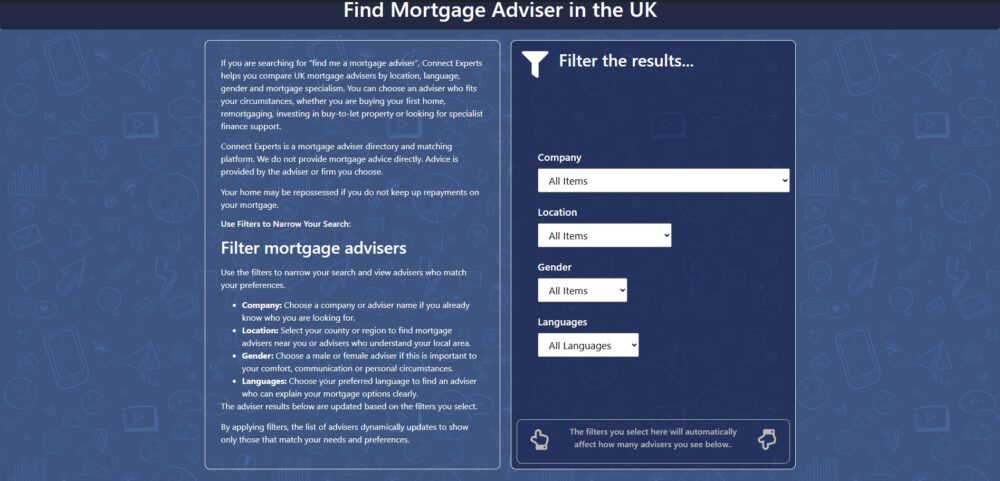
The Connect Experts mortgage broker directory lets you search by mortgage type, location, language, gender, company and adviser name.
Review the adviser’s profile before making contact. Check the areas in which the adviser or firm has permission to advise.
You can also check the firm on the Financial Services Register.
Connect Experts does not provide mortgage advice or select a mortgage product for you. Advice is given by the adviser or authorised firm you decide to contact.
Why Adviser Choice Matters for Older Borrowers
Later-life borrowing can involve several overlapping questions:
- Can the monthly payment remain affordable?
- Will the lender accept the proposed term?
- Is the repayment strategy credible?
- Would a RIO mortgage work better?
- Should equity release be considered?
- What happens after a death or move into care?
- How much property equity could remain?
An adviser should not begin by assuming which product you need.
The adviser’s role is to understand your objectives, assess the available evidence and explain suitable routes, risks and alternatives.
The philosophical point is simple: property wealth can support later life, but every use of that wealth changes what remains available later.
A sound decision therefore considers today’s need and tomorrow’s flexibility together.
Frequently Asked Questions
Is there a maximum age for getting a mortgage?
There is no single maximum age used by every lender. Each lender sets its own age and term criteria. Some focus on age at application, while others focus on age when the mortgage ends.
Can pension income be used for mortgage affordability?
Some lenders accept State Pension, workplace pension, private pension, annuity or other retirement income. The evidence and calculation method differ between lenders.
Can I remortgage after retirement?
It may be possible. The lender will consider affordability, income, property value, mortgage term and how the capital will be repaid.
What is a retirement interest-only mortgage?
A RIO mortgage generally requires monthly interest payments. The capital is usually repaid when the property is sold or after a specified life event.
Is a RIO mortgage the same as equity release?
No. A RIO mortgage usually requires interest to be paid monthly. A lifetime mortgage can allow interest to accumulate, although some plans permit repayments.
Can I get a mortgage if I am still working after retirement age?
Potentially. Lenders may consider earned income, but they may ask how long it is likely to continue. They can also assess pension and other sustainable income.
Should every older homeowner consider equity release?
No. Equity release is only one possible route. Standard mortgages, RIO mortgages, downsizing, savings and other alternatives should also be considered.
How can I check whether an adviser is FCA-authorised?
Search the adviser’s firm on the Financial Services Register. Check that the firm’s details and permissions correspond with the service being offered.
Does Connect Experts provide mortgage advice?
No. Connect Experts is a directory and matching platform. Mortgage advice is provided by the adviser or authorised firm you choose.
Find an Adviser for Older Borrower Mortgages
Use Connect Experts to find advisers who may help with later-life mortgage questions.
You can compare advisers by:
- Specialist mortgage experience.
- UK location.
- Language.
- Gender.
- Company.
- Contact preference.
Start your search for an older borrower mortgage adviser.
Connect Experts is a mortgage adviser directory and matching platform. We do not provide mortgage advice directly. Advice is provided by the adviser or firm you choose.