
Protection Adviser in East London: Protection is ultimately a question of financial consequence. You cannot know exactly what will happen in the future, but you can decide which financial risks you are prepared to carry yourself and which may be transferred to an insurer.
A protection adviser in East London can help you examine what could happen to your income, mortgage, household or family finances following death, serious illness or an extended period away from work.
Connect Experts helps you find protection advisers in East London, including E1, Whitechapel, Bethnal Green, Bow, Hackney, Stratford, Canary Wharf, Royal Docks, East Ham, and the wider area.
Connect Experts is a directory and matching platform. We do not provide protection advice directly. Advice is provided by the adviser or authorised firm you choose.
Protection Advice in East London
A protection adviser can assess your existing financial commitments before explaining insurance designed to protect against specific risks.
Depending on your circumstances, that may include:
- Life insurance
- Critical illness cover
- Income protection
- Family income benefit
- Mortgage-related protection
- Business protection
- A review of existing policies
A useful protection review should consider more than the premium.
An adviser may need to consider your income, mortgage or rent, debts, dependants, occupation, health, savings, employer benefits and the period for which financial support would be needed.
Policy definitions, exclusions, underwriting rules and payment structures can differ between insurers.
The objective is therefore not simply to find insurance. It is to understand what needs protecting, how much protection may be appropriate and under which circumstances a policy may pay.
What Does a Protection Adviser in East London Do?
A protection adviser reviews the financial effect that death, illness or incapacity could have on you and the people who rely on you.
The starting point should normally be your circumstances rather than a particular insurance product.
An adviser may discuss:
- Your monthly income
- Mortgage or rent commitments
- Household spending
- Loans and other debts
- Financial dependants
- Existing life insurance
- Employer death-in-service benefits
- Employer sick pay
- Savings and investments
- Your occupation
- Self-employed or employed status
- Business ownership
- Desired policy term
- The amount of financial support required
They can then explain the protection products that may address those risks.
A recommendation should also explain why a particular type and amount of cover has been selected.
How Protection Products Differ
Different protection policies answer different financial problems.
| Protection type | Primary insured event | Typical benefit |
|---|---|---|
| Life insurance | Death during the insured term | Lump sum or, with some policies, regular family income |
| Critical illness cover | Diagnosis meeting a specified policy definition | Usually a lump sum |
| Income protection | Eligible illness or injury preventing work | Regular income payments |
| Family income benefit | Death during the policy term | Regular payments for the remaining term |
| Business protection | Death or illness affecting an insured individual connected to a business | Structure depends on the policy |
The distinction matters.
Life insurance, for example, may provide valuable financial support following death but would not normally replace earnings if you survived an illness and could not work.
Critical illness cover may provide a lump sum after a qualifying diagnosis, but it does not mean every serious medical condition will automatically result in a payment.
Income protection approaches the risk differently because it is principally concerned with the loss of earnings caused by illness or injury.
The FCA identifies life insurance, critical illness insurance and income protection as important forms of pure protection designed to help consumers manage serious financial shocks.
You can read more about the FCA’s current work on the UK protection market.
Life Insurance Advice in East London
Life insurance is designed to provide financial support following the death of the insured, subject to the policy terms.
The appropriate amount of cover will depend on what the money is intended to achieve.
Possible objectives include:
- Repaying a mortgage
- Reducing major debts
- Supporting a partner
- Providing for children
- Replacing lost household income
- Funding future family expenses
- Supporting financial dependants
An adviser may also explain the difference between common structures.
Level Term Life Insurance
The amount of cover generally remains at the agreed level during the policy term.
It may suit someone who wants a fixed insured amount rather than one designed to reduce alongside a repayment mortgage.
Decreasing Term Life Insurance
The insured amount generally reduces over time.
It is frequently considered when the principal objective is to protect a repayment mortgage whose outstanding balance is expected to fall.
Family Income Benefit
Rather than providing one large lump sum, family income benefit is designed to provide regular payments following an eligible claim for the remaining policy term.
This can be relevant when the main concern is replacing regular household income.
For a more detailed explanation, see our guide to finding Life Insurance Advisers.
Critical Illness Cover in East London
Critical illness cover is designed to pay following the diagnosis of a serious illness specified by the policy, provided the relevant definition and claim requirements are satisfied.
This detail is essential.
A policy name alone does not tell you precisely when it will pay.
Different policies may have different:
- Medical definitions
- Covered conditions
- Severity requirements
- Exclusions
- Survival periods
- Partial payment provisions
- Children’s cover provisions
A protection adviser can explain these differences and consider whether the proposed amount of cover reflects your financial commitments.
A successful lump-sum claim could potentially be used towards a mortgage, debts, household expenses or costs arising during recovery.
However, how you use a payment will depend on your individual circumstances.
Read more about finding Critical Illness Cover Advisers.
Income Protection Advice in East London
For many households, the most valuable financial asset is not the property they already own. It is the income they expect to earn over the years ahead.
Income protection is designed to replace part of an insured person’s earnings when eligible illness or injury prevents them from working.
An adviser may need to examine several technical features before making a recommendation.
Deferred Period
The deferred period is the time between becoming unable to work and the start of benefit payments.
Someone with substantial employer sick pay or savings may be able to consider a longer deferred period than someone with little financial support.
Benefit Amount
Policies normally limit the proportion of earnings that can be insured.
The calculation may also differ according to employment status and the insurer’s rules.
Benefit Period
Some policies can potentially pay benefits for a defined maximum period per claim.
Other arrangements may be able to continue for considerably longer, subject to the policy conditions.
Definition of Incapacity
How the insurer defines your inability to work is an important part of policy comparison.
Occupation and duties can therefore affect how cover is assessed.
Employment Status
Employees, contractors, company directors, and the self-employed can have very different safety nets.
A self-employed person without substantial sick pay, for example, may need to think differently about the consequences of an extended period away from work.
You can search for specialists through our Income Protection Advisers page.
What Should an East London Protection Review Examine?
Good protection planning requires both numbers and product names.
An adviser may explore questions such as:
What needs protecting?
This could include a mortgage, household expenditure, children’s needs, debts, income or business obligations.
How much money would be required?
The answer may differ if your priority is fully repaying a mortgage rather than providing a temporary financial buffer.
How long would support be required?
A family with young children can have different timescales from someone approaching retirement.
What protection already exists?
Existing policies, savings, employer sick pay and death-in-service benefits may reduce or change the need for additional protection.
What can remain affordable?
Protection needs to be financially sustainable. A technically comprehensive policy is of limited practical value if premiums cannot be maintained.
What events should trigger financial support?
Death, defined critical illness and inability to work are separate risks. One product should not automatically be assumed to cover all three.
Medical Underwriting and Protection Insurance
Many protection applications require information about health and lifestyle.
Depending on the policy and insurer, underwriting may consider matters such as:
- Age
- Medical history
- Current health
- Smoking status
- Occupation
- Height and weight
- Family medical history
- Lifestyle factors
- Amount of cover requested
An insurer may then offer standard terms, adjust the premium, apply specific terms or decide that it cannot offer the requested cover.
Accurate disclosure is important.
A protection adviser can explain the application process, but the customer remains responsible for answering insurer questions accurately and completely.
Protection for East London Homeowners
A mortgage creates a long-term financial commitment.
Protection planning can examine what would happen to that commitment if household income changed because of death, serious illness or incapacity.
The solution does not automatically need to equal the mortgage balance.
An adviser may consider:
- Outstanding mortgage amount
- Remaining mortgage term
- Monthly mortgage payment
- Number of borrowers
- Dependants
- Savings
- Existing insurance
- Household income
- Other debts
- Desired financial buffer
This allows the protection recommendation to be connected to the household’s actual financial exposure rather than simply attaching an insurance policy to a mortgage.
For a broader explanation of the different types of cover available, see Protection Options.
Protection for Self-Employed People and Company Directors
East London is home to a wide mix of employees, professionals, contractors, entrepreneurs, and business owners.
The protection assessment for someone running a business can differ materially from that of an employee with extensive workplace benefits.
A review may need to consider:
- Personal drawings or salary
- Dividends
- Business continuity
- Existing company benefits
- Personal income requirements
- Business debts
- Dependants
- Other directors or shareholders
- Key employees
Personal and business risks should be identified separately.
For example, insurance designed to replace personal earnings serves a different purpose from protection intended to reduce disruption to a company following the death or illness of a key individual.
The legal, tax and ownership structure of business protection can also matter, so suitable professional advice may be required.
High-Value and Complex Financial Commitments
Parts of East London include households with substantial property, business and income commitments.
Having significant assets does not necessarily remove the need for protection.
The relevant question is how quickly those assets could realistically provide money when required and what financial consequences would arise before that happened.
A higher-income household may have:
- A substantial mortgage
- Private school costs
- Business commitments
- Investment liabilities
- More than one property
- Variable bonuses
- Share income
- International income
- Significant monthly expenditure
Protection planning should therefore reflect the structure of the financial responsibilities rather than relying solely on income or property value.
Finding a Protection Adviser in East London
Connect Experts allows you to search for advisers who may be able to assist with protection planning.
You can compare available adviser information before deciding who you wish to contact.
Depending on the information available within individual profiles, you may be able to consider factors such as:
- Location
- Protection expertise
- Language
- Adviser profile
- Contact preferences
- Other specialist areas
Searching geographically can be useful if you prefer someone covering E1 or another East London postcode.
Others may be comfortable receiving advice by telephone or video and may place greater importance on the adviser’s experience in protection or language.
The important distinction is that Connect Experts helps you find and compare advisers. Any regulated recommendation is provided by the adviser or firm you ultimately choose.
Questions to Ask a Protection Adviser
Before proceeding with protection insurance, useful questions may include:
- What financial risk is this policy intended to cover?
- Why has this amount of cover been recommended?
- Why has this policy term been selected?
- Which exclusions should I understand?
- What must happen before the policy pays?
- How does the insurer define a critical illness?
- How does income protection define incapacity?
- What deferred period applies?
- How long could an income protection benefit be paid?
- Does my existing workplace cover affect the recommendation?
- Are my current policies still suitable?
- Can the policy be changed later?
- What happens if my occupation changes?
- What happens if I stop smoking?
- How is the adviser paid?
- What would cause premiums or benefits to change?
These questions turn an insurance discussion into a practical assessment of financial risk.
Protection and Later-Life Planning in London
Protection requirements can change considerably as mortgages are reduced, children become financially independent, employment ends, or retirement approaches.
Someone considering later-life property finance may therefore require a different form of specialist advice from that required when arranging conventional life or income protection.
Where that becomes relevant, separate guidance is available from Equity Release Advisers in London.
Equity release is a distinct area of advice and should not be treated as a substitute for protection planning.
When Should Protection Be Reviewed?
Protection should not necessarily be treated as a one-time decision.
A review may become appropriate after:
- Buying a home
- Remortgaging
- Moving home
- Getting married
- Having children
- Becoming self-employed
- Starting a company
- Receiving a substantial pay increase
- Taking on new debt
- Changing occupation
- Losing employer benefits
- Repaying a significant part of a mortgage
- Divorce or separation
- An existing policy approaching its end date
A policy arranged years earlier may still be appropriate.
Alternatively, your financial responsibilities may have changed enough to justify reviewing the amount, term or type of protection.
Do not cancel an existing policy simply because you are considering a replacement. Health and underwriting circumstances can change, and replacement cover may have different conditions.
Why Use Connect Experts to Find a Protection Adviser in East London?
Finding protection advice should begin with finding an adviser whose experience fits the problem you are trying to solve.
Connect Experts provides a directory where you can search for advisers and review available profile information before making contact.
This can help you distinguish between searching for:
- Life insurance advice
- Critical illness cover
- Income protection
- Mortgage protection
- Family protection
- Business-related protection
- A wider protection review
The platform does not make the protection recommendation itself.
Your chosen adviser or authorised firm assesses your circumstances and is responsible for the regulated advice they provide.
Frequently Asked Questions
What does a protection adviser in East London do?
A protection adviser reviews the financial risks created by death, serious illness or an inability to work. Depending on their permissions and expertise, they may advise on life insurance, critical illness cover, income protection and other forms of protection.
How can I find a protection adviser in East London?
You can use Connect Experts to search for available protection advisers and compare profile information, such as location, specialist areas, and other listed preferences, before deciding who to contact.
What is the difference between life insurance and critical illness cover?
Life insurance is generally designed to pay following the death of an insured person during the policy term. Critical illness cover is designed to pay following the diagnosis of a condition covered by the policy, provided the required medical definition is satisfied.
What does income protection cover?
Income protection is designed to replace part of your earnings if eligible illness or injury prevents you from working. Policies differ in their deferred periods, benefit amounts, benefit periods, definitions of incapacity, and other conditions.
Do I need protection if I have employer benefits?
Employer benefits should form part of the assessment. Sick pay, death-in-service insurance and other workplace benefits may reduce some financial risks, but whether additional protection is appropriate depends on your individual circumstances.
Can self-employed people obtain income protection?
Potentially, yes. The insurer will normally assess matters such as occupation, earnings, and health. Self-employed people may find income protection particularly relevant where they have limited or no employer-provided sick pay.
Does critical illness insurance cover every serious illness?
No. Claims depend on the illnesses included in the policy and the insurer’s relevant medical definitions and conditions. Reading the policy wording is therefore essential.
How much protection do I need?
There is no universal amount. A protection adviser may consider your income, mortgage, debts, dependants, household expenditure, savings, existing insurance and the period during which financial support would be required.
Is the cheapest protection policy always the best option?
Price is one factor, but policies can differ in definitions, exclusions, benefits, policy structure and additional features. The practical question is whether the policy appropriately addresses the financial risk for which it is being arranged.
Does Connect Experts provide protection advice?
No. Connect Experts is a directory and matching platform that helps users find advisers. Protection advice and any individual recommendation are provided by the adviser or authorised firm selected by the customer.
Find a Protection Adviser in East London
The purpose of protection is not to predict the future. It is to understand the financial consequences of events that cannot be predicted with certainty.
For someone in East London, that may mean examining what would happen to a mortgage, household income, dependants or business commitments if circumstances changed unexpectedly.
A protection adviser can assess those risks, explain relevant policy options and show how different forms of cover work before making any recommendation.
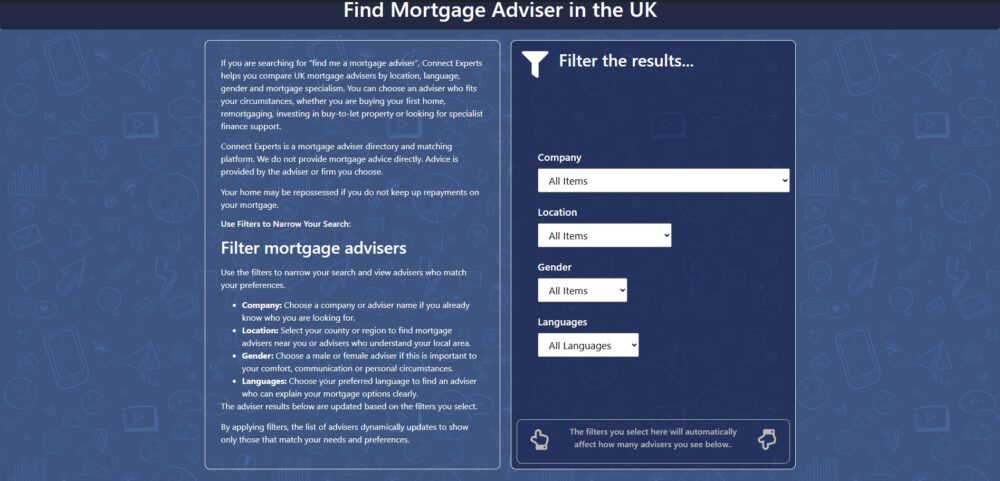
Use Connect Experts to compare protection advisers and choose someone whose expertise and approach fit your circumstances.