Protection Adviser in South West London: In South West London, protecting a household can involve considerably more than matching life cover to a mortgage balance.
Higher-value homes, substantial borrowing, professional income, business ownership, school fees and long-term family commitments can create several financial risks at the same time. The essential question is not simply whether you have insurance. It is whether your protection would still work if death, serious illness or an extended loss of income changed your financial position.
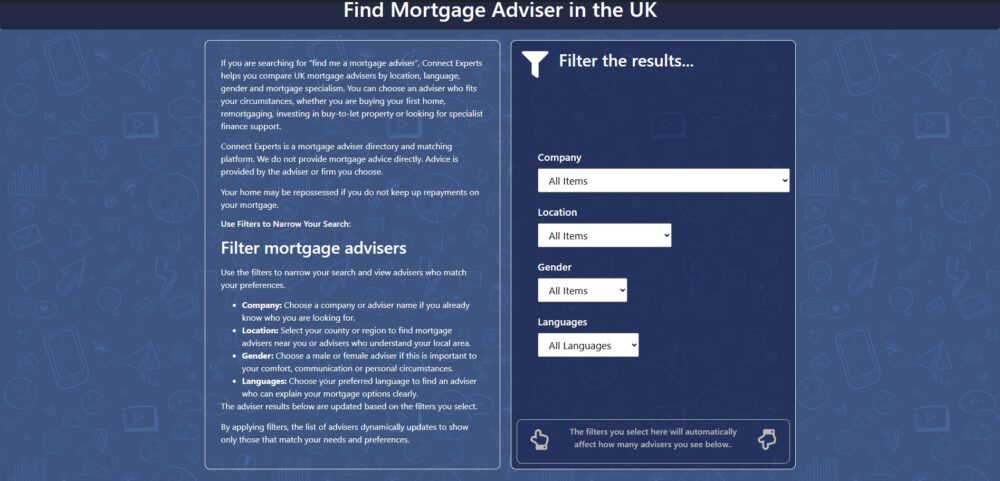
Connect Experts helps you search for protection advisers who can discuss life insurance, critical illness cover, income protection, family protection, mortgage-related cover and relevant business protection.
Connect Experts is a directory and matching platform. The adviser or firm you select provides the protection advice.
Protection Advice in South West London at a Glance
A protection review may consider:
- Your mortgage and other debts
- Household expenditure
- Family income requirements
- School or childcare costs
- Existing employer benefits
- Savings and accessible investments
- Life insurance already in force
- Income protection
- Critical illness cover
- Family income benefit
- Business ownership
- Key employees or shareholders
- Property and investment liabilities
- The financial effect of death or serious illness
- How long financial support might be required
The purpose is not to insure every possible risk.
It is to identify which events could cause serious financial disruption and decide whether transferring some of that risk to an insurer is appropriate.
Why Protection Needs Can Be Different in South West London
South West London contains some of London’s higher-value residential markets.
Office for National Statistics figures for May 2026 recorded a provisional average house price of approximately £789,000 in Richmond upon Thames. Homes purchased with a mortgage averaged approximately £662,000 in Wandsworth and £590,000 in Merton, while Kingston upon Thames recorded an overall average of approximately £582,000.
Property value alone does not determine how much protection somebody needs.
However, a high-value home can sit alongside a substantial mortgage, larger household costs or financial responsibilities that may continue even if a household’s income changes.
For some South West London households, protection planning may therefore need to consider more than the outstanding mortgage.
The calculation might include:
- Mortgage repayments
- Household bills
- Dependants
- Education costs
- Childcare
- Existing debt
- Lifestyle commitments
- Maintenance payments
- Business commitments
- Income replacement
- Future family expenditure
Wealth and financial resilience are not necessarily the same thing.
Someone may own valuable property, company shares or investments but have limited cash available immediately. Protection can therefore be partly about preserving liquidity and financial choice at a difficult time.
What Does a Protection Adviser Do?
A protection adviser reviews the financial consequences of events such as death, serious illness or an inability to work.
The adviser can then assess whether insurance might reduce those risks.
The process normally begins with your circumstances rather than a particular product.
An adviser may examine:
- What needs protecting?
- Who depends financially on you?
- How much income would disappear?
- Which costs would continue?
- What insurance or employer benefits already exist?
- How much accessible capital is available?
- How long would financial support be required?
- What level of premium is sustainable?
- What medical or occupational underwriting may apply?
- Which type of policy could address the identified risk?
This distinction matters.
Buying a policy and conducting protection planning are not necessarily the same exercise.
A suitable review considers the financial problem first and the insurance product second.
The Financial Conduct Authority’s Insurance Conduct of Business Sourcebook sets standards for general and protection insurance sales. The FCA states that advised insurance recommendations must be suitable and that customers should receive appropriate information in a clear and comprehensible form.
What Types of Protection Can an Adviser Discuss?
Different policies solve different financial problems.
You can explore the wider range of protection options available through Connect Experts.
Life Insurance
Life insurance can pay a benefit if the insured person dies during the policy term, subject to the policy conditions.
The cover may be structured in several ways.
A level-term policy normally maintains the same sum assured throughout the agreed term.
A decreasing-term policy reduces the amount of cover over time and is commonly considered where the liability being protected is also expected to reduce.
Some clients may require cover that is not directly linked to a mortgage.
For example, life cover might be considered for:
- Family living costs
- Education commitments
- Outstanding debts
- Financial dependants
- Estate liquidity
- Business liabilities
The correct level cannot be determined from a postcode or property value alone.
Critical Illness Cover
Critical illness insurance can provide a lump sum following diagnosis of an illness covered by the policy, provided the insurer’s definition and policy conditions are satisfied.
Policies differ.
An adviser should therefore explain matters such as:
- Conditions covered
- Definitions
- Exclusions
- Survival periods where applicable
- Partial payments where offered
- Children’s cover where included
- Premium structure
- Whether cover is level or decreasing
The important question is not merely whether a condition appears on a list.
It is whether the policy definition and structure meet the client’s identified need.
Income Protection
Income protection is designed to replace part of an individual’s income if illness or injury prevents them from working, subject to the policy terms.
This can be particularly relevant where earnings support:
- A substantial mortgage
- Family expenditure
- Private education
- Childcare
- Investment commitments
- Regular household costs
A policy can involve several technical decisions.
These may include:
- The insured income
- Deferred period
- Benefit period
- Occupation definition
- Maximum benefit
- Indexation
- Guaranteed or reviewable premiums
- Existing employer sick pay
For professionals, company directors, contractors and self-employed clients, correctly establishing insurable income can be particularly important.
Family Income Benefit
Family income benefit generally provides a regular benefit for the remaining policy term rather than one single lump sum, subject to the policy terms.
It may be considered where the objective is to replace part of the regular income that a family would otherwise lose.
That structure can be useful when the identified risk is continuing household expenditure rather than one specific debt.
Mortgage Protection
A mortgage is often one of a household’s largest liabilities.
Protection planning may examine what would happen to the mortgage if:
- One borrower died
- A borrower developed a serious illness
- Income stopped for a prolonged period
The required insurance does not automatically need to equal the mortgage amount.
An adviser should consider existing assets, income, dependants, other insurance and the client’s objectives before making a recommendation.
Protection for High-Value Homes and Affluent Households
A high property value does not automatically make somebody high-net-worth.
Equally, substantial assets do not make protection unnecessary.
South West London households may hold significant wealth in property, pensions, investments, or businesses while still relying on ongoing income to meet day-to-day commitments.
This is why high-net-worth protection services may involve a wider analysis than standard mortgage life insurance.
The review can consider:
- High-value mortgage liabilities
- Multiple properties
- Business interests
- Company shares
- Variable remuneration
- Bonuses and dividends
- Dependants
- Private education costs
- Estate liquidity
- Existing trusts
- Overseas assets
- Family lifestyle expenditure
- Existing insurance arrangements
The objective is financial resilience.
Protection can provide liquidity precisely when selling a property, business interest or investment may be undesirable.
For clients whose insurance needs are closely connected with substantial property borrowing, Connect Experts also provides access to high-net-worth mortgage brokers.
Protection for Company Directors and Business Owners
South West London protection requirements are not limited to personal insurance.
A business may also depend heavily on particular individuals.
Where appropriate, an adviser may discuss areas such as:
Key Person Protection
A company can be financially vulnerable if a person responsible for substantial revenue, specialist expertise, management or client relationships dies or becomes seriously ill.
Key person protection may help a business manage some of the financial consequences, subject to the policy structure and underwriting.
Shareholder Protection
The death or serious illness of a shareholder can create financial and ownership questions for both the business and the shareholder’s family.
Suitable planning may help secure funds for the purchase of shares, subject to appropriate legal, tax and insurance advice.
Relevant Life Cover
Relevant life insurance can sometimes provide employer-funded life cover for eligible employees or directors.
Its suitability depends on the company structure, individual circumstances and current rules.
Protection advice should therefore be coordinated with appropriate professional tax and legal guidance where necessary.
How Much Protection Might You Need?
There is no meaningful South West London average.
A useful calculation begins with financial consequences.
For life cover, an adviser might consider:
Liabilities + future family expenditure – accessible assets and existing cover = potential protection requirement
That is only a framework.
A complete assessment may also consider how long the money needs to last and whether expenditure changes after death.
For income protection, the focus is different.
The adviser needs to establish:
- Your eligible earnings
- Existing sick pay
- How long you could manage from savings
- Essential expenditure
- Insurer limits
- Your occupation
- The required deferred period
The best protection structure is therefore not necessarily the policy with the largest benefit.
It is the arrangement that addresses the identified risk while remaining suitable and affordable.
Underwriting Matters
Protection premiums and terms can depend on more than age.
Insurers may consider factors including:
- Medical history
- Current health
- Smoking status
- Occupation
- Income
- Lifestyle
- Hazardous activities
- Amount of cover
- Policy term
Possible underwriting outcomes can include ordinary terms, higher premiums, exclusions, postponed decisions or an inability to offer cover.
Different insurers may assess risk differently.
This is one reason a protection adviser can be valuable when medical, occupational or financial circumstances are more complicated.
Existing Protection Should Be Reviewed
Having an existing policy does not automatically mean your current needs are covered.
Life can change.
A protection review may be appropriate after events such as:
- Buying a property
- Increasing a mortgage
- Moving home
- Having children
- Marriage or separation
- Changing employment
- Becoming self-employed
- Starting or buying a business
- Becoming a company director
- Significant salary changes
- Taking on additional debt
- Changes to existing workplace benefits
The purpose of a review is not automatically to replace existing cover.
Replacement can result in different premiums, underwriting, terms or exclusions.
An adviser should first determine what the current policy provides and whether changing it is appropriate.
What Should You Compare When Choosing a Protection Adviser?
Finding an adviser should involve more than selecting the nearest postcode.
Consider:
Regulatory status
Check the adviser or firm’s regulatory status and permissions before proceeding with regulated financial advice.
Protection experience
Ask whether the adviser regularly deals with the type of protection you need.
A family requiring straightforward life insurance may have different needs from a business owner considering shareholder protection or an affluent household assessing estate liquidity.
Product knowledge
The adviser should be able to explain why different structures may or may not suit your circumstances.
Underwriting experience
This can be important where there are medical conditions, unusual occupations or substantial amounts of cover.
Communication
Protection involves detailed personal and financial information.
Choose somebody who explains policy definitions, exclusions and limitations clearly.
Advice method
Some clients prefer face-to-face meetings.
Others prefer telephone or video appointments.
Location is important, but it is not the only factor to consider when judging suitability.
How Connect Experts Helps You Find a Protection Adviser in South West London
Connect Experts helps users search for advisers using practical criteria.
Rather than recommending a particular person simply because they appear in a location search, the directory allows you to review advisers and decide who appears appropriate for your circumstances.
You may want to compare factors such as:
- Location
- Protection experience
- Adviser language
- Gender preference
- Areas of specialism
- Appointment method
- Experience with complex cases
For needs extending beyond straightforward protection, you can also explore specialist mortgage and protection brokers.
Connect Experts does not provide the protection recommendation itself.
The adviser or regulated firm you choose assesses your circumstances and provides any resulting advice.
Protection and Later-Life Property Wealth
Some South West London homeowners may reach later life with considerable wealth held in their property.
Protection and later-life lending solve different financial problems.
However, both can form part of a wider discussion about liquidity, debt, dependants and the long-term use of property wealth.
Older homeowners considering later-life borrowing can separately find Equity Release Advisers in London through Connect Lifetime.
Equity release is not a substitute for protection advice, and protection insurance is not a substitute for later-life lending advice.
Each requires its own suitability assessment.
A Practical Protection Checklist
Before speaking with a protection adviser, it can help to gather:
- Current mortgage balance
- Other significant debts
- Monthly household expenditure
- Income details
- Employer sick-pay entitlement
- Death-in-service benefits
- Existing life insurance
- Existing critical illness insurance
- Existing income protection
- Savings and accessible investments
- Pension death benefits
- Dependants’ requirements
- Business ownership details
- Relevant shareholder agreements
You do not need to decide which policy you want before speaking with an adviser.
The purpose of advice is to establish the need first.
Frequently Asked Questions
How do I find a protection adviser in South West London?
Connect Experts lets you search for and compare protection advisers. Consider the adviser’s location, protection experience, areas of specialism, language, appointment options and the type of advice you require before deciding who to contact.
What does a protection adviser help with?
A protection adviser can assess financial risks connected with death, illness or an inability to work. Depending on the client’s circumstances, advice may involve life insurance, critical illness cover, income protection, family income benefit, mortgage protection or appropriate business protection.
Is life insurance enough to protect a mortgage?
Not necessarily.
Life insurance addresses death. It does not automatically replace income following a prolonged illness or provide a critical illness benefit.
A protection review should consider the range of events that could create financial difficulty.
Does a protection policy have to match my mortgage?
No.
The appropriate amount depends on the need being insured.
Some people may want to protect only a mortgage. Others may need to consider dependants, household expenditure, education, debt or continuing family income.
Why might income protection be important in South West London?
Income protection can be relevant where household expenditure and mortgage commitments depend heavily on continued earnings.
The need is determined by personal circumstances rather than postcode alone.
Do high-net-worth clients still need protection?
They may.
Substantial wealth can be held in property, company shares, pensions or investments rather than immediately accessible cash.
Protection may provide liquidity at a time when selling assets would be undesirable.
Can a protection adviser help business owners?
Some protection advisers specialise in business protection. Depending on circumstances, areas considered may include key person insurance, shareholder protection and relevant life cover.
What information affects the cost of protection insurance?
Premiums may be influenced by age, health, smoking status, occupation, policy type, amount of cover and policy term. Underwriting decisions depend on the individual insurer and application.
Should I cancel my existing policy before arranging new cover?
Generally, existing protection should be reviewed before any cancellation.
A replacement policy may have different premiums, exclusions, medical underwriting or policy conditions. Your adviser should explain the implications before changes are made.
Does Connect Experts provide the protection advice?
No.
Connect Experts helps users find and compare advisers. The adviser or regulated firm selected by the user provides any protection advice and recommendation.
Find a Protection Adviser in South West London
Good protection planning is ultimately about preserving choice.
A high-value home, successful career, or growing business can create financial strength, but it can also create commitments that depend on people continuing to earn, work, and contribute.
Insurance cannot prevent an unexpected event.
It can, where suitable, reduce its financial consequences.
Use the Connect Expert Directory to compare protection advisers who can review your income, family commitments, mortgage, existing cover and wider financial responsibilities before recommending an appropriate course of action.