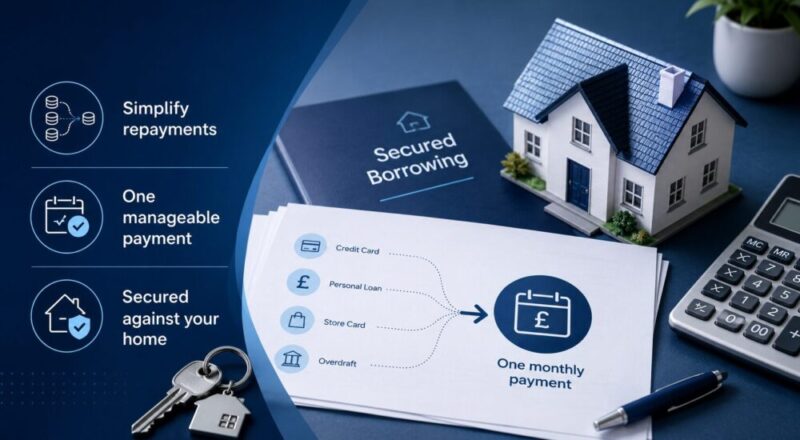
Second Charge Mortgage for Debt Consolidation: A second-charge mortgage may consolidate selected debts into a single secured payment.
However, reducing the monthly payment can increase the repayment period and total interest. Unsecured debts also become secured against the property.
Advice should examine the cause of the debt, not only its current balance.
Using a Second Charge Mortgage for Debt Consolidation
Debt consolidation changes the structure of debt. It does not remove the amount owed.
A second-charge mortgage may repay credit cards, personal loans or other commitments. The borrower then makes a new secured loan payment alongside the first mortgage.
This may reduce monthly outgoings.
However, a lower payment can result from spreading the debt across a much longer period. Therefore, total interest may rise.
The essential question is not whether debts can be combined. It is whether securing them against the home produces a sustainable improvement.
What changes after consolidation?
Before consolidation, the borrower may have several unsecured accounts with different rates and payment dates.
After consolidation:
- Selected balances are repaid.
- A new secured loan is created.
- The property supports the borrowing.
- Repayments may run for longer.
- The borrower normally retains the first mortgage.
- Early repayment conditions may apply.
Turning unsecured borrowing into secured borrowing increases the consequences of missed payments.
MoneyHelper provides an independent explanation of secured and unsecured borrowing.
Why monthly payments can fall
Payments may fall because:
- The new rate is lower.
- The repayment term is longer.
- Several minimum payments are replaced.
- The debt moves to a structured repayment arrangement.
A lower payment can create breathing space. Yet the total cost must remain visible.
For example, repaying a balance over five years and repaying it over twenty years produce very different outcomes.
Time solves a cash-flow problem by delaying the obligation. It should not be mistaken for forgiveness.
Questions an adviser should examine
A suitable review should consider:
- Why the debts accumulated.
- Whether spending has changed.
- Whether income is stable.
- Existing arrears or missed payments.
- The interest rates on current debts.
- The remaining term of each commitment.
- The proposed second-charge term.
- The total interest payable.
- The effect on future mortgage plans.
- Whether independent debt advice is more appropriate.
Where credit problems already exist, an adverse credit mortgage broker may help explain how lenders could assess the application.
When consolidation may not solve the problem
Consolidation may be unsuitable where:
- Income does not cover essential spending.
- New credit is likely to be used again.
- The borrower is already missing mortgage payments.
- The term extends short-lived spending over many years.
- Fees outweigh the potential benefit.
- Selling or remortgaging soon is likely.
- Another debt solution requires consideration.
Someone experiencing persistent payment problems may need free debt guidance before taking on more debt.
What should the cost comparison show?
The adviser should compare:
Current position
- Total outstanding balances.
- Current monthly payments.
- Interest rates.
- Remaining repayment periods.
- Expected total repayment.
Proposed position
- Second-charge loan amount.
- Interest rate.
- Mortgage term.
- Monthly payment.
- All fees.
- Total amount repayable.
- Early repayment charges.
- Variable-rate exposure.
The comparison should not end with “monthly saving”.
It should explain how much will be repaid and for how long.
How affordability is assessed
A lender may review:
- Verified income.
- Household expenditure.
- Existing mortgage payments.
- Credit commitments.
- Dependants.
- Credit history.
- Property equity.
- Expected changes in circumstances.
Passing an affordability assessment does not automatically make the borrowing appropriate. It means the application meets that lender’s assessment.
Advice should place the borrowing within the household’s wider position.
Using the directory
Use Find a Broker by Expertise to understand how specialist searches work.
You can then compare second mortgage loan advisers by location, language and profile information.
Connect Experts is a directory. Advice is provided by the adviser or firm selected.
FAQ
Can a second charge repay credit cards?
It may be used for this purpose, subject to advice and lender criteria.
Will consolidation improve my credit score?
It is not guaranteed. Credit outcomes depend on payment history, balances and future account management.
Can I keep using repaid credit cards?
The accounts may remain available unless closed. Reusing them could increase overall debt.
Why might the total interest increase?
The new loan may run for much longer than the original debts.
Does consolidation affect my first mortgage?
The first mortgage usually remains. However, the property then supports two secured loans.
Next step
A successful consolidation plan should improve more than the next monthly payment.
Compare second mortgage loan advisers who can explain costs, risks and alternative options.