Holiday Let Mortgages UK: A holiday property can generate income in an uneven way.
One summer week may generate more revenue than several winter weeks. Therefore, a holiday let mortgage cannot be assessed like an ordinary residential tenancy.
Holiday let mortgages are specialist products for properties rented to paying guests for short periods. They may support coastal cottages, rural accommodation, city apartments and other furnished short-stay properties.
Lenders may examine seasonal income, location, occupancy, property type and management arrangements. They may also assess the applicant’s income, deposit, credit position and existing borrowing.
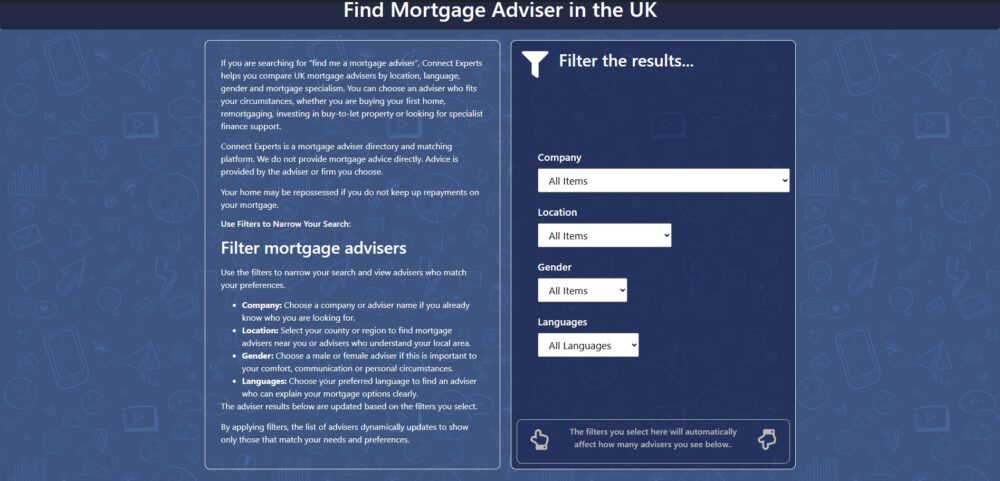
Connect Experts helps you find mortgage advisers who understand holiday let lending. You can compare advisers by expertise, location, language and profile.
Find a holiday let mortgage adviser
At a Glance
- Holiday let mortgages are designed for short-term guest accommodation.
- A residential mortgage will not normally permit commercial guest letting.
- Standard buy-to-let products may exclude short-term bookings.
- Deposits often start near 25%, although lender requirements vary.
- Lenders may use seasonal rental projections and personal income.
- Personal use can restrict the lenders available.
- Limited company applications require separate underwriting.
- The former Furnished Holiday Lettings tax regime ended in April 2025.
- Local planning, licensing and insurance requirements should be checked.
- Connect Experts can help you compare suitable mortgage advisers.
What Is a Holiday Let Mortgage?
A holiday let mortgage finances a property that will be rented to guests for short stays.
Guest bookings may last several nights, one week or several weeks. This differs from a standard buy-to-let property occupied under a longer residential tenancy.
Holiday let mortgages may be used for:
- Coastal cottages
- Rural holiday homes
- Furnished countryside properties
- Short-stay city apartments
- Purpose-built holiday accommodation
- Properties advertised through booking platforms
- Existing holiday lets being refinanced
- Properties being converted to short-term accommodation
The mortgage must permit the intended use.
Using an unsuitable residential or buy-to-let mortgage could breach the lender’s conditions.
Why Holiday Let Lending Is Different
A conventional tenancy usually provides a regular monthly rent.
Holiday accommodation may have several income levels throughout the year. Demand may rise during school holidays, local events or summer months. It may then fall sharply outside those periods.
Lenders must therefore consider whether the property remains financially sustainable across a complete year.
Their decision may involve:
- Peak-season income
- Mid-season income
- Low-season income
- Expected occupancy
- Average nightly rates
- Management and booking costs
- Cleaning and maintenance costs
- Personal use
- Local demand
- The borrower’s wider affordability
The question is not simply whether the property can earn money.
The question is whether the evidence supports the proposed mortgage under the lender’s criteria.
Holiday Let Mortgage Versus Buy-to-Let Mortgage
| Area | Holiday let mortgage | Standard buy-to-let mortgage |
|---|---|---|
| Occupation | Short guest stays | Longer residential tenancy |
| Income | Seasonal and variable | Usually regular monthly rent |
| Assessment | Projected revenue, occupancy and affordability | Monthly rent and rental coverage |
| Management | Frequent bookings and guest turnover | Lower tenant turnover |
| Personal use | Sometimes permitted | Usually prohibited |
| Location | Visitor demand can be important | Long-term tenant demand matters |
| Evidence | Letting projections or booking records | Market rent or tenancy evidence |
A standard buy-to-let product should not be assumed suitable for holiday accommodation.
Applicants can learn more about longer-term rental finance through the UK buy-to-let mortgage guide.
How Much Deposit Is Usually Required?
A deposit of around 25% is common in holiday let lending. However, this is not a universal minimum.
A lender may require more equity where:
- The property has no booking history.
- Local demand is strongly seasonal.
- The property is unusual.
- The applicant has limited landlord experience.
- The loan is relatively large.
- Personal use will reduce available booking periods.
- The application uses a limited company.
- Projected income provides limited headroom.
- The property has restrictions affecting resale.
For example, a £320,000 property with a 25% deposit would require £80,000 before fees and taxes.
A lower loan-to-value can improve the financial margin. However, it does not replace income assessment or property checks.
How Lenders Assess Holiday Let Income
Lenders do not all calculate holiday let affordability in the same way.
Some may use an annual letting projection. Others may examine expected income across several seasons. Existing holiday lets may be assessed using completed bookings and historical accounts.
Evidence may include:
- A projection from an established holiday letting agent
- Expected weekly rents for different seasons
- Previous booking statements
- Booking-platform records
- Occupancy figures
- Comparable local properties
- Business bank statements
- Accountant-prepared figures
- Details of management charges
- Evidence of personal income
A lender may apply a stressed interest rate or rental coverage calculation.
That calculation tests whether the projected income provides enough headroom above the mortgage payment. The required margin varies between lenders.
Applicants should not base affordability only on the strongest summer weeks.
A realistic projection should allow for empty periods, repairs, cleaning, platform fees, insurance and local charges.
A Practical Seasonal Income Example
Consider a property with the following projected gross revenue:
| Period | Weeks booked | Weekly income | Projected revenue |
| Peak season | 12 | £1,500 | £18,000 |
| Mid-season | 18 | £900 | £16,200 |
| Low season | 10 | £550 | £5,500 |
| Unoccupied | 12 | £0 | £0 |
| Annual total | 40 | £39,700 |
The £39,700 figure represents gross projected income.
It does not represent profit.
The applicant must still consider:
- Mortgage payments
- Cleaning
- Repairs
- Utilities
- Council tax or business rates
- Booking fees
- Insurance
- Management charges
- Replacement furniture
- Accounting and legal costs
A lender may use its own calculation rather than the applicant’s expected profit.
Does Personal Income Matter?
Some lenders assess the property primarily based on projected rental income.
Others also require a minimum personal income. Personal income may become more important where the property has no trading record.
Lenders may examine:
- Employment income
- Self-employed profits
- Pension income
- Existing rental income
- Current mortgage commitments
- Personal loans
- Credit card balances
- Dependants
- Portfolio borrowing
An adviser can identify lenders whose income requirements fit the applicant’s circumstances.
This can prevent applications being submitted to lenders with incompatible criteria.
Can First-Time Landlords Apply?
Some lenders consider first-time landlords.
Others require applicants to own their main home or have previous letting experience.
A first-time landlord may need stronger evidence concerning:
- Property management
- Expected bookings
- Local demand
- Personal affordability
- Contingency funds
- Maintenance arrangements
- Deposit source
A person buying their first rental property should compare lender rules before making a formal application.
Find a mortgage adviser near you and check whether their profile includes holiday let experience.
Can You Stay in the Property?
Some holiday let lenders permit limited personal use.
Other lenders impose strict limits or prohibit it. The rules should be confirmed before exchange and before making personal bookings.
Personal use can affect:
- Available letting weeks
- Projected income
- Mortgage eligibility
- Insurance
- Local tax treatment
- Planning conditions
- Property management
- The commercial purpose of the property
A property bought mainly as a private second home may require a different mortgage.
The intended use must be explained accurately to the lender.
Mortgages for Airbnb and Booking-Platform Properties
Some lenders accept properties advertised through Airbnb-style platforms.
However, acceptance of short-term letting does not mean every property or management model will qualify.
The lender may ask:
- Which platforms will be used?
- Who will manage the bookings?
- Is there an existing booking history?
- What local restrictions apply?
- Does the lease permit short-term occupation?
- Is specialist insurance in place?
- Will the owner stay at the property?
- How will empty periods be funded?
Leasehold apartments can require particular care.
The lease, freeholder’s rules or building insurance may restrict short-term guest accommodation. Mortgage approval does not override those restrictions.
Limited Company Holiday Let Mortgages
A holiday let can sometimes be purchased through a limited company.
The lender may prefer a special-purpose vehicle established for property-related activities. Its accepted company classifications can vary.
Limited company underwriting may include:
- Company registration details
- Director and shareholder information
- Personal guarantees
- Business bank statements
- Existing company borrowing
- Director income
- Deposit source
- Portfolio schedules
- Company credit checks
Company ownership should not be selected only because a mortgage is available.
The legal, tax and administrative consequences should be considered first.
Applicants considering company ownership can compare limited company mortgage brokers.
Independent tax advice should be obtained before choosing an ownership structure.
Holiday Let Tax Changes Since April 2025
The separate Furnished Holiday Lettings tax regime has been abolished.
For individuals, the change took effect from 6 April 2025. For companies, it took effect from 1 April 2025.
Former furnished holiday lets now generally form part of the owner’s UK or overseas property business.
The change removed several previous FHL-specific treatments, including:
- Separate capital allowance treatment for new expenditure
- Certain Capital Gains Tax reliefs
- Treatment of income as relevant UK earnings for pension purposes
- The former unrestricted treatment of finance costs for individuals
Read the government’s guidance on the abolition of the Furnished Holiday Lettings tax regime.
Tax treatment depends on ownership and personal circumstances. Mortgage advisers do not replace qualified tax advisers.
Local Planning and Letting Restrictions
Mortgage approval is only one part of the process.
Planning, licensing and local operating rules can affect whether short-term letting is permitted.
Checks may include:
- Planning use
- Local licensing schemes
- Lease restrictions
- Title restrictions
- Holiday occupancy conditions
- Council tax or business rates
- Fire safety
- Gas and electrical safety
- Furniture safety
- Waste arrangements
- Insurance conditions
Rules differ across England, Scotland, Wales and Northern Ireland.
Applicants should check the requirements applying to the property’s exact location.
Property Types That May Need Further Review
Some properties require specialist underwriting.
These may include:
- Listed buildings
- Thatched cottages
- Timber-framed properties
- Properties with private drainage
- Rural properties with land
- Flats above commercial premises
- Studio apartments
- Park homes
- Lodges
- Properties with restricted occupancy
- Properties needing renovation
- Multi-unit accommodation
- Properties with annexes
A lender may consider marketability as well as rental performance.
An unusual property may produce strong guest income but still have a restricted resale market.
Holiday Let Mortgage Costs
The interest rate is only one part of the cost.
Applicants should consider:
- Mortgage arrangement fees
- Valuation fees
- Adviser fees
- Legal costs
- Property taxes
- Insurance
- Survey costs
- Letting agent charges
- Booking-platform fees
- Cleaning
- Utilities
- Maintenance
- Furniture replacement
- Compliance work
- Early repayment charges
Some specialist mortgages have percentage-based arrangement fees.
These can become significant on larger loans. Applicants should compare the total borrowing cost rather than the headline rate alone.
Remortgaging an Existing Holiday Let
An existing holiday let may be remortgaged when:
- A fixed or discounted rate is ending.
- The owner wants to release equity.
- The property has developed a booking record.
- Ownership is being restructured.
- The existing lender no longer fits the property’s use.
- Funds are required for renovation.
- The owner wants to expand a portfolio.
The lender may request recent accounts, booking statements and current projections.
Consent should be obtained before changing a residential property into a holiday let. The property should not be marketed to guests without suitable mortgage permission.
When Bridging Finance May Be Considered
Short-term bridging finance may be considered when a standard mortgage cannot complete immediately.
This might apply where:
- The property is bought at auction.
- Renovation is required.
- The purchase has a short deadline.
- The property is not initially mortgageable.
- The buyer is waiting for another sale.
- A longer-term holiday let mortgage will follow later.
A credible exit route is essential.
This could involve refinancing after renovation or repaying the bridge from another property sale.
Bridging loans can involve higher rates and fees. They require careful assessment.
Applicants can compare bridging loan mortgage brokers before choosing short-term finance.
Holiday Let Mortgage Application Checklist
Prepare the following information before approaching an adviser:
Applicant information
- Proof of identity
- Proof of address
- Employment or self-employed income evidence
- Personal and business bank statements
- Credit commitments
- Existing property details
- Deposit evidence
- Portfolio schedule
Property information
- Address and purchase price
- Property type
- Tenure
- Lease details
- Planning position
- Current condition
- Renovation requirements
- Access and services
- Occupancy restrictions
Letting information
- Peak-season rent
- Mid-season rent
- Low-season rent
- Expected occupancy
- Letting agent projection
- Existing booking history
- Management arrangement
- Platform fees
- Personal-use plans
- Estimated annual costs
Good preparation helps the adviser assess the case before a lender performs a credit search.
How to Compare Holiday Let Mortgage Advisers
A specialist mortgage cannot be judged only by the nearest office.
Relevant experience may matter more than distance.
Ask each adviser:
- Do you regularly advise on holiday let mortgages?
- Which property types have you handled?
- Do you advise on limited company applications?
- Can you assess projected seasonal income?
- Do you work with first-time landlords?
- Can you review Airbnb-style letting models?
- What fees do you charge?
- When are those fees payable?
- How will you explain lender restrictions?
- What documents should be prepared first?
Connect Experts allows users to compare adviser profiles before making contact.
The directory does not provide mortgage advice directly. Advice is provided by the adviser or firm selected by the user.
Search the mortgage broker directory.
Why Adviser Choice Matters
A holiday let application involves two financial stories.
The first concerns the borrower’s income, deposit and commitments.
The second concerns the property’s ability to produce sustainable short-term rental income.
A suitable adviser can examine both before recommending a lender.
This may help identify:
- Income evidence gaps
- Property restrictions
- Unsuitable ownership structures
- Personal-use conflicts
- Weak rental projections
- Missing planning checks
- Lender criteria mismatches
A good application begins before the application form.
It begins with an accurate description of the property, its intended use and the applicant’s circumstances.
Frequently Asked Questions
What is a holiday let mortgage?
It is a specialist mortgage for a property rented to guests for short stays. It differs from residential and standard buy-to-let lending.
How much deposit is needed?
A deposit near 25% is common. However, the required amount depends on the lender, property and applicant.
Can I use a residential mortgage?
Usually not. Residential mortgages normally restrict commercial guest letting. Permission must be obtained before changing the property’s use.
Can I get a mortgage for an Airbnb property?
Some lenders consider Airbnb-style properties. They may examine booking records, projections, property type, management and local restrictions.
Do lenders use projected income?
Many lenders accept professional rental projections. Existing properties may also provide booking statements and accounts.
Can I stay in my holiday let?
Some lenders permit limited personal use. Others impose restrictions. Personal use must be discussed before applying.
Can a first-time landlord apply?
Yes, with some lenders. Other lenders require homeownership or previous landlord experience.
Can I buy through a limited company?
Some lenders accept limited companies. Company structure, personal guarantees, income and tax implications must be considered.
Are holiday let mortgages regulated?
The regulatory position depends on the borrower, intended use and transaction structure. Some cases may fall within consumer buy-to-let rules.
The FCA provides guidance concerning consumer buy-to-let mortgage business.
Is holiday let income still covered by the old FHL tax regime?
No. The separate Furnished Holiday Lettings tax regime ended in April 2025.
Can I remortgage a holiday let?
Potentially. The lender may assess current value, booking history, rental projections, ownership and personal affordability.
Why use Connect Experts?
Connect Experts helps users compare mortgage advisers by expertise, location, language and profile before deciding whom to contact.
Find a Holiday Let Mortgage Adviser
Connect Experts helps users find UK mortgage advisers by expertise, location, language and profile.
You can:
- Review adviser specialisms
- Search by location
- Compare language support
- Read adviser profiles
- Check contact preferences
- Choose who you wish to approach
Connect Experts is a mortgage adviser directory and matching platform. It does not provide mortgage advice itself.
Compare holiday let mortgage brokers