What Does a Mortgage Broker Actually Do?
A mortgage broker turns a borrower’s circumstances into a mortgage application that a lender can assess.
They examine income, spending, credit history, deposit, property details and future plans. They then research lenders whose criteria may fit those circumstances.
However, the work does not stop when a mortgage product is found.
A broker can explain the recommendation, prepare the application, organise evidence and manage questions from the lender. They may continue supporting the case until the mortgage offer and completion.
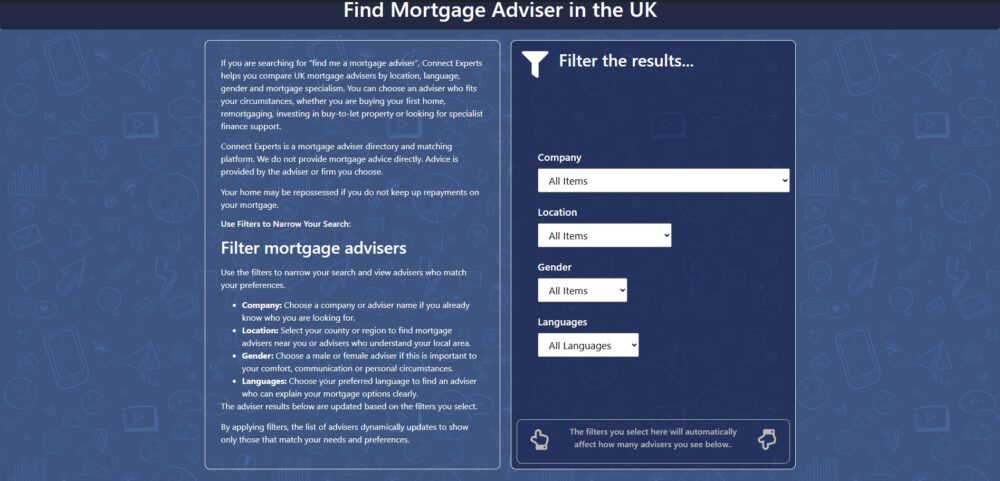
Connect Experts helps you find a mortgage adviser by location, mortgage type, language, gender or specialist experience.
Connect Experts is a directory and matching platform. It does not provide mortgage advice directly. Advice is provided by the adviser or firm you choose.
Your home or property may be repossessed if you do not keep up repayments on your mortgage.
At a Glance
A mortgage broker can:
- Understand your borrowing requirements
- Review your income, spending and deposit
- Assess potential affordability
- Explain different mortgage structures
- Research suitable lenders and products
- Compare rates, fees and lender criteria
- Recommend a suitable mortgage
- Prepare and submit the application
- Manage lender and underwriting questions
- Support the case through to mortgage offer
A broker cannot guarantee approval, control the valuation or remove a lender’s requirements.
What is the broker trying to establish?
The first task is not finding the lowest advertised rate.
It is understanding whether a proposed mortgage is affordable, suitable and realistically available.
A broker must establish several facts before conducting meaningful research:
- How much you want to borrow
- The purpose of the mortgage
- Your income and employment structure
- Your regular financial commitments
- The source and amount of your deposit
- Your credit history
- The property type
- Your preferred mortgage term
- Your future plans
- Your attitude towards payment changes
Two applicants seeking the same loan may receive different options. Their income, commitments, credit records and properties may differ.
Mortgage advice is therefore a process of matching evidence to criteria.
What happens during the first mortgage conversation?
The first conversation usually establishes your objective and broad circumstances.
You might be:
- Buying your first home
- Moving to another property
- Remortgaging
- Buying a rental property
- Releasing funds from a property
- Purchasing through a limited company
- Seeking commercial property finance
- Reviewing options after a declined application
The broker may explain the likely process, their service scope and how they are paid.
This is also an opportunity to ask whether the adviser covers the relevant mortgage market. Some advisers use a restricted lender panel. Others offer a broader market review.
You can read more about the distinction in our guide to whole-of-market mortgage brokers.
What is a mortgage fact-find?
A fact-find is a structured record of your circumstances, requirements and objectives.
The broker may ask about:
- Employment
- Salary
- Overtime
- Bonuses
- Commission
- Self-employed income
- Benefits
- Existing mortgages
- Loans
- Credit cards
- Childcare
- Maintenance payments
- Household spending
- Financial dependants
- Deposit source
- Property plans
These questions are not merely administrative.
The answers help the broker understand affordability, identify possible difficulties and avoid unsuitable lender searches.
Applicants with company income, retained profits, contracts or irregular earnings may need more detailed assessment. A self-employed mortgage broker may understand how different lenders treat these income structures.
How does a mortgage broker assess affordability?
The broker reviews the information you provide and considers how lenders may assess it.
Lenders do not rely solely on a simple income multiple. They may also examine:
- Committed monthly spending
- Household costs
- Dependants
- Loan repayments
- Credit card balances
- Mortgage term
- Interest-rate stress testing
- Retirement age
- Property costs
- Rental income
- Business commitments
Each lender can use different calculations and limits.
A broker may estimate possible borrowing. However, only the lender can make the final lending decision.
An affordability estimate is not a promise of approval.
Does a mortgage broker check your credit record?
A broker may ask you about your credit history and request a copy of your credit report.
This can reveal:
- Missed payments
- Defaults
- County Court judgments
- Individual voluntary arrangements
- Debt management plans
- High credit use
- Recent credit applications
- Address inconsistencies
The purpose is not to judge the applicant.
It is to understand how lenders may interpret the record and whether further explanation is required.
Submitting repeated applications to unsuitable lenders can create further credit searches. Careful research before applying may reduce avoidable applications.
People with previous credit problems can search for adverse credit mortgage brokers with relevant experience.
How does a broker research mortgage lenders?
Once the broker understands the case, they can compare lender criteria and available products.
Research may consider:
- Maximum borrowing
- Deposit requirements
- Income treatment
- Credit policy
- Property restrictions
- Mortgage term
- Age limits
- Repayment method
- Arrangement fees
- Valuation fees
- Early repayment charges
- Incentives
- Product availability
- Application timescales
The lowest interest rate is not always the lowest-cost option.
A mortgage with a lower rate may carry a larger arrangement fee. Another product may have a higher rate but lower initial costs.
The broker should therefore consider the product as a complete financial arrangement.
Does a mortgage broker recommend a mortgage?
Where regulated mortgage advice is provided, the adviser should explain why the recommended mortgage is suitable.
The recommendation may consider:
- Your preferred payment structure
- Monthly affordability
- Mortgage term
- Rate period
- Product fees
- Early repayment charges
- Expected future changes
- Lender criteria
- Your plans for the property
The broker should also explain important disadvantages and restrictions.
For example, a fixed rate can provide payment certainty during the fixed period. However, early repayment charges may apply if the mortgage ends early.
A variable rate may offer greater flexibility. However, payments could rise if the applicable rate increases.
Good mortgage advice is not simply the presentation of a product. It is the explanation connecting the recommendation to the applicant’s evidence.
What is an agreement in principle?
An agreement in principle is an early lender assessment.
It may also be called:
- A decision in principle
- Mortgage in principle
- Approval in principle
The lender usually considers selected financial details and may conduct a credit search.
An agreement in principle is not a mortgage offer. It does not guarantee that the lender will approve the property or complete the application.
The full decision normally depends on:
- Supporting documents
- Full underwriting
- Property valuation
- Legal checks
- Confirmation of the information supplied
The broker can explain what the lender has assessed and what remains outstanding.
What documents does a mortgage broker need?
Requirements differ by applicant and lender.
Common documents include:
- Passport or driving licence
- Proof of address
- Payslips
- Bank statements
- Proof of deposit
- Existing mortgage statement
- Details of loans and credit cards
- Evidence of bonuses or overtime
- Gifted deposit evidence
Self-employed applicants may also need:
- Accounts
- Tax calculations
- Tax year overviews
- Business bank statements
- Accountant details
- Current contracts
- Company information
The broker checks whether the documents support the information entered within the application.
Missing, unclear or inconsistent evidence can delay underwriting.
Does the broker submit the mortgage application?
The broker can complete and submit the mortgage application after you agree to proceed.
This normally includes:
- Personal information
- Address history
- Employment information
- Income details
- Financial commitments
- Property information
- Deposit details
- Solicitor information
- Supporting documents
Accuracy matters.
An incorrect figure, missing commitment or unexplained transaction may lead to questions. It could also affect the lending decision.
You remain responsible for providing complete and truthful information.
What does the broker do during underwriting?
Underwriting is the lender’s detailed assessment of the application.
The underwriter may ask for:
- Updated bank statements
- Further payslips
- Deposit explanations
- Evidence of debt repayment
- Employment confirmation
- Business information
- Property documents
- Explanations for credit events
The broker can collect the requested evidence, explain the question and return the information to the lender.
They may also identify where the lender has misunderstood part of the case.
However, the broker cannot instruct the lender to approve an application.
The final decision belongs to the lender.
What happens during the property valuation?
The lender usually arranges a valuation to assess the property for mortgage purposes.
The valuation may consider:
- Property condition
- Construction type
- Location
- Marketability
- Estimated value
- Comparable sales
- Major defects
- Lease terms
A lender’s valuation is primarily for the lender. It is not necessarily a detailed structural survey.
The broker can explain the lender’s response and discuss possible mortgage implications.
They cannot change the valuer’s professional opinion.
What does the broker do after the mortgage offer?
A mortgage offer confirms that the lender is prepared to lend, subject to its stated conditions.
The broker can:
- Check the offer against the application
- Explain the mortgage rate and term
- Confirm product fees
- Highlight offer conditions
- Review early repayment charges
- Check the offer expiry date
- Answer mortgage-related questions
- Liaise with relevant parties where appropriate
The solicitor handles the legal transfer, searches and completion work.
The broker does not replace a conveyancer, surveyor, accountant or tax adviser.
Each professional has a different role.
Does a mortgage broker help until completion?
Many brokers continue monitoring the mortgage until completion.
This may involve contact with:
- The lender
- The applicant
- The estate agent
- The solicitor
- The developer
- The valuer
The broker may check whether mortgage conditions have been satisfied and whether further information is needed.
However, the completion date depends on the wider transaction. It may be affected by legal work, property chains, searches or other parties.
The government’s home-buying guidance explains the broader purchase process in England and Wales.
What does a mortgage broker not do?
A mortgage broker cannot:
- Guarantee mortgage approval
- Guarantee the lowest future rate
- Change your credit history
- Control the lender’s timescale
- Control the property valuation
- Provide legal conveyancing
- Guarantee an offer will remain available
- Conceal financial commitments
- Remove lender conditions
- Make the lender accept unsuitable evidence
A broker can improve the structure and presentation of an application. They cannot replace the lender’s decision-making process.
How are mortgage brokers paid?
Payment arrangements vary.
A broker may receive:
- A fee from the customer
- Commission from the lender
- A combination of both
The adviser should explain any applicable fee before you proceed.
Ask:
- How much is the fee?
- When is it payable?
- Is any part refundable?
- Does the broker receive lender commission?
- Is the fee charged once or at different stages?
- Does the service include later mortgage reviews?
Price matters, but the cheapest service is not automatically the most suitable.
Consider the adviser’s regulatory status, experience, communication and service scope.
How can you check a mortgage broker?
Before proceeding, check:
- The adviser or firm’s regulatory status
- Their mortgage permissions
- Their service scope
- Their fees
- Their lender access
- Their relevant experience
- Their communication arrangements
- Their complaints process
The FCA Financial Services Register is a public record of authorised firms, individuals and other regulated bodies.
You can also use our UK mortgage broker directory checklist when comparing advisers.
How Connect Experts helps you find a mortgage adviser
Connect Experts allows you to search for a mortgage adviser according to practical preferences.
You can search by:
- Location
- Mortgage type
- Adviser language
- Adviser gender
- Adviser name
- Company name
- Specialist mortgage area
The directory helps you identify advisers who may fit your requirements.
You should still review the adviser’s profile, regulatory status, experience, service scope and fees before proceeding.
Connect Experts does not recommend a particular mortgage product. The adviser or firm you choose provides the mortgage advice.
Frequently asked questions
What does a mortgage broker actually do?
A mortgage broker assesses your circumstances, researches lenders and recommends a suitable mortgage where regulated advice is provided.
They can also prepare documents, submit the application and manage lender questions through to mortgage offer.
Is a mortgage broker the same as a mortgage adviser?
The terms are often used together.
A mortgage adviser provides mortgage advice. A broker may also research lenders, recommend a mortgage and arrange the application.
Check that the adviser or firm holds the correct regulatory permissions.
Does a mortgage broker decide how much I can borrow?
No.
A broker can assess possible affordability and identify relevant lender calculations. The lender decides how much it is prepared to lend.
Can a mortgage broker guarantee approval?
No.
Approval depends on the lender’s criteria, underwriting, credit assessment, property valuation and supporting evidence.
Can a mortgage broker get a better rate than a bank?
A broker may compare products from several lenders, depending on their service scope.
A bank can discuss only its own products. However, using a broker does not guarantee a lower rate or lower total cost.
Does a broker check every UK mortgage?
Not necessarily.
Some products are available only directly from lenders. Others may fall outside the broker’s panel, permissions or service scope.
Ask the adviser what part of the market they review.
When should I contact a mortgage broker?
You can make contact before viewing properties, before making an offer or before an existing mortgage rate ends.
Early discussions can help you understand affordability, documentation and possible lender requirements.
Can a broker help after a mortgage application is declined?
Potentially.
A broker may review the reason, check whether the information was accurate and assess whether another lender uses different criteria.
A further application should not be made without first understanding the previous outcome.
Find a mortgage adviser
A mortgage broker’s real work is not measured by the number of products displayed.
It is measured by how carefully the applicant’s circumstances are converted into a reasoned, evidenced application.
The broker gathers information, tests the available routes and explains the consequences of each decision.
Connect Experts helps you find an adviser whose location, experience, language and mortgage expertise reflect your requirements.
Search the Connect Experts mortgage adviser directory.