What Is a Remortgage?
A remortgage replaces the mortgage on your existing property with a new mortgage from another lender.
You remain in the same home, but your lender, interest rate, mortgage term or borrowing amount may change.
Homeowners often remortgage when a fixed or discounted deal approaches its end. Others remortgage to change their mortgage terms or borrow more against their property.
However, switching lenders is not automatically worthwhile. Fees, early repayment charges and long-term interest can outweigh an attractive headline rate.
At a Glance
- A remortgage replaces your existing mortgage with one from another lender.
- It usually involves affordability, credit, property and legal checks.
- A product transfer keeps your mortgage with your current lender.
- The lowest advertised rate may not provide the lowest total cost.
- Fees and early repayment charges must be included in any comparison.
- Starting before your current deal ends provides more time to assess your options.
- Connect Experts helps you find a suitable remortgage mortgage broker.
What Does Remortgage Mean?
Remortgaging means repaying your current mortgage with a new mortgage secured against the same property.
The new mortgage may have:
- A different lender
- A new interest rate
- A different mortgage term
- New repayment conditions
- A different loan amount
- New overpayment rules
- Different early repayment charges
Ownership of the property does not normally change during a straightforward remortgage.
However, legal work may be needed because the lender’s charge against the property must be replaced.
A remortgage should not be confused with moving home. When you remortgage, the property usually stays the same.
Why Do People Remortgage?
Most people remortgage because their current mortgage deal is approaching its end.
A fixed, tracker or discounted deal may later move onto the lender’s standard variable rate. That rate can change and may produce different monthly payments.
Other common reasons include:
- Seeking greater payment certainty
- Reviewing the mortgage term
- Changing from interest-only to repayment
- Borrowing for home improvements
- Responding to changed income
- Reviewing borrowing after a property value change
- Adding or removing a borrower
- Refinancing a buy-to-let property
- Moving away from an unsuitable mortgage feature
The purpose should be clear before an application begins.
A mortgage is not merely a monthly payment. It is a long-term claim against future income and property value.
Therefore, a sound comparison considers the full cost and the borrower’s wider plans.
Remortgage or Product Transfer?
A remortgage and a product transfer are different transactions.
| Feature | Remortgage | Product transfer |
|---|---|---|
| Lender | A different lender | Your existing lender |
| New mortgage application | Usually required | May involve a simpler process |
| Affordability assessment | Normally required | Depends on the lender and changes requested |
| Property valuation | May be required | May not be required |
| Legal work | Usually required | Usually limited |
| Available products | Products from the new lender | Your lender’s available products |
| Additional borrowing | May be possible | May be possible |
| Completion process | New lender repays the old mortgage | Existing mortgage product changes |
A product transfer may be simpler. However, it only provides access to products offered by the existing lender.
A remortgage may offer wider choice, but it can involve more checks, paperwork and costs.
Neither route is automatically better.
The comparison should consider the rate, fees, mortgage term, flexibility and total amount repayable.
How Does a Remortgage Work?
A typical remortgage follows seven stages.
1. Review the existing mortgage
Begin with the current mortgage statement and original mortgage offer.
Check:
- Outstanding balance
- Current interest rate
- Monthly payment
- Remaining mortgage term
- Deal end date
- Early repayment charge period
- Exit or administration fees
- Current repayment method
These details establish the starting point for comparison.
2. Estimate the property value
The property value helps determine the loan-to-value ratio.
Loan-to-value, or LTV, compares the mortgage balance with the property value.
For example:
- Estimated property value: £400,000
- Outstanding mortgage: £260,000
- Loan-to-value: 65%
The calculation is:
£260,000 ÷ £400,000 × 100 = 65% LTV
Lenders often use LTV bands when setting product availability and rates.
The lender may still require its own valuation.
3. Establish the required mortgage amount
The new mortgage must normally repay the existing mortgage.
The amount may also include extra borrowing, subject to lender approval.
Borrowing more can increase:
- Monthly payments
- Total interest
- Loan-to-value
- Affordability requirements
- Risk to the property
Any additional borrowing should have a defined purpose and realistic repayment plan.
4. Compare the total cost
A lower interest rate does not always mean a cheaper mortgage.
The comparison should include:
- Product fees
- Valuation costs
- Legal costs
- Adviser fees
- Exit fees
- Early repayment charges
- Incentives or cashback
- Interest over the chosen period
- Costs added to the mortgage
Adding a fee to the mortgage may mean interest is charged on that fee.
The relevant question is not simply, “What is the rate?”
It is, “What will this mortgage cost over the period that matters?”
5. Complete affordability and eligibility checks
A new lender will normally assess whether the mortgage is affordable.
Checks may include:
- Basic salary
- Overtime, commission or bonuses
- Self-employed income
- Household expenditure
- Loans and credit cards
- Dependants
- Credit history
- Mortgage term
- Retirement plans
- Property type
- Reason for extra borrowing
People with variable or business income may benefit from finding a self-employed mortgage broker who understands different income structures.
6. Submit the mortgage application
The lender will assess the applicant and property.
Documents may include:
- Proof of identity
- Proof of address
- Recent payslips
- Bank statements
- Latest mortgage statement
- Tax calculations
- Tax year overviews
- Company accounts
- Evidence of bonuses or commission
- Details of existing debts
- Evidence supporting extra borrowing
Requirements vary between lenders and applications.
7. Receive the offer and complete
The lender issues a mortgage offer after approving the application.
A solicitor or conveyancer then completes the required legal work.
On completion:
- The new lender sends the mortgage funds.
- The existing mortgage is repaid.
- The old lender’s legal charge is removed.
- The new lender’s charge is registered.
- The new mortgage begins.
The final offer should be checked before completion.
Pay particular attention to the rate, term, monthly payment, fees and early repayment conditions.
How Much Does Remortgaging Cost?
Remortgage costs depend on the existing mortgage and the selected product.
Possible costs include:
Product fee
Some mortgages charge a fee for accessing the product.
A low rate with a high fee may be less suitable for a smaller mortgage balance.
Valuation fee
The new lender may value the property before approving the mortgage.
Some remortgage products include a standard valuation.
Legal fee
Legal work is normally required when moving to another lender.
Some lenders provide a standard legal service. Complex legal work may still cost more.
Adviser fee
Mortgage advisers may charge for research, advice and application support.
The amount and payment stage should be explained before work begins.
Early repayment charge
An early repayment charge may apply if you leave the existing deal before its charge period ends.
This cost can remove any benefit from switching early.
Exit fee
The existing lender may charge an administration or mortgage exit fee.
Always check the current mortgage documents before proceeding.
When Should You Review a Remortgage?
A review can begin before the current deal ends.
Starting early gives you time to:
- Confirm the end date
- Check early repayment charges
- prepare financial documents
- Compare a product transfer
- Research other lenders
- Resolve property or credit issues
- Consider likely completion dates
The right starting point depends on lender offer validity and the existing mortgage terms.
Leaving the review until the final week may reduce the time available for a considered decision.
Good financial decisions often depend less on prediction than preparation.
Can You Remortgage Before a Fixed Rate Ends?
You may apply before the fixed rate ends.
However, completing the remortgage too early could trigger an early repayment charge.
Before switching, compare:
- The early repayment charge
- Interest saved
- New mortgage fees
- Remaining months on the current deal
- New monthly payment
- Offer expiry date
- Alternative product-transfer terms
A new rate should not be viewed separately from the cost of leaving the existing rate.
Can You Remortgage to Borrow More?
A remortgage can sometimes include additional borrowing.
Possible reasons include:
- Home improvements
- Essential property repairs
- Buying another person’s property share
- Family support
- Major planned expenses
- Selected debt consolidation
Approval depends on affordability, equity, credit history and lender policy.
Borrowing more increases the debt secured against the property.
It may also increase the total interest paid, particularly when borrowing continues over a long term.
Remortgaging to Consolidate Debt
Some homeowners consider using a mortgage to repay credit card debt or loans.
This may reduce monthly outgoings. However, lower monthly payments do not necessarily mean lower total costs.
Debt consolidation can:
- Extend short-term debts over many years
- Increase total interest
- Introduce new mortgage fees
- Turn unsecured debt into secured debt
- Place the property at greater risk
Advice should compare the proposed mortgage with other realistic options.
Remortgage or Second-Charge Mortgage?
A second-charge mortgage is separate borrowing secured against a property.
It sits behind the existing first mortgage.
It may be considered when replacing the first mortgage would create significant costs.
For example, a borrower may wish to preserve an existing low fixed rate.
However, a second charge has its own rate, fees, affordability checks and risks.
A second-charge mortgage broker can help compare both forms of secured borrowing.
Can Landlords Remortgage?
Landlords can remortgage a buy-to-let property.
The assessment may include:
- Expected monthly rent
- Interest coverage calculations
- Property value
- Loan-to-value
- Property type
- Tenancy arrangement
- Landlord experience
- Portfolio size
- Personal income
- Ownership structure
Buy-to-let criteria can differ from those for residential mortgages.
Some forms of buy-to-let mortgage are not regulated by the Financial Conduct Authority.
Landlords can search for a buy-to-let mortgage broker with relevant experience.
When Might Remortgaging Be Unsuitable?
Remortgaging may not be suitable when:
- Early repayment charges exceed the expected benefit
- The mortgage balance is small
- The borrower plans to move soon
- The current lender offers suitable terms
- Income has reduced
- Credit circumstances have changed
- The property does not meet lender requirements
- Extra borrowing is unaffordable
- Fees outweigh potential savings
- The new term greatly increases total interest
Remaining with the existing lender can sometimes be reasonable.
The correct outcome is not always a new mortgage. Sometimes the strongest decision is to avoid unnecessary change.
How Can a Remortgage Adviser Help?
A mortgage adviser can assess the proposed remortgage against the borrower’s circumstances.
Their work may include:
- Reviewing the existing mortgage
- Calculating loan-to-value
- Checking likely lender eligibility
- Comparing mortgage products
- Comparing product-transfer terms
- Explaining fees and charges
- Reviewing affordability
- Supporting complex income applications
- Checking required documents
- Managing the application
- Explaining the mortgage offer
An adviser should explain their service, lender access and fees before you proceed.
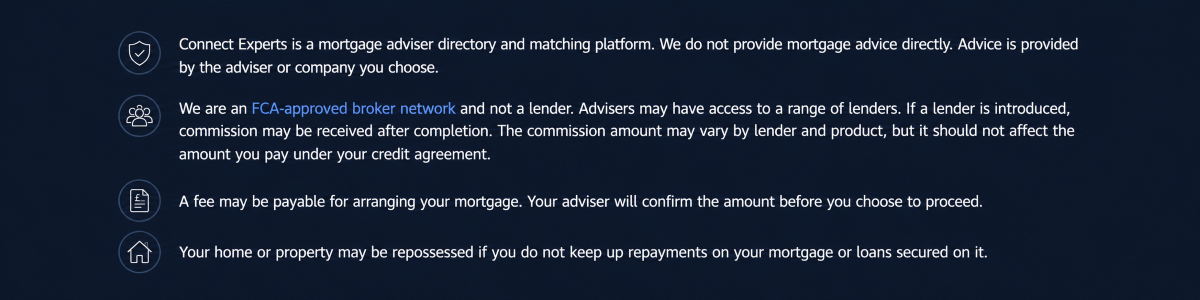
Connect Experts does not provide mortgage advice directly.
It is a directory and matching platform that helps users find mortgage advisers. Advice is provided by the adviser or firm selected by the user.
Quick Remortgage Checklist
Before taking action, confirm:
- Your mortgage deal end date
- The outstanding balance
- Your estimated property value
- Your approximate loan-to-value
- Any early repayment charge
- Exit and administration fees
- The remaining mortgage term
- Your current monthly payment
- Whether you need extra borrowing
- Whether your income has changed
- Whether your credit record has changed
- Whether your lender offers a product transfer
- The full cost of each option
Frequently Asked Questions
What is a remortgage?
A remortgage replaces the mortgage on your current property with a new mortgage from another lender.
Is switching products with the same lender a remortgage?
It is normally called a product transfer. The existing lender remains in place, but the mortgage product changes.
Do lenders check affordability when remortgaging?
A new lender will normally assess income, expenditure, debts, mortgage term and other affordability factors.
Do I need a property valuation?
The new lender may require a valuation. The method depends on the lender, property and application.
Do I need a solicitor?
Legal work is normally required when moving to a new lender. Some mortgage products include a standard legal service.
Can I remortgage with bad credit?
It may be possible. The outcome depends on the type, date and severity of the credit issue.
Can I remortgage when self-employed?
Yes, subject to lender criteria. Evidence may include accounts, tax calculations, tax year overviews and bank statements.
Is the lowest rate always the best remortgage?
No. Fees, incentives, mortgage term and early repayment charges can change the overall cost.
Can I remortgage to release equity?
Additional borrowing may be possible, subject to affordability, property value, loan-to-value and lender criteria.
Where can I find a remortgage adviser?
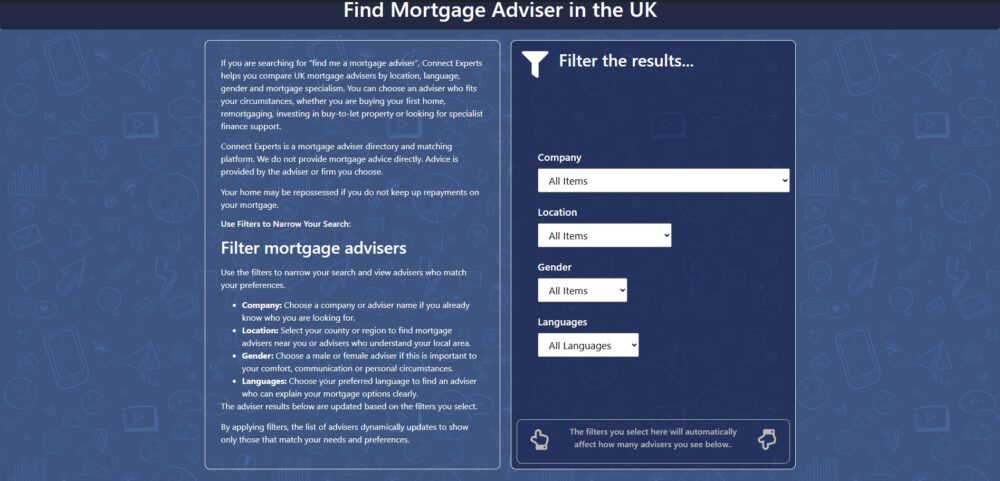
Connect Experts lets you compare mortgage advisers by location, specialism, language and other preferences.
Find a Mortgage Adviser Through Connect Experts
You can use Connect Experts to search for advisers by:
- Location
- Mortgage specialism
- Preferred language
- Gender preference
- Adviser name
- Company name
Start with the mortgage adviser directory or search for a mortgage adviser by location.
Review each profile and ask about:
- Regulatory status
- Remortgage experience
- Available lenders
- Advice fees
- Communication methods
- Expected application support
You can also read the wider UK mortgage guides before contacting an adviser.