When to Prepare for a Self-Employed Mortgage: Begin preparing before a property purchase or remortgage becomes urgent.
Early preparation can help you:
- Identify missing tax documents.
- Check whether accounts need finalising.
- Understand which income periods may be assessed.
- Document the deposit.
- Review credit commitments.
- Avoid unsuitable lender applications.
- Plan around a fixed-rate end date.
Preparation is not about manufacturing stronger figures. It is about understanding the available evidence while time remains to correct administrative gaps.
Timing matters because financial records close at different points
A self-employed applicant may have:
- An accounting year-end
- A tax-year end
- A mortgage rate end date
- A property completion target
- A contract renewal date
- A planned dividend date
These events do not necessarily occur together.
A mortgage discussion begun too late may reveal that the most useful evidence has not yet been prepared. A discussion begun earlier can establish which dates matter before the application becomes time-sensitive.
Twelve months before a possible purchase
At this stage, the applicant may not know the exact property or loan amount.
Useful actions include:
- Reviewing personal and business credit commitments
- Checking credit reports for errors
- Building a traceable deposit
- Keeping tax records current
- Separating business and personal transactions
- Discussing future accounts with an accountant
- Avoiding assumptions about likely affordability
This is not the stage for changing company remuneration solely for a mortgage.
The purpose is to understand the current position and prevent avoidable record-keeping problems.
Six to nine months before applying
This may be a suitable time to compare advisers, particularly where:
- A company year-end is approaching.
- A sole trader’s profit has changed.
- A contractor expects a new contract.
- A business has recently incorporated.
- Income comes from several sources.
- The deposit includes a gift or business funds.
- A current mortgage deal is nearing its end.
An adviser may help identify which completed accounting periods are likely to be relevant.
That information can also help the applicant ask their accountant for the correct documents.
Three to six months before applying
By this stage, an applicant may need to assemble:
- Accounts
- SA302 tax calculations
- Tax year overviews
- Personal bank statements
- Business bank statements
- Contracts
- Proof of deposit
- Identification
- Details of loans and credit
- Evidence of other income
A self-employed applicant whose fixed-rate mortgage is ending should not assume that staying with the current lender is the only option.
The existing lender might offer a product transfer. A remortgage could involve a new affordability assessment and updated evidence.
Applicants can compare mortgage rate ending advisers.
Before making an offer
A discussion before making an offer may help establish:
- A working purchase budget
- Likely deposit requirements
- Which income evidence is available
- Whether the property type may restrict lender choice
- Whether the intended timescale is realistic
- Which costs need to be allowed for
An agreement in principle can provide an indication rather than a final mortgage commitment.
It may involve a credit check and is usually based on information supplied before a full underwriting review.
After an offer is accepted
The process becomes more time-sensitive once a seller accepts an offer.
The applicant may need to provide updated evidence and answer further questions.
Delays can arise where:
- Accounts are incomplete.
- Tax documents are unavailable.
- The deposit source is unclear.
- A contract ends shortly.
- The business recently changed structure.
- Bank statements contain unexplained transactions.
- Information differs between documents.
Preparing earlier does not remove underwriting. It reduces the chance that a routine request becomes an unexpected obstacle.
Timing for first-time buyers
A self-employed first-time buyer may need to understand both mortgage evidence and the wider purchase process.
The buyer should allow for:
- Deposit preparation
- Legal costs
- Valuation or survey costs
- Mortgage advice fees
- Product fees
- Moving expenses
- Property searches
- Possible repair costs
A maximum borrowing estimate should not become the entire purchase budget.
First-time buyers can compare advisers through the first-time buyer mortgage adviser directory.
Timing when moving home
A home mover may have two connected transactions.
The mortgage discussion can involve:
- Sale proceeds
- Existing mortgage redemption
- Early repayment charges
- Porting rules
- The new property value
- Additional borrowing
- Self-employed income evidence
- Purchase and sale timing
An existing mortgage being portable does not guarantee that the applicant can borrow the required amount for the next home.
The lender may still assess affordability and the new property.
Timing after a strong trading year
An applicant may want to apply immediately after a successful year. However, the completed evidence may not yet exist.
Questions include:
- Has the accounting period ended?
- Have the accounts been finalised?
- Has the tax return been submitted?
- Are current bank statements consistent with the result?
- Will the lender accept management accounts?
- Does the latest period materially differ from earlier years?
A strong internal estimate is not the same as final evidence.
Timing after a weaker year
Waiting does not automatically solve a weaker year.
The appropriate decision depends on:
- Why profit fell
- Whether income has recovered
- What evidence is available
- Whether the mortgage need is urgent
- How lenders may assess the trend
- The deposit and wider affordability position
Applicants should not delay solely because they expect a future lender to ignore completed figures.
Timing for contractors
Contractors should consider:
- Remaining contract term
- Likelihood of renewal
- Gaps between assignments
- Time in the same occupation
- Current day rate
- Previous contracts
- Whether the application will use accounts or contract income
A contract ending during the mortgage process may prompt further questions.
Discussing the timing before applying can reduce uncertainty.
A practical readiness check
You may be ready for an adviser discussion when you can explain:
- How the business is structured.
- How long you have traded.
- Which income sources you receive.
- Which accounts and tax records are complete.
- How much deposit is available.
- Where the deposit came from.
- Which debts and commitments exist.
- When you intend to buy or remortgage.
- Whether anything recently changed.
You do not need to diagnose the lender outcome yourself.
The purpose of the discussion is to establish how the evidence may be assessed.
Finding advice at the right stage
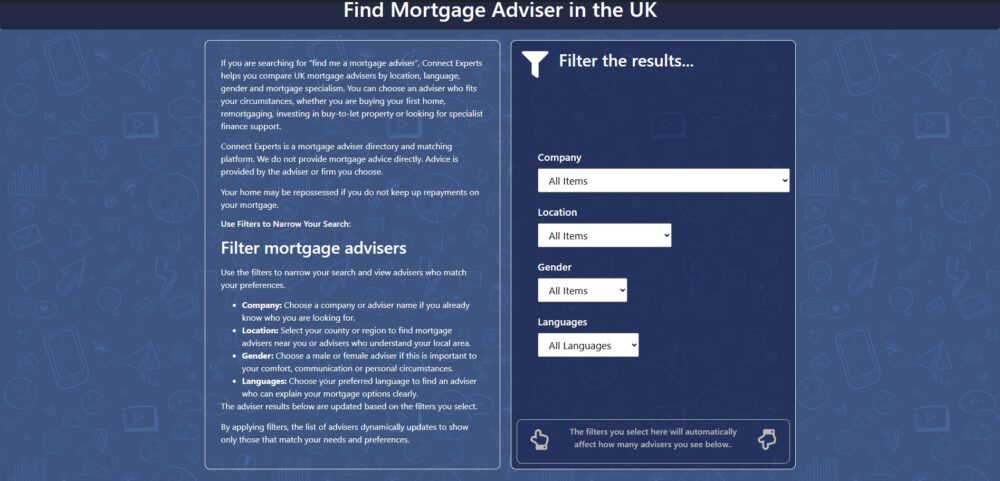
Connect Experts helps users compare advisers based on their mortgage requirements and practical preferences.
Someone buying their next property can use the directory to find a mortgage adviser for moving home.
The philosophical point
Preparation cannot change the past recorded in completed accounts. It can change how clearly the present is understood.
Time provides space to gather evidence, correct errors and make decisions without the pressure of an imminent completion date.
Find a residential mortgage adviser