Mortgages for Self-Employed Borrowers: Self-employment can produce strong income without producing a simple monthly payslip.
That distinction matters when applying for a mortgage.
A lender must understand where the income comes from, whether it is sustainable and how reliably it can support repayments. The question is not simply whether someone is self-employed. The real question is how clearly their financial position can be evidenced.
This guide explains how UK mortgage lenders may assess self-employed borrowers. It also explains the documents commonly requested and how to find an adviser through Connect Experts.
Connect Experts is a UK mortgage adviser directory and matching platform. It does not provide mortgage advice directly. Advice is provided by the adviser or firm you choose.
At a Glance
- Self-employed applicants usually apply for standard mortgage products.
- Lenders differ in how they calculate self-employed income.
- Evidence may include accounts, SA302s, tax year overviews and bank statements.
- Some lenders may consider applicants with a shorter trading history.
- Company directors may be assessed using salary, dividends or wider company performance.
- Falling profits, recent business changes and irregular income may require more explanation.
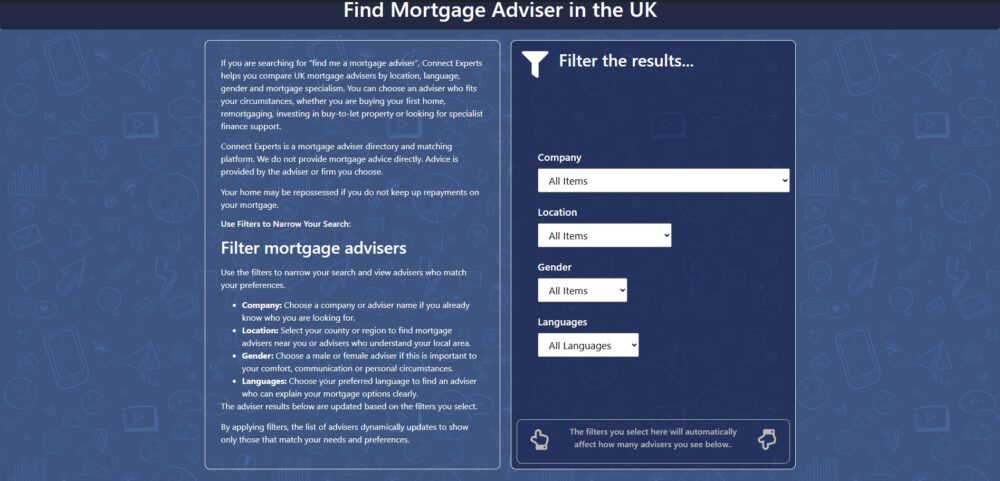
- Connect Experts helps users find advisers by expertise, location, language and other preferences.
Can Self-Employed People Get a Mortgage?
Yes. Being self-employed does not prevent someone from obtaining a mortgage.
Self-employed borrowers normally apply for the same residential mortgage products as employed applicants. However, proving income may involve more documents and a closer assessment of business performance.
Different lenders may use different methods.
One lender might use an average of recent earnings. Another might use the latest year where profits are rising. A different lender may take a cautious approach when income has fallen.
The outcome can therefore depend on:
- The applicant’s business structure
- Length of trading history
- Recent and previous earnings
- Deposit size
- Credit history
- Existing financial commitments
- Property type
- Lender affordability rules
- Quality and consistency of the supporting evidence
A strong income does not automatically produce a strong application. The evidence must also fit the lender’s criteria.
Who May Be Treated as Self-Employed?
Mortgage lenders may treat several types of applicants as self-employed.
These can include:
- Sole traders
- Limited company directors
- Business partners
- LLP members
- Freelancers
- Consultants
- Contractors
- Subcontractors
- Applicants receiving income from several businesses
There is no single ownership percentage used by every lender.
Some lenders treat a director as employed when their shareholding is below a stated threshold. Others may still examine the business in which the applicant controls the income.
This is why the applicant’s legal title alone does not provide the full answer.
The lender may also consider who controls the company, how income is drawn and whether the business supports that income.
How Do Lenders Calculate Self-Employed Income?
The calculation depends on the applicant’s business structure and the lender’s policy.
Sole Traders
Sole traders are commonly assessed using taxable profit shown through their tax calculations and business records.
A lender may:
- Average the latest two years
- Average two or three years
- Use the latest year where profits are stable or rising
- Use the lower figure where income has fallen
- Request an explanation for a substantial change
Turnover is not the same as personal income.
A business may receive substantial revenue while producing a much lower taxable profit after allowable expenses.
Limited Company Directors
Limited company directors may receive income through:
- Salary
- Dividends
- Pension contributions
- Director’s remuneration
- Benefits
- Retained company profit
Many lenders assess salary and dividends. However, this approach may not reflect the full financial position of a director who leaves profit inside the company.
Some lenders may consider retained profit or the director’s share of company profit. Their requirements can be more detailed.
Applicants whose affordability depends on several income sources may benefit from reading about complex income mortgages.
Business owners with substantial assets, retained profits or high-value borrowing may also need a high-net-worth mortgage broker.
Partnerships and LLP Members
Partners may be assessed using their declared share of the partnership profit.
The lender may request:
- Partnership accounts
- Personal tax calculations
- Tax year overviews
- Partnership agreements
- Evidence of the applicant’s profit share
- Confirmation of any recent changes
A newly admitted partner may need to explain how future income is calculated.
Contractors and Freelancers
Contractor income may be assessed using completed accounts, tax records, current contracts or a daily-rate calculation.
The lender may consider:
- Contract length
- Remaining contract term
- Previous contract history
- Gaps between contracts
- Daily or weekly rate
- Industry experience
- Whether the contract is likely to continue
- Whether income is paid through a limited company
Two applicants with the same annual earnings may therefore receive different affordability results.
How Many Years of Accounts Are Required?
Many lenders prefer at least two years of trading history. However, this is not a universal rule.
Some lenders may consider one year of accounts where the wider case is strong.
They may examine:
- Previous experience in the same industry
- Earlier employed income
- Current contracts or future work
- Business bank statements
- An accountant’s projections
- Deposit size
- Credit conduct
- Evidence that the business remains viable
A shorter history can reduce the number of lenders available. It does not always make borrowing impossible.
The important point is to identify lenders whose criteria fit the evidence before submitting an application.
What Documents May Be Required?
Document requirements vary by lender and business structure.
A self-employed applicant may be asked for:
- Proof of identity
- Proof of address
- Personal bank statements
- Business bank statements
- Full business accounts
- Tax calculations or SA302s
- Tax year overviews
- Evidence of deposit
- Existing mortgage statements
- Credit commitment details
- Current contracts
- Accountant’s references
- Evidence explaining unusual transactions
- Proof of additional income
Applicants can obtain an SA302 tax calculation and tax year overview through GOV.UK.
The information across the documents should be consistent.
Unexplained differences between accounts, tax records and bank statements can delay underwriting.
What Is an SA302?
An SA302 is a tax calculation produced after a Self Assessment tax return has been submitted.
It summarises the income reported to HM Revenue and Customs and the resulting tax calculation.
A tax year overview shows the tax due and payments recorded for that tax year.
Lenders may request both documents. However, requirements differ, so applicants should confirm what evidence is acceptable before applying.
An SA302 does not guarantee mortgage approval. It is one part of the lender’s affordability and risk assessment.
Why Do Business Bank Statements Matter?
Business bank statements can help a lender understand recent trading activity.
They may show:
- Regular business income
- Current cash flow
- Major recurring expenses
- Tax payments
- Loan commitments
- Overdraft use
- Returned payments
- Whether recent activity supports the accounts
Historic accounts describe what happened during a completed financial period. Bank statements may show what is happening now.
A lender may therefore request both.
What Happens When Profits Have Fallen?
Falling profits do not automatically prevent a mortgage. However, the lender may want to understand the reason.
A reduction might result from:
- Business investment
- Recruitment costs
- Equipment purchases
- Temporary market conditions
- Loss of a contract
- Reduced working hours
- Maternity or parental leave
- Illness
- A change in accounting period
- Restructuring
- One-off expenses
The distinction between temporary cost and lasting decline can be important.
Some lenders use the latest, lower income. Others may assess the wider trend after reviewing supporting evidence.
The explanation should be factual and supported by documents where possible.
Does Paying Less Tax Reduce Mortgage Affordability?
Legitimate tax planning can reduce taxable profit. However, lower declared income may also reduce the income available for mortgage affordability calculations.
This creates a practical tension.
A business owner may seek to manage tax efficiently. A mortgage lender must assess evidenced, sustainable income.
The best tax position and the strongest mortgage position are not always identical.
Mortgage applicants should not alter tax arrangements solely to obtain a mortgage without professional tax advice. Mortgage advisers do not replace accountants or tax advisers.
Can Retained Profit Be Used?
Some lenders may consider retained company profit when assessing a limited company director.
This can be useful where the director draws a modest salary and dividends while leaving funds within the business.
The lender may examine:
- The applicant’s shareholding
- Company profitability
- Cash held by the business
- Current liabilities
- Corporation tax
- Director’s loan accounts
- Dividend history
- The sustainability of future drawings
- Whether retained funds are needed for business operations
Not every lender uses retained profit. Those that do may calculate it differently.
This makes lender selection particularly important.
Can a Self-Employed Applicant Use Joint Income?
Yes. A self-employed applicant can apply jointly with an employed or self-employed person.
The lender may consider both incomes and both applicants’ financial commitments.
Each applicant will usually need to provide evidence relevant to their income type.
Both applicants are normally responsible for the mortgage payments. Joint affordability should therefore reflect the household’s full financial position.
How Does Deposit Size Affect the Application?
A larger deposit reduces the loan-to-value ratio.
A lower loan-to-value ratio may:
- Increase the range of available products
- Reduce the lender’s exposure
- Support a case with a shorter trading history
- Improve access to more competitive rates
- Provide flexibility where affordability is close
However, a larger deposit does not replace the need to prove income and affordability.
The FCA requires mortgage lenders to consider income, expenditure, and the effect of future interest rate changes. Property equity alone cannot form the basis of an affordability decision.
What Can Make a Self-Employed Application More Difficult?
Common issues include:
- Less than one year of trading
- Falling or inconsistent profits
- Recent company restructuring
- Late tax returns
- Unpaid tax liabilities
- Heavy business borrowing
- Frequent overdraft use
- Large unexplained transactions
- Income from several sources
- A recent change of industry
- Significant gaps between contracts
- Adverse personal credit
- Accounts that are not current
- Dividends exceeding sustainable profit
- A property outside standard lending criteria
These issues do not always produce a refusal. They may reduce the number of suitable lenders or increase the evidence required.
How to Prepare Before Applying
Preparation should begin before a full mortgage application is submitted.
1. Bring financial records up to date
Make sure accounts, tax returns and supporting records reflect the latest completed period.
2. Check tax documents
Download the required tax calculations and tax year overviews. Check that the figures match the submitted return.
3. Review personal and business bank statements
Identify unusual payments, overdraft use or transfers that may require an explanation.
4. Check the credit reports
Review the reports held by the main UK credit reference agencies. Correct inaccurate information before applying.
5. Avoid unnecessary new credit
New borrowing can affect affordability and the applicant’s credit profile.
6. Establish the source of the deposit
Savings, gifts, investments and property sale proceeds may require different evidence.
7. Discuss business changes early
Tell the adviser about falling income, changed ownership, new contracts or a different accounting period.
8. Do not submit several speculative applications
Multiple applications can create credit searches without solving the underlying criteria issue.
Why Lender Selection Matters
Self-employed mortgages are not a separate product category.
The difference lies mainly in how lenders interpret income and risk.
One lender may use salary and dividends. Another may consider retained profit. Another may accept a recent contractor history.
The lowest advertised rate may not be available to every applicant.
A suitable starting point is the lender whose criteria match the borrower’s documented circumstances. Rate comparison becomes meaningful after that test.
This is why an adviser’s understanding of self-employed income can matter.
Finding a Self-Employed Mortgage Adviser
Connect Experts helps users search for self-employed mortgage brokers across the UK.
You can compare advisers using factors such as:
- Mortgage expertise
- Location
- Language
- Gender preference
- Company
- Adviser name
- Appointment method
- Experience with specialist cases
You can also find a broker by expertise or search for a mortgage adviser by location.
Before choosing an adviser, consider asking:
- Which self-employed applicant types do you regularly support?
- Have you handled cases involving retained profits?
- How do you compare different lender income calculations?
- What documents should I prepare?
- What fees may apply?
- Will you explain why a lender appears suitable?
- Is your firm authorised to provide regulated mortgage advice?
You can verify a firm’s permissions through the Financial Services Register.
Connect Experts does not recommend a particular mortgage product. The directory helps you identify and contact an adviser who may suit your requirements.
Frequently Asked Questions
Is it harder to get a mortgage when self-employed?
The process can require more evidence, but self-employed people can obtain mortgages. Difficulty depends on income, trading history and lender criteria.
Can I get a mortgage with one year of accounts?
Some lenders may consider one year of accounts. They may require evidence of industry experience, contracts, deposit and continuing income.
Do I need three years of accounts?
Not always. Many lenders commonly request two years, while some accept one year. Requirements differ between lenders.
Can a limited company director use retained profits?
Some lenders may consider retained company profits. They may examine ownership, business liabilities, cash flow and the sustainability of future income.
Do lenders use turnover or profit?
Lenders normally focus on income available to the applicant rather than turnover alone. The exact calculation depends on the business structure.
What happens if my latest profit is lower?
A lender may use the lower figure or request an explanation. The cause and likely duration of the reduction can affect the assessment.
Can contractors get a mortgage?
Yes. Some lenders assess contractors using accounts. Others may consider contract value, day rate, experience and contract history.
Does a larger deposit guarantee approval?
No. A larger deposit may widen the options, but the lender must still assess income, expenditure, credit and affordability.
Should I apply directly to several lenders?
Submitting several applications without checking criteria can create unnecessary credit searches. Reviewing suitability before applying may reduce that risk.
How do I find an adviser experienced with self-employed applicants?
Use Connect Experts to search by mortgage expertise, location, language and adviser preferences. Review the adviser’s profile before making contact.
Find a Mortgage Adviser for Self-Employed Income
Business income rarely tells its whole story through one figure.
Accounts show completed periods. Bank statements show current activity. Contracts may show future work. Tax records provide formal evidence.
A mortgage application becomes clearer when those parts support the same financial account.
Use the Connect Experts directory to find an adviser who understands self-employed income and the evidence different lenders may request.
Find a self-employed mortgage adviser