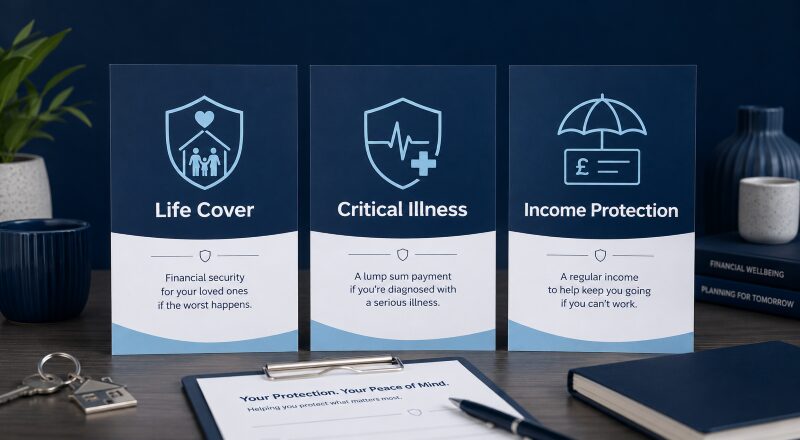
Life insurance vs critical illness vs income protection: Life insurance typically pays out after death. Critical illness cover can pay after a qualifying diagnosis.
Income protection can provide regular payments when illness or injury prevents you from working.
These products respond to different events. One policy does not automatically replace the others.
A mortgage protection adviser can compare your mortgage, income, savings, employment benefits and family responsibilities.
Three risks, three different financial responses
A mortgage creates a payment obligation that may last several decades.
However, the mortgage itself is only one part of the household budget. Council tax, energy, food and childcare continue regardless.
Protection insurance attempts to answer a practical question:
Where would the household’s money come from after a serious change in health or income?
The answer depends on what happened.
Death, serious illness and an extended absence from work create different financial needs. Therefore, each product uses a different payment structure.
What does life insurance cover?
Life insurance can pay a lump sum when an insured person dies during the policy term.
The payment could help surviving family members:
- Repay all or part of a mortgage
- Meet household expenses
- Replace lost financial support
- Cover other debts
- Fund future family costs
A decreasing-term policy may be used alongside a repayment mortgage. Its potential benefit typically declines over the policy term.
A level-term policy keeps the insured amount fixed. It may leave additional money after the mortgage has been repaid.
The right structure depends on the mortgage type and the wider purpose of the cover.
Read more about mortgage life insurance in the UK.
What does critical illness cover do?
Critical illness cover can pay a lump sum following diagnosis of a condition covered by the policy.
The money does not usually need to be spent in a particular way. It might be used to:
- Reduce the mortgage
- Adapt the home
- Meet treatment-related expenses
- Cover household bills
- Support a period away from work
However, the policy will not cover every illness.
Definitions, severity requirements and exclusions vary between insurers. A condition must meet the wording stated in the policy.
MoneyHelper notes that critical illness insurance is often combined with life insurance or income protection.
This is why product names should never replace a review of the actual policy terms.
How does income protection work?
Income protection can provide a regular benefit when illness or injury prevents an insured person from working.
It is designed to replace part of their earnings rather than repay the whole mortgage immediately.
The benefit may help fund:
- Mortgage repayments
- Utility bills
- Food
- Transport
- Childcare
- Other regular expenses
Most policies include a deferred period. This is the time between becoming unable to work and receiving payments.
A suitable deferred period may reflect:
- Employer sick pay
- Personal savings
- Business reserves
- Household income from another person
- Existing insurance
MoneyHelper describes income protection as long-term insurance providing regular income until recovery, retirement or the policy limit.
Product comparison
| Product | Main insured event | Common payment format | Possible purpose |
|---|---|---|---|
| Life insurance | Death during the term | Lump sum | Repay a mortgage or support dependants |
| Critical illness cover | Qualifying serious illness | Lump sum | Reduce debt or meet recovery costs |
| Income protection | Inability to work through illness or injury | Regular payments | Maintain monthly household spending |
| Mortgage payment protection | Specified short-term income interruption | Monthly payments | Meet mortgage costs for a limited period |
A policy may contain exclusions, waiting periods and claim limits.
The benefit shown in a quotation should not be considered without these terms.
Can one policy provide enough protection?
One policy may address the household’s main risk. However, it may leave other risks uncovered.
For example, life insurance may repay the mortgage after death. It would not normally provide an income following a non-fatal illness.
Critical illness cover may produce a lump sum after a qualifying diagnosis. It might not pay for an illness outside the policy definitions.
Income protection can support monthly spending. It does not usually provide a mortgage-sized lump sum after death.
Therefore, the question is not simply which product is best.
The better question is:
Which financial problem must each policy solve?
How should cover be compared?
A protection review should consider:
- The mortgage balance and remaining term
- Monthly household expenditure
- Income from each household member
- Employer and state benefits
- Savings and accessible investments
- Other debts
- Financial dependants
- Existing workplace and personal policies
From 6 April 2026, Statutory Sick Pay became payable from the first full day of eligible sickness absence. However, its value may remain below normal household income.
This makes employer benefits, savings and personal cover important parts of the calculation.
What affects the price?
Insurers may consider:
- Age
- Health
- Smoking status
- Occupation
- Policy term
- Amount of cover
- Deferred period
- Medical history
- Lifestyle information
Price matters, but price alone cannot show whether a policy fits the intended risk.
A cheaper policy may contain narrower definitions or less cover. A more expensive policy is not automatically better.
Questions to ask an adviser
Ask:
- What financial risk is this policy intended to cover?
- When would the policy pay?
- How is incapacity defined?
- Which conditions are included?
- How long is the deferred period?
- Does the benefit change over time?
- Are premiums guaranteed or reviewable?
- What information must be disclosed?
- What happens if my job changes?
- When should the cover be reviewed?
The FCA expects insurance personnel to understand policy terms, customer needs, complaints and relevant markets.
Frequently asked questions
Is mortgage protection legally required?
Mortgage protection insurance is not generally a legal requirement.
However, buildings insurance may be required by a mortgage lender.
Can I hold life and income protection together?
Yes. They insure different events and use different payment structures.
Suitability depends on your circumstances and budget.
Does critical illness cover include every cancer diagnosis?
Not necessarily. The diagnosis must meet the policy’s definition and severity requirements.
Can protection be arranged after mortgage completion?
Yes. Protection can usually be reviewed at any stage.
However, age and health changes may affect future terms and premiums.
How can I check an adviser?
Confirm the adviser or firm’s regulatory details through the Financial Services Register.
Finding suitable advice
Connect Experts allows users to search by adviser expertise, location, language and gender.
The platform is a directory and matching service. Advice is provided by the adviser or firm selected.
You can use the directory to find mortgage protection brokers who can compare the relevant cover types.
You can also review broader protection options before choosing an adviser.